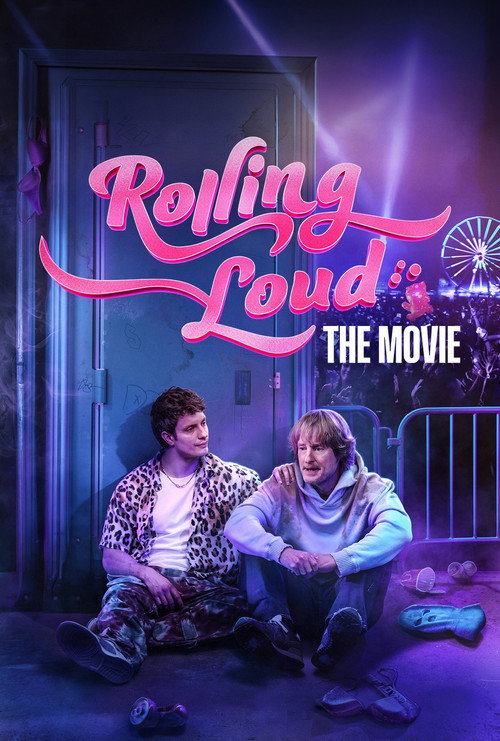
Rolling Loud: The Movie (2026)
Directed by Jeremy Garelick
Jeremy Garelick's Rolling Loud: The Movie arrives as a genuine curiosity in the annals of cinema: a film inspired by a real event, co-produced by the corporation that also organized the real event's most catastrophic predecessor, and starring the artist most associated with that catastrophe, all in service of a comedy about a child going missing inside a chaotic festival crowd.
Consciousness Markers
The cast is racially diverse, featuring Christine Ko, Travis Scott, Sexyy Red, and Playboi Carti among others. This diversity is entirely organic to the setting of a hip-hop festival, however, and carries no detectable casting-as-statement energy.
The comedy derives some of its engine from the contrast between a white suburban father and contemporary Black hip-hop culture. This is a fish-out-of-water trope with no apparent interest in making a point about race, however, and the film does not appear to editorialize on the subject.
No LGBTQ+ themes, characters, or subtext are present in the available research or premise. The film is too busy losing a child in a mosh pit to attend to these matters.
The wife functions as a domestic authority figure whose rules must be circumvented for the plot to function. This is not a feminist framing. It is, if anything, the opposite.
No climate themes are present. The film's ecological footprint, given the festival setting, is presumably substantial, but no one in the film appears concerned about this.
The film is co-produced by Live Nation Studios and functions in part as a feature-length advertisement for the Rolling Loud brand. Anti-capitalism is not on the agenda. It is, in fact, the opposite of the agenda.
No body positivity themes or messaging are identifiable in the research summary or premise.
No neurodivergence themes or characters are present. The edible-induced hallucination sequences represent a different kind of altered cognition, and not the kind the marker is looking for.
The film has no historical dimension to revise. It is set at a contemporary music festival and is interested in the present tense exclusively.
A raunchy R-rated comedy about a panicking father navigating mosh pits has no discernible interest in lecturing its audience. The film's moral, insofar as it has one, is that children grow up, which is not a progressive revelation.
Why it received this score
Jeremy Garelick's Rolling Loud: The Movie arrives as a genuine curiosity in the annals of cinema: a film inspired by a real event, co-produced by the corporation that also organized the real event's most catastrophic predecessor, and starring the artist most associated with that catastrophe, all in service of a comedy about a child going missing inside a chaotic festival crowd. The audacity of this arrangement is, in its way, more impressive than anything occurring on screen. Owen Wilson plays Hank, a suburban father of the familiar cinematic strain, soft around the edges and out of his depth, plunging into a world of mosh pits, edible-laced snacks, and Playboi Carti in search of his thirteen-year-old son. It is a premise as old as comedy itself, dressed in a Rolling Loud-branded tracksuit.
The film's progressive credentials are, to put it charitably, sparse. The cast is diverse in the way that a hip-hop festival necessarily produces diversity, which is to say it is the setting doing the work and not any ideological intent. Christine Ko and the assembled roster of hip-hop artists appear to exist in their natural habitat. Hank is the fish. The water is simply the water. No one pauses to explain structural inequality, no character's identity is treated as a teaching moment, and the wife back home functions less as a liberated figure than as a ticking clock of domestic consequence. The film is, in its bones, a very old joke about fathers and sons, updated with louder music and more aggressive product placement.
What the film lacks in social consciousness it compensates for in corporate transparency. Live Nation Studios is listed as a producer. The Rolling Loud brand is the title. Travis Scott, whose association with festival crowd safety is a matter of public record and active litigation, appears prominently. The film does not appear to engage with any of this. It does not need to. The comedy of the situation, for those keeping score at home, requires no additional embellishment.
Analysis generated by our Consciousness Algorithm
Synopsis
Desperate to reconnect with his 13-year-old son, Hank secretly takes him to Rolling Loud against his wife's wishes. When Zion disappears inside the massive festival, Hank teams with two unlikely allies and plunges into an increasingly insane search—while hiding the truth from his wife and confronting the harder truth that his son is growing up.