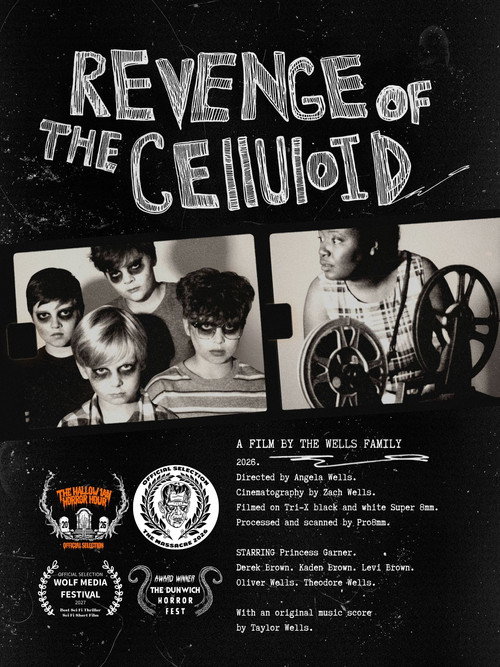
Revenge of the Celluloid (2026)
Directed by Angela Wells
Angela Wells arrives in 2026 with six minutes of black-and-white 8mm celluloid and a thesis statement so legible it practically hands you a pamphlet at the door.
Consciousness Markers
The anti-generative-AI allegory is worn openly on the film's sleeve, and a six-minute runtime spent making one pointed metaphorical argument does carry a modest sermonizing charge. It stops short of a full lecture, being horror first.
The generative machine as a metaphor for automated creative labor displacement carries a faint anti-capitalist undertone, specifically a critique of technology displacing human workers. It is not foregrounded as an ideological argument.
The film centers on a lone woman dismantling a predatory male-run machine of control, a structure that gestures toward feminist horror archetypes. The framing appears incidental to the anti-AI allegory rather than a driving ideological concern.
No documented commentary or controversy regarding diversity in casting. The ensemble appears to be a tight-knit DIY collective with no evidence of representational agenda-setting.
No LGBTQ+ themes, characters, or subtext have been identified in the film's narrative or promotional materials.
No racial consciousness themes, commentary, or framing have been identified in the film's content or surrounding discourse.
No climate or environmental themes are present. The film's concerns are entirely directed at artificial intelligence, not ecological crisis.
No body positivity themes or messaging are present in the film.
No neurodivergence themes or representation have been identified in the film's narrative or promotional context.
The film is an original horror allegory with no historical setting or revisionist historical framing.
Why it received this score
Angela Wells arrives in 2026 with six minutes of black-and-white 8mm celluloid and a thesis statement so legible it practically hands you a pamphlet at the door. M. Balm, the mad embalmer at the center of this short horror allegory, runs a generative machine disguised as a cinema, converting children into ghouls. The machine, we understand, is artificial intelligence. The children are the audience. The cinema is everything we are losing. Wells does not trust us to miss the point, but she shoots it on physical film with practical effects, which is at minimum a form of putting your money where your metaphor is.
The film's social consciousness, such as it is, runs on a single track: the preservation of human creative labor against automated displacement. There is a woman who fights back against the machine, which gives the film a faint feminist horror architecture in the tradition of the resourceful final girl, though the framing feels more generic than ideological. The anti-capitalist undertone is similarly modest, a quiet suggestion that industrialized creativity devours its audience, present but never amplified into argument. On the scale of progressive sensibilities, this film is less a manifesto and more a strongly worded letter written in the ink of expired film stock.
What saves it from the heavier end of the lecture register is that it remains, at its core, a horror film doing horror things. The allegorical machinery is visible, but it is also atmospheric and brief. Six minutes is not long enough to sustain a full sermon. Wells appears to understand this. The result is a film that has opinions, expresses them through a monster, and then ends before anyone can ask a follow-up question. In this critic's exhausted estimation, that is a form of restraint worth acknowledging.
Analysis generated by our Consciousness Algorithm
Synopsis
In the underbelly of a monochromatic world lurks a mad embalmer conducting a sinister experiment. A generative machine disguised as a moving picture show turns children into mindless ghouls. One woman aims to put an end to M. Balm's cinema of horrors.