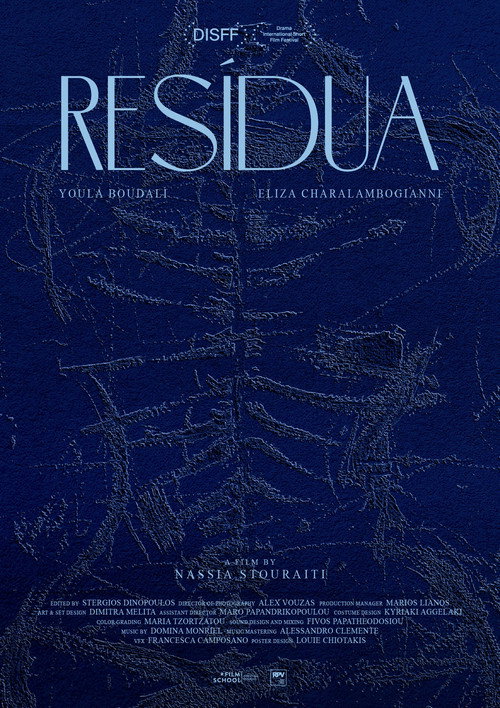
Resídua (2026)
Directed by Nassia Stouraiti
Resídua arrives at the 2026 festival circuit as a 13-minute Greek short film about a woman being painted in a studio, and we are asked to receive this as cinema.
Consciousness Markers
The film's entire conceptual architecture is built on the female gaze and the power dynamics of being looked at. A woman as canvas, observed and painted by another woman, is a direct inversion of the traditional male-artist-female-subject paradigm. The director's TEDx work on deconstructing beauty standards reinforces this as an intentional authorial posture.
The film's central image, a body being covered, transformed, and reclaimed as canvas, engages directly with questions of bodily autonomy and how we see the female form. The director's documented advocacy around deconstructing beauty standards adds meaningful authorial context, though the film itself appears to approach this poetically rather than prescriptively.
The film features an all-female cast in both principal roles, and the director is a woman working in a predominantly male-coded art form. This is notable, though in a 13-minute Greek arthouse short it registers as artistic disposition rather than a programmatic casting statement.
The intimate dynamic between two women, framed through desire and the gaze, carries a latent ambiguity that could be read as queer. The film does not foreground this explicitly, and the research confirms no such framing in critical discourse.
The film is described as a silent, fragile process, which by definition suppresses any tendency toward overt sermonizing. The themes are present but the delivery appears to be atmospheric rather than instructional. Ten points for the concept alone.
No evidence of racial consciousness as a thematic concern. The film operates in a culturally specific Greek arthouse context without apparent engagement with race as a subject.
No climate themes are present or implied. The film takes place in a painter's studio and concerns itself with entirely different matters.
No anti-capitalist content identified. The power dynamics explored are relational and gendered, not economic.
No evidence of neurodivergence as a theme or representational concern.
Not applicable. The film is a contemporary, intimate two-hander with no historical dimension.
Why it received this score
Resídua arrives at the 2026 festival circuit as a 13-minute Greek short film about a woman being painted in a studio, and we are asked to receive this as cinema. We do. The premise is deceptively spare: a young woman becomes a living canvas, paint is applied, and in the silence between brush strokes, director Nassia Stouraiti locates what the synopsis calls "a fragile interplay of gaze, power, desire and gradual transformation." This is the kind of sentence that festival programmers photocopy and laminate. It is also, to be fair, a reasonably accurate description of what the film appears to be doing.
The feminist credentials here are structural rather than decorative. Stouraiti, whose TEDx talk on beauty standards suggests a director who arrives at her subjects with prior convictions, has constructed a scenario that inverts centuries of art history in a single casting decision: the painter is a woman, the subject is a woman, and the male gaze has been asked to wait outside. The body positivity dimension operates similarly, less as a message delivered and more as a premise inhabited. The body is not displayed for approval. It is transformed. This is a meaningful distinction, and the film appears to understand it.
What keeps Resídua from scoring higher on our instruments is precisely its commitment to silence and atmosphere. A film that lectures cannot, by definition, be silent. Stouraiti seems more interested in sensation than in argument, which is either an artistic virtue or a missed opportunity, depending on your appetite for ambiguity. The overall reading is of a film that holds progressive sensibilities the way a painter holds a brush: with intention, but without making speeches about it.
Analysis generated by our Consciousness Algorithm
Synopsis
A young woman poses as a living canvas in a painter's studio. As her body is gradually covered in paint, the silent process reveals a fragile interplay of gaze, power, desire and gradual transformation.