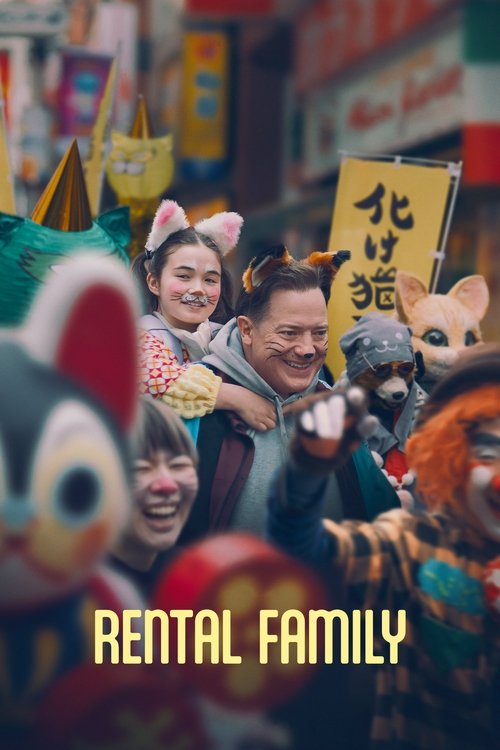
Rental Family (2025)
Directed by Hikari
No — Rental Family is not especially woke, scoring 30 out of 100 on our wokeness meter.
Here is a film that arrives wearing its kindness like a cardigan, and we are meant to find the fit charming.
Consciousness Markers
A significant subplot involves Yoshie, a closeted lesbian who is already married to a woman and plans to secretly emigrate to Canada with her wife, with the rental 'fiancé' helping her stage a traditional wedding for her parents.
An international US-Japan co-production with a predominantly Japanese ensemble cast and a mixed-race child character, though the diversity is organic to the Tokyo setting rather than a deliberate diversity mandate.
The film wryly acknowledges Phillip's hiring as a 'token white guy' and explores half-Japanese identity through Mia's school enrollment and her relationship with a fabricated American father.
Aiko's arc critiques the abuse she endures playing mistresses beaten by wronged wives, leading the agency to discontinue the practice, and Hitomi is a single mother controlling her daughter's future, but the film advances no explicit feminist thesis.
Phillip accuses Shinji of using Rental Family to 'soullessly fill empty holes rather than make genuine connections,' a mild critique of commodifying human relationships, but the film resolves warmly rather than as an economic indictment.
Critics uniformly describe the film as gentle, sweet-natured, and humane rather than preachy, with only light thematic musings on authenticity and connection.
No environmental or climate themes appear anywhere in the film.
No body positivity themes or content are present.
Kikuo's dementia is portrayed with dignity, but it is a degenerative illness rather than the neurodivergence identity marker, and no neurodivergent framing is applied.
The film is a contemporary fictional story with no historical revisionism.
Why it received this score
Here is a film that arrives wearing its kindness like a cardigan, and we are meant to find the fit charming. Brendan Fraser plays Phillip, an American actor in Tokyo reduced to toothpaste-commercial fame and then to a rental family agency, where he is hired, in the film's own candid phrasing, as a token white guy. The picture is an American and Japanese co-production with a largely Japanese ensemble, and it goes about its business in Tokyo without ever stopping to announce how multicultural it is being. That restraint earns it some credit. Mia, a half-Japanese girl, navigates a fabricated American father and a school enrollment scheme, which allows the film to muse on identity without turning the musing into a lecture. The tone stays gentle. Critics have called it sweet, and they are not wrong.
The most substantive thread concerns Yoshie, a closeted lesbian who stages a traditional wedding for her parents before slipping away to Canada with the wife they do not know she has. It is handled with warmth and no small amount of narrative cunning, and the film treats it as a human predicament instead of a policy statement. Aiko's subplot carries a quiet grievance: she is routinely beaten by wronged wives while playing the mistress, and the agency eventually discontinues the practice. That is a critique of a working condition, not a thesis on patriarchy, and the film seems content to leave it there. Phillip's jab that the business soullessly fills empty holes lands softly, then the movie resolves into a hug. Dementia appears, treated with dignity, though it is illness and not identity. There is no climate anxiety here. No body politics. No historical rewriting. The sermon count is low and the sincerity count is high.
A picture this nice is hard to score with a straight face, but the ledger is the ledger. It gestures at social consciousness the way a polite guest gestures at the hors d'oeuvres: briefly, and without commitment. The result is a warm, well-acted drama that would rather move us than instruct us. Refreshing, in its way. Also, conveniently, easy to classify.
Analysis generated by our Consciousness Algorithm


Synopsis
An American actor in Tokyo struggles to find purpose until he lands an unusual gig: working for a Japanese 'rental family' agency, playing stand-in roles for strangers. As he immerses himself in his clients' worlds, he begins to form genuine bonds that blur the lines between performance and reality.
Questions about Rental Family
Is Rental Family woke?
No — Rental Family is not especially woke, scoring 30 out of 100 on our wokeness meter. That earns it a verdict of Based.
Does Rental Family have any woke elements?
3 of the 10 markers register at 30 or above, led by LGBTQ+ Themes (45), Representation Casting (40) and Racial Consciousness (35). On LGBTQ+ Themes: A significant subplot involves Yoshie, a closeted lesbian who is already married to a woman and plans to secretly emigrate to Canada with her wife, with the rental 'fiancé' helping her stage a traditional wedding for her parents.
How does Rental Family compare to other 2025 movies?
It ranks #63 of the 217 films from 2025 we've scored; their average is 26. The wokest is STRAW (92).
How is the Woke Score calculated?
An AI-assisted process researches the film and its reception, scores it 0–100 on ten markers, then combines those into one 0–100 Woke Score. It measures a specific set of 2020s cultural themes, not film quality.