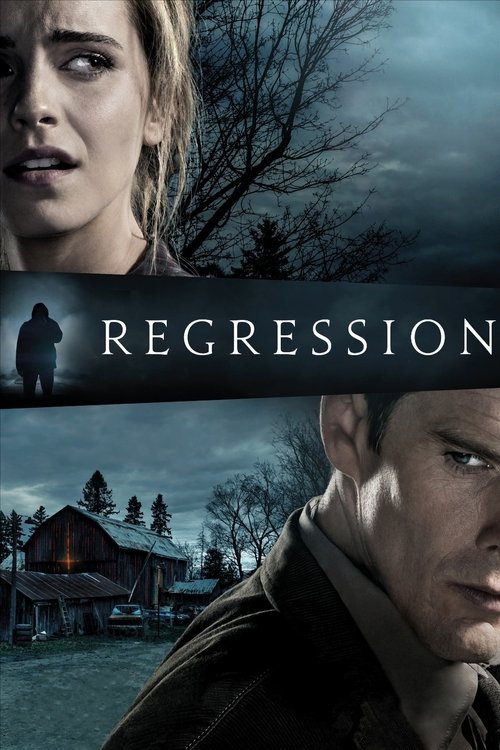
Regression (2015)
Directed by Alejandro Amenábar
No — Regression is not woke, scoring 0 out of 100 on our wokeness meter.
Regression arrives from Alejandro Amenábar with the sober gray palette of a film that has read the case files and intends to respect them.
Consciousness Markers
The film carries a mild thesis about mass hysteria and recovered-memory therapy, but delivers it through plot mechanics rather than preachy monologue.
The cast is overwhelmingly white (Hawke, Watson, Thewlis, Bluteau, Dickey), with no diverse casting choices made for representational purposes.
No LGBTQ+ characters or themes appear anywhere in the film.
The film's central female character is a manipulative fabulist who weaponizes false accusations; this is the opposite of a feminist agenda.
The film engages no racial themes whatsoever; the satanic-panic narrative is entirely within a white Minnesotan milieu.
No environmental or climate content of any kind.
No economic critique or class-based messaging; the villain is mass hysteria, not capital.
No body-positivity themes; the film deals with abuse allegations, not body image.
No neurodivergence representation; the film's subject is false-memory therapy, not neurodiversity.
Set in 1990 and drawing on the real satanic-panic era, but it is a fictional thriller rather than a revisionist reframing of historical events.
Why it received this score
Regression arrives from Alejandro Amenábar with the sober gray palette of a film that has read the case files and intends to respect them. Minnesota, 1990. A detective named Bruce Kenner, played by Ethan Hawke with the weary vigilance of a man who suspects he has wandered into the wrong movie, investigates a father accused of an unspeakable crime by his seventeen-year-old daughter. The father cannot remember doing it. A psychologist arrives with a regression technique. Soon there are hooded figures, a cemetery, a church, and the slow rot of a small town's imagination.
The film's cultural inventory is sparse to the point of austerity. Its cast is uniformly white, its milieu uniformly white, and its anxieties belong entirely to the early 1990s satanic panic. Nothing has been updated to speak to the present moment's vocabulary, and no contemporary grievance is invited to the table. The narrative's engine, Emma Watson's Angela, is a fabulist who constructs an entire cult out of whole cloth to escape a family she despises. She accuses, she manipulates, she kisses the detective in a graveyard, and she threatens him with the story of that kiss when he finally corners her. The film treats her as the architect of the ruin, not its victim, which places it at some distance from the prevailing mood of its release year.
A thesis about mass hysteria and the seductive machinery of recovered-memory therapy sits buried in the material, but Amenábar delivers it through plot mechanics, not sermons. The result is a restrained, well-tailored shrug of a thriller, and its restraint reads today as nearly antique. Critics gave it fourteen percent. American audiences gave it fifty-five thousand dollars. Spain, for its part, made it a hit. Some films are remembered. This one is filed.
Analysis generated by our Consciousness Algorithm


Synopsis
Minnesota, 1990. Detective Bruce Kenner investigates the case of young Angela, who accuses her father, John Gray, of an unspeakable crime. When John unexpectedly and without recollection admits guilt, renowned psychologist Dr. Raines is brought in to help him relive his memories and what they discover unmasks a horrifying nationwide mystery.
Questions about Regression
Is Regression woke?
No — Regression is not woke, scoring 0 out of 100 on our wokeness meter. That earns it a verdict of Ultra Based.
Does Regression have any woke elements?
Very few. None of the 10 markers reaches 30, the level where a marker counts as present; the highest is Lecture Energy at 10.
How does Regression compare to other 2015 movies?
It ranks #258 of the 289 films from 2015 we've scored; their average is 15. The wokest is Chi-Raq (78).
How is the Woke Score calculated?
An AI-assisted process researches the film and its reception, scores it 0–100 on ten markers, then combines those into one 0–100 Woke Score. It measures a specific set of 2020s cultural themes, not film quality.