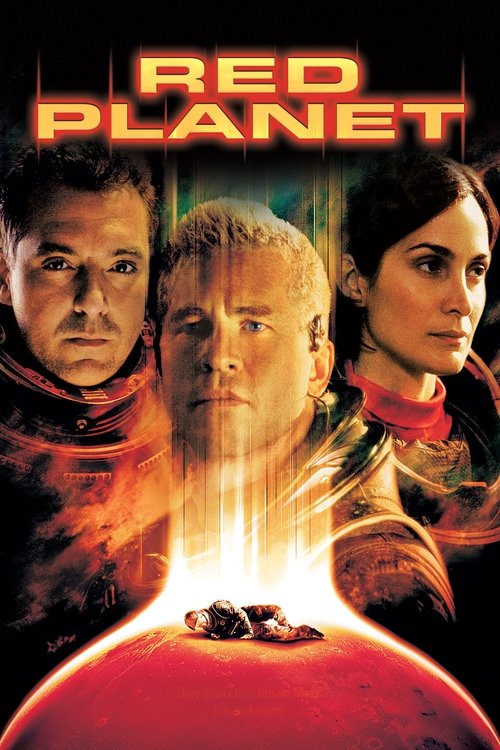
Red Planet (2000)
Directed by Antony Hoffman
No — Red Planet is not woke, scoring 12 out of 100 on our wokeness meter.
There is a dying Earth in Red Planet, and it is treated as a scheduling problem.
Consciousness Markers
A woman (Carrie-Anne Moss) commands the mission and a Latino actor (Benjamin Bratt) is in the crew, but the casting is unremarkable for a 2000 studio sci-fi film and never foregrounded as a statement.
Kate Bowman is a competent female mission commander who ultimately rescues the male lead, but the film offers no feminist argument or commentary; it is simply a capable character in a survival plot.
The premise hinges on a 21st-century ecological crisis on a dying Earth and the terraforming of Mars, giving the film a genuine environmental backdrop, though it functions as plot machinery rather than advocacy.
The film is a lean survival thriller that prioritizes hardware and problem-solving over moral instruction; it never pauses to lecture the audience.
No LGBTQ+ characters, themes, or subtext appear anywhere in the film.
The crew includes a Latino actor, but race is never a subject, theme, or point of commentary in the film.
No critique of capitalism, corporations, or wealth appears; the mission is a straightforward government/NASA-style endeavor.
No body-positivity themes or messaging are present.
No neurodivergent characters or themes are depicted.
The film invents its own near-future scenario and makes no revisionist claims about historical events.
Why it received this score
There is a dying Earth in Red Planet, and it is treated as a scheduling problem. The algae seeded across Mars has stopped producing, the oxygen is falling, and a crew is dispatched to determine why. This is the correct use of an environmental catastrophe in a studio picture of 2000: it generates urgency and then steps aside so that men and women in bulky suits can argue about fuel. The film has no sermon to deliver on the subject and no apparent interest in delivering one.
The personnel are worth a moment. Carrie-Anne Moss commands the mission, and Benjamin Bratt flies it, and neither fact is presented as a thesis. Kate Bowman is capable, she ultimately retrieves the male lead from a failing orbit, and the screenplay declines to make anything of it. She is a competent officer in a survival plot, which is a modest achievement and nothing more. The romance that closes the film is a stock beat, the diversity of the crew is ambient, and the picture contains no other social architecture to speak of. No same-sex anything. No meditation on race. No interest in bodies, minds, or the histories that might be revised.
The rest is machinery, and the machinery is agreeable. A malfunctioning military robot stalks the crew, a dead Russian probe becomes a launch vehicle, and Martian nematodes turn out to be the answer. The film solves problems in sequence and refuses to lecture us about them. It is a lean, humorless, mostly forgotten exercise in zero-sum plotting, and there are worse ways to spend ninety minutes. Even the off-screen conduct of its stars, which involved an exercise machine and a thrown weight, was at least a matter of physical logistics.
Analysis generated by our Consciousness Algorithm
Part of


Synopsis
Astronauts search for solutions to save a dying Earth by searching on Mars, only to have the mission go terribly awry.
Questions about Red Planet
Is Red Planet woke?
No — Red Planet is not woke, scoring 12 out of 100 on our wokeness meter. That earns it a verdict of Ultra Based.
Does Red Planet have any woke elements?
Very few. None of the 10 markers reaches 30, the level where a marker counts as present; the highest is Representation Casting at 25.
How does Red Planet compare to other 2000 movies?
It ranks #48 of the 125 films from 2000 we've scored; their average is 13. The wokest is But I'm a Cheerleader (72).
How is the Woke Score calculated?
An AI-assisted process researches the film and its reception, scores it 0–100 on ten markers, then combines those into one 0–100 Woke Score. It measures a specific set of 2020s cultural themes, not film quality.