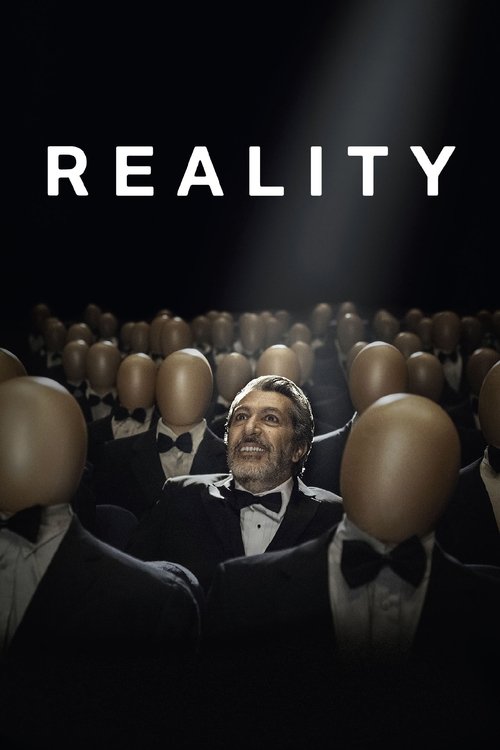
Reality (2015)
Directed by Quentin Dupieux
No — Reality is not woke, scoring 0 out of 100 on our wokeness meter.
Quentin Dupieux's Reality concerns a filmmaker who is granted forty-eight hours by a producer to locate the finest groan of pain in existence, an utterance deemed worthy of an Academy Award and the sole condition for financing his project.
Consciousness Markers
The cast is a predominantly white ensemble of French and American actors with no deliberate or commented-upon diversity casting.
There are no LGBTQ+ characters, themes, or subtext present in this surrealist comedy.
The film has no feminist agenda or commentary on gender dynamics; its absurdist plot centers on a male director's quest.
Race is entirely absent as a theme or subject of commentary in the film.
No environmental or climate-related content appears in the film.
While a producer funds the protagonist's film, the movie offers no critique of capitalism or wealth; it is purely absurdist.
There is no body positivity messaging; the film's premise revolves around groans of pain, not body image.
No neurodivergent characters or themes are present or explored.
The film is a work of surreal fiction with no historical subject matter to revise.
Dupieux's film is deliberately nonsensical and surreal, offering no moral instruction or social messaging to the audience.
Why it received this score
Quentin Dupieux's Reality concerns a filmmaker who is granted forty-eight hours by a producer to locate the finest groan of pain in existence, an utterance deemed worthy of an Academy Award and the sole condition for financing his project. That is the plot. There is also a dermatologist's waiting room, a child in a television costume, and a rat. The film drifts between dream, fiction, and what passes for waking life with the patience of a man arranging furniture in a house that has no floor.
The cast is French and American, led by Alain Chabat and Jonathan Lambert, with Élodie Bouchez, Eric Wareheim, and John Glover drifting through scenes that decline to explain themselves. Thomas Bangalter appears briefly as a patient. The soundtrack is the first five minutes of Philip Glass's Music with Changing Parts, looped until it becomes a mild form of punishment. Nothing in this arrangement carries a message about society, identity, or the distribution of power. The film has no interest in instructing us. It has an interest in groans.
We examined the picture for evidence of contemporary cultural sensibility and found the cupboard bare. No representational politics, no gender argument, no racial commentary, no environmental alarm, no economic grievance, no body-image discourse, no neurodivergent framing, no historical revision, no sermon. Dupieux has made something nearly extinct: an absurdist comedy that wants nothing from us but our confusion. In an era when even a car chase arrives with a thesis attached, this is either a failure of ambition or a strange species of integrity. The groans, at least, are earned.
Analysis generated by our Consciousness Algorithm


Synopsis
A wanna-be director is given 48 hours by a producer to find the best groan of pain, worthy of an Oscar, as the only condition to back his film.
Questions about Reality
Is Reality woke?
No — Reality is not woke, scoring 0 out of 100 on our wokeness meter. That earns it a verdict of Ultra Based.
Does Reality have any woke elements?
No. All 10 markers score zero.
How does Reality compare to other 2015 movies?
It ranks #258 of the 289 films from 2015 we've scored; their average is 15. The wokest is Chi-Raq (78).
How is the Woke Score calculated?
An AI-assisted process researches the film and its reception, scores it 0–100 on ten markers, then combines those into one 0–100 Woke Score. It measures a specific set of 2020s cultural themes, not film quality.