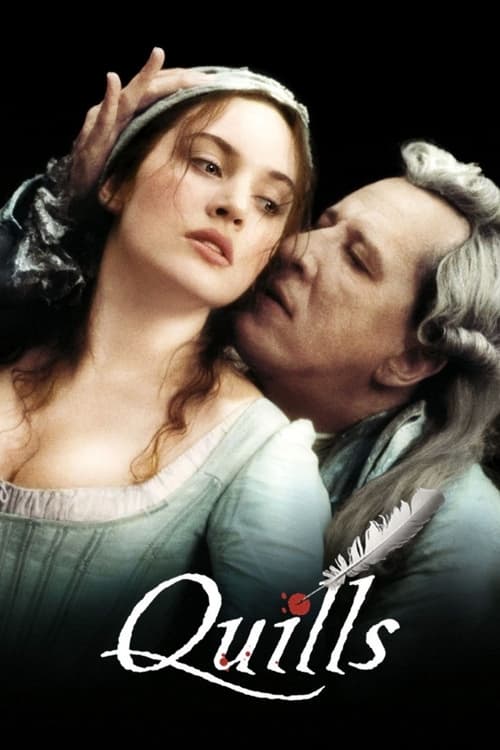
Quills (2000)
Directed by Philip Kaufman
No — Quills is not especially woke, scoring 27 out of 100 on our wokeness meter.
Quills arrives from 2000, a period piece about the Marquis de Sade at Charenton, and it approaches modern cultural checkboxes the way a cautious sommelier approaches a volatile vintage: with tongs and a fire extinguisher.
Consciousness Markers
Casting directors recruited actors from a disabled actor's company to portray many of the Charenton inmates, a genuine inclusive-casting choice. Otherwise the principal cast is uniformly white and period-appropriate.
Madeleine is given real agency as a literate smuggler and the film critiques Royer-Collard's rape and imprisonment of his underage bride, with Simone escaping her abuser. These are period-drama humanist beats rather than a modern feminist program.
The film carries a thesis about freedom of expression and censorship that it states fairly directly, though it remains a character-driven drama rather than a sermon.
The film openly reimagines de Sade's final years, inventing the Justine smuggling plot, the climactic play, and a grotesque death, as critics like Neil Schaeffer noted. This is dramatic artistic license rather than social-justice revisionism.
No same-sex themes, relationships, or queer identity markers appear; the Marquis's libertinism is depicted as heterosexual in orientation.
The film engages no racial themes and features an entirely white cast in 19th-century France.
No environmental or climate content whatsoever.
The central conflict is censorship and artistic freedom versus state and religious repression, not economic critique; no anti-capitalist argument is advanced.
No body-positivity themes; the film's treatment of the body is erotic and transgressive rather than affirming.
The asylum setting depicts 19th-century madness and institutional cruelty, not modern neurodiversity advocacy or neurodivergent identity.
Why it received this score
Quills arrives from 2000, a period piece about the Marquis de Sade at Charenton, and it approaches modern cultural checkboxes the way a cautious sommelier approaches a volatile vintage: with tongs and a fire extinguisher. The film's most concrete concession to inclusive practice is in its asylum population. Casting directors drew several inmates from a disabled actors' company, which gives the Charenton chorus a lived texture. The principal players remain white and period-appropriate, so this is a single sincere gesture inside an otherwise traditional prestige drama.
Kate Winslet's Madeleine is the closest thing to a feminist argument. She reads, writes, smuggles manuscripts, and pays for her defiance. The film also treats Dr. Royer-Collard's marriage to the underage Simone as the horror it is, and it lets Simone flee her abuser with the young architect. These are humanist period beats, not a modern gender program. Elsewhere, the ledger is bare. There is no same-sex desire, no racial consciousness, no climate sermon, no economic critique, no body-affirming message, and no neurodiversity framework. The asylum's madness is a 19th-century spectacle of cruelty and erotic disorder, not a platform for identity advocacy.
The film does carry a thesis about censorship, art, and the state, and it states that thesis plainly. Doug Wright and Philip Kaufman invent the Justine smuggling plot, the climactic play, and de Sade's grotesque death, liberties that historians have noted with some irritation. The result is less biography than a chamber drama with a point. It argues for free expression while indulging the very excesses it defends. That tension is the film's real subject, and it keeps Quills from becoming a simple sermon. It is a serious, grubby, well-acted provocation, culturally aware in a few corners and content to be a 19th-century freak show in most others.
Analysis generated by our Consciousness Algorithm
Part of


Synopsis
In early 19th-century France, the Marquis de Sade is confined to an asylum where his forbidden writings continue to circulate beyond its walls. As the authorities tighten control, a clash unfolds between the Marquis’ unyielding imagination, the reformist ideals of the Abbé in charge, and the repressive measures of a doctor sent to silence him. Desire, power, and censorship collide in a battle over freedom of expression.
Questions about Quills
Is Quills woke?
No — Quills is not especially woke, scoring 27 out of 100 on our wokeness meter. That earns it a verdict of Based.
Does Quills have any woke elements?
2 of the 10 markers register at 30 or above, led by Representation Casting (35) and Feminist Agenda (30). On Representation Casting: Casting directors recruited actors from a disabled actor's company to portray many of the Charenton inmates, a genuine inclusive-casting choice.
How does Quills compare to other 2000 movies?
It ranks #19 of the 125 films from 2000 we've scored; their average is 13. The wokest is But I'm a Cheerleader (72).
How is the Woke Score calculated?
An AI-assisted process researches the film and its reception, scores it 0–100 on ten markers, then combines those into one 0–100 Woke Score. It measures a specific set of 2020s cultural themes, not film quality.