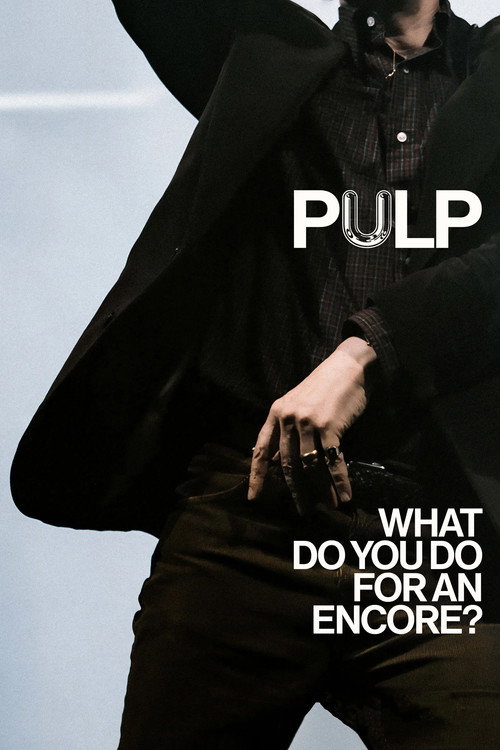
Pulp: What Do You Do for an Encore? (2026)
Directed by Garth Jennings
Garth Jennings' documentary about Pulp's reunion tour arrives bearing the fundamental question that haunts all concert films about bands of a certain vintage: does the spectacle justify the excavation, or are we simply watching people who were once young, now older, doing the same things they did when they were young.
Consciousness Markers
Pulp's entire artistic identity is built on class resentment and the absurdity of aspiration, most legibly in 'Common People'. The film foregrounds this legacy. However, this is 1990s British socialism, not 2020s eat-the-rich agitprop, and the documentary itself is distributed by MUBI, a prestige streaming platform.
The documentary features Pulp's actual band members and archival footage, so casting is not a variable. The concert audience is noted as multi-generational, which earns a token acknowledgment, but no deliberate diversity architecture is present.
Pulp's catalogue contains a degree of gender-fluid aesthetics and Cocker's own androgynous stage persona, but the film does not foreground LGBTQ+ themes as a conscious agenda. This is vintage Britpop ambiguity, not a 2020s statement.
Songs like 'Mis-Shapes' carry an undercurrent of solidarity with the marginalised, and Candida Doyle's presence as a long-standing keyboardist is noted, but the film makes no explicit feminist argument. It simply documents a band that happens to include a woman.
Pulp's music has always carried a knowing, slightly superior narrator voice, and the film inherits that tone. But Garth Jennings keeps the camera pointed at the spectacle rather than the sermon. The score is for Cocker's general disposition, not any specific moralising in the film itself.
There is no evidence of racial consciousness framing in the documentary. Pulp's social commentary is rooted in class and geography, specifically Sheffield and the British working class, not race.
No climate themes, environmental messaging, or ecological anxiety appear anywhere in the film or its surrounding discourse. The carbon footprint of an O2 Arena tour is, mercifully, left unexamined.
No body positivity themes are present. The film is largely concerned with Jarvis Cocker's angular, unrepentant thinness and the passage of time on a man who has always looked like a supply teacher from the future.
No neurodivergence themes are raised in the film or its critical reception. The 'social misfit' framing of Pulp's identity is not medicalised or coded in contemporary neurodivergent terms.
The documentary is retrospective but not revisionist. It presents Pulp's history on its own terms without recontextualising the past through a corrective modern lens.
Why it received this score
Garth Jennings' documentary about Pulp's reunion tour arrives bearing the fundamental question that haunts all concert films about bands of a certain vintage: does the spectacle justify the excavation, or are we simply watching people who were once young, now older, doing the same things they did when they were young. In Pulp's case, the answer is complicated by the fact that Jarvis Cocker has always looked like a man in his sixties, even in 1994, which gives the whole enterprise a strange temporal coherence. The film weaves arena footage from the More tour with four decades of archival material, and the effect is of a band that has been consistently, patiently itself across an improbable span of time.
The social commentary embedded in the Pulp catalogue, "Common People" and "Mis-Shapes" most prominently, gives reviewers the opportunity to invoke class consciousness and British outsider identity, and the film obliges by contextualising Cocker's school notebooks from 1978 against the O2 Arena in 2025. This is not a film with a contemporary progressive agenda. It is a film about Sheffield, about ambition that curdles into art, about the specific texture of wanting something and not quite getting it and writing very good songs about that condition instead. The class politics here predate the current cultural vocabulary by several decades and are none the worse for it.
On the markers of modern social consciousness, this documentary is almost aggressively inert. No climate messaging, no identity politics framework, no lecture energy to speak of, unless you count Cocker's habitual air of a man who has considered your situation and found it mildly amusing. The anti-capitalist score reflects the band's genuine ideological history, not any fresh provocation. Distributed by MUBI, scored on a scale of wokeness, reviewed in 2026: Pulp would almost certainly find this entire situation funny, and write a song about it, and the song would be very good.
Analysis generated by our Consciousness Algorithm

Synopsis
A fusion of the brilliantly choreographed stage spectacle of Pulp's biggest ever arena show — part of the global tour for More, the band's first album in 24 years — with four decades of colorful, never-seen-before archival material.