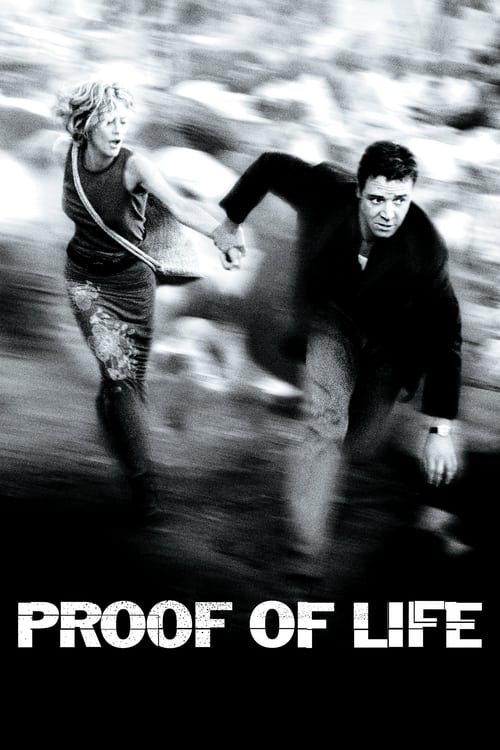
Proof of Life (2000)
Directed by Taylor Hackford
No — Proof of Life is not woke, scoring 9 out of 100 on our wokeness meter.
Proof of Life arrives from the year 2000 carrying a premise a studio would greenlight twice a week if it could: an American engineer is seized by guerrillas in a fictional Andean republic, his oil company pleads poverty, and his wife must hire a laconic British hostage negotiator to buy him back.
Consciousness Markers
The oil company Quad Carbon is portrayed as heartless, abandoning its kidnapped employee because it is bankrupt and uninsured. This is a mild critique of corporate indifference rather than an eat-the-rich polemic.
The leads are white Hollywood stars (Ryan, Crowe, Morse), with Latin American performers largely confined to background roles as maids, guerrillas, and local officials. The setting provides incidental diversity but no deliberate representative casting agenda.
Meg Ryan's Alice takes initiative in the negotiation, but she is ultimately defined by her role as wife and by a romantic entanglement with the male rescuer. No feminist thesis is advanced.
The film gestures at Latin American political conflict and American corporate presence abroad, but treats the guerrillas and locals as exotic backdrop rather than engaging racial or postcolonial consciousness.
The dam and oil pipeline form the story's backdrop, but environmental concern is never raised as a theme or message.
The film is a straightforward genre thriller that dramatizes rather than preaches; it offers no explicit moral instruction to the audience.
No LGBTQ+ characters, themes, or subtext appear anywhere in the film.
No body-positive themes or messaging are present.
No neurodivergent characters or themes are depicted.
The film is a fictionalized thriller inspired by real events, not a revisionist retelling of established history.
Why it received this score
Proof of Life arrives from the year 2000 carrying a premise a studio would greenlight twice a week if it could: an American engineer is seized by guerrillas in a fictional Andean republic, his oil company pleads poverty, and his wife must hire a laconic British hostage negotiator to buy him back. Taylor Hackford directs with the sober competence of a man filing paperwork. The film has the good sense to treat its subject as a procedural, all radio calls and ransom tranches and jungle logistics, and the bad sense to remember, around the ninety-minute mark, that it is also a romance.
What social instruction the picture offers is faint and largely accidental. Quad Carbon, the employer, is drawn as a bloodless spreadsheet that abandons its worker because it cannot afford him, which registers as a mild shrug at corporate callousness, not a manifesto. The Tecalan guerrillas and townspeople exist as weather, a backdrop of machetes and maids, and the screenplay shows no interest in what they might think about the American pipeline through their territory. Meg Ryan's Alice does push back against the corrupt local fixer and the men who would decide her husband's fate without her, but the film keeps returning her to the twin poles of wifehood and an affair with her rescuer. That is a triangle, not a thesis.
The supporting cast is white and the jungle is brown, and nobody in the production appears to have noticed. There is no environmental conscience attached to the dam, no interior life granted to the rebels, no argument advanced about anything. What we have is a sturdy, melancholy thriller about the price of a human being, performed with gravel and restraint, and it asks nothing of the audience but attention. It gets some of that. It earns a little more than it receives.
---
**Marker Scores**
- Representation Casting: 15
- LGBTQ+: 0
- Feminist Agenda: 12
- Racial Consciousness: 10
- Climate Crusade: 5
- Eat the Rich: 20
- Body Positivity: 0
- Neurodivergence: 0
- Revisionist History: 0
- Lecture Energy: 5
**Overall Woke Score: 6.7**
**Thematic Tags:** true_story, book_adaptation
**Rationale:** A 2000 genre thriller with no meaningful engagement with modern progressive markers. The only notable element is the oil company's abandonment of its kidnapped employee, a mild anti-corporate gesture that predates the current cultural flashpoint and carries no explicit political program. The film is based on real events (Thomas Hargrove's kidnapping, recounted in his book Long March to Freedom, and William Prochnau's Vanity Fair article), which accounts for both thematic tags.
Analysis generated by our Consciousness Algorithm


Synopsis
When Peter Bowman, an American engineer working in a South American country, is captured by anti-government forces, the rebels learn his identity and demand $5 million for his safe return. However, his US employer is on the verge of insolvency and will not provide the ransom. Peter's wife Alice is forced to deal with the matter on her own and she retains the services of freelance professional hostage negotiator Terry Thorne.
Questions about Proof of Life
Is Proof of Life woke?
No — Proof of Life is not woke, scoring 9 out of 100 on our wokeness meter. That earns it a verdict of Ultra Based.
Does Proof of Life have any woke elements?
Very few. None of the 10 markers reaches 30, the level where a marker counts as present; the highest is Eat the Rich at 20.
How does Proof of Life compare to other 2000 movies?
It ranks #57 of the 125 films from 2000 we've scored; their average is 13. The wokest is But I'm a Cheerleader (72).
How is the Woke Score calculated?
An AI-assisted process researches the film and its reception, scores it 0–100 on ten markers, then combines those into one 0–100 Woke Score. It measures a specific set of 2020s cultural themes, not film quality.