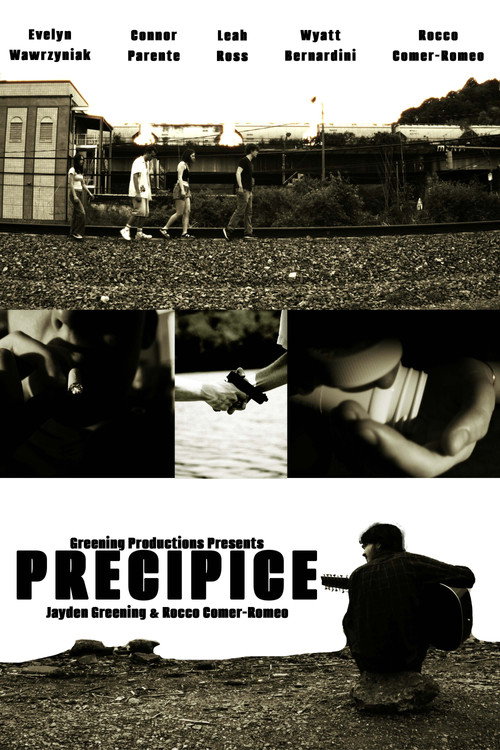
Precipice (2026)
Directed by Jayden Greening
Precipice arrives before us as a seven-minute student short from Point Park University, a format that has historically demanded economy of vision.
Consciousness Markers
A teen drama built around existentialism and a 'downward spiral' carries a faint whiff of the morality-tale format, though at seven minutes there is limited runway for sustained sermonizing.
No evidence of casting assembled as a conscious diversity exercise. The ensemble appears to reflect the natural composition of a student production with no documented intent to check demographic boxes.
No LGBTQ+ themes, characters, or commentary are present or documented in this seven-minute short.
The film's premise of teens spiraling into drug abuse and violence carries no discernible feminist framing or messaging.
No racial commentary, identity politics, or consciousness-raising around race is evident in the film's premise or documented reception.
There is no climate anxiety, environmental messaging, or ecological subtext present or reported in this film.
The existential dread on display appears to be personal and adolescent in nature, not a structural critique of capitalism or wealth inequality.
No body positivity themes or messaging are present or documented.
No neurodivergent characters, themes, or framing are present or documented.
As a contemporary drama about teenagers, the film has no historical subject matter to revise.
Why it received this score
Precipice arrives before us as a seven-minute student short from Point Park University, a format that has historically demanded economy of vision. Director Jayden Greening gives us teenagers, drugs, violence, and existentialism, which is either a very ambitious agenda for 420 seconds of screen time or a perfectly calibrated one, depending on your tolerance for adolescent entropy. The film won recognition at the Steel City Emerging Film Festival, which is the kind of credential that announces a filmmaker is at the beginning of something, not the end.
On the spectrum of progressive cultural signaling, Precipice registers as essentially inert. The premise is the oldest in independent cinema: young people destroying themselves while staring into the void. This is Cassavetes territory, Larry Clark territory, the territory of a thousand film school theses written at 2am with the conviction that chaos is its own argument. There is a faint trace of lecture energy in the existentialist framing, the sense that the film knows it is delivering a message about youth and futility, but at this runtime the sermon barely clears its throat before the credits roll.
The most culturally provocative thing about Precipice may be its almost aggressive refusal to engage with any of the contemporary markers our rubric demands. No climate anxiety, no identity politics, no body affirmations, no neurodivergent protagonists discovering their gifts. Just teenagers in trouble, which is, in its own quiet way, a remarkably old-fashioned artistic choice. We note this without judgment. The precipice, it turns out, is simply a precipice.
Analysis generated by our Consciousness Algorithm
Synopsis
A reckless group of teens on the run from the ever approaching future engage in a downward spiral of drug abuse, violence, and existentialism.