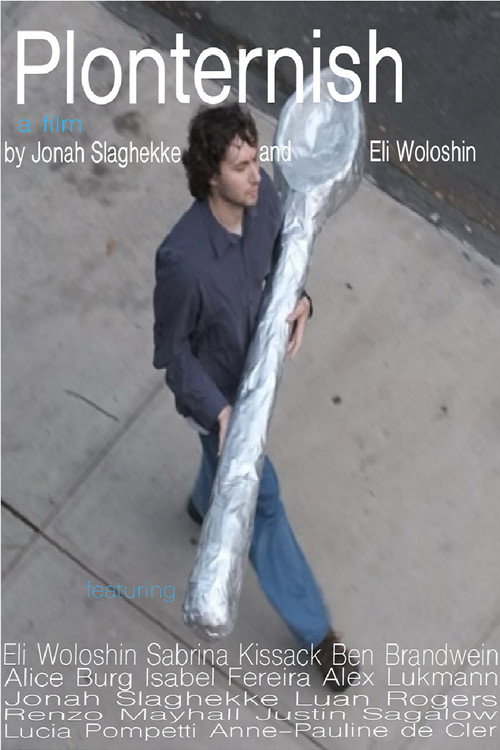
Plonternish (2026)
Directed by Eli Woloshin
Plonternish arrives bearing a Yiddish title meaning "muddle" or "tangle," which is either an act of radical self-awareness or a very efficient piece of marketing.
Consciousness Markers
No evidence of casting driven by representational agenda. This is a micro-budget indie in which the director cast himself and his immediate artistic circle, a practice predating the concept of representation casting by several centuries.
No LGBTQ+ themes, characters, or messaging have been identified in any available material about this film.
No feminist framing or agenda is present. The film follows a man named Eli writing a play, which is, at its core, a story about a man named Eli writing a play.
No racial consciousness themes have been identified. The research surfaces no discourse, critique, or commentary along these lines.
No climate themes detected. The ecological footprint of one person writing a play is, we must assume, relatively modest.
No anti-capitalist messaging identified. Making a micro-budget documentary about writing a play is arguably the most anti-capitalist act imaginable, but it does not appear to be the point.
No body positivity themes or messaging have been identified in any available material.
No neurodivergence themes identified. The creative struggle of writing a play is not, by itself, a neurodivergence narrative.
No historical revisionism present. There is no history to revise. There is only Eli, and the play.
No lecture energy detected. The film's entire premise, as summarized in three words, does not leave obvious room for sermonizing, though ambitious filmmakers have managed with less.
Why it received this score
Plonternish arrives bearing a Yiddish title meaning "muddle" or "tangle," which is either an act of radical self-awareness or a very efficient piece of marketing. The film concerns Eli Woloshin writing a play. That is the film. A man, a play, the space between intention and execution. In the long and storied tradition of artists making art about making art, this occupies a modest but sincere position, somewhere between a journal entry and a thesis statement.
The search for progressive social messaging in Plonternish is, to put it plainly, a fruitless expedition. The film generates no public discourse, no representational controversy, no climate allegory, no lecture energy of any measurable kind. It does not appear to be interested in correcting your politics. It is interested in Eli. This is, depending on your perspective, either a refreshing act of artistic restraint or simply the natural consequence of a very small camera pointed at a very specific creative process with no apparent agenda beyond documentation.
We are left, then, with a film that scores a clean zero across all ten markers. Not because it is reactionary, not because it is apolitical in a pointed way, but because it is, by every available measure, a man writing a play. The title word, that Yiddish muddle, turns out to describe the critical apparatus brought to bear on the film far more accurately than it describes the film itself.
Analysis generated by our Consciousness Algorithm
Synopsis
Eli writes a play.