Phytophonics (2026)
Directed by Karel Doing
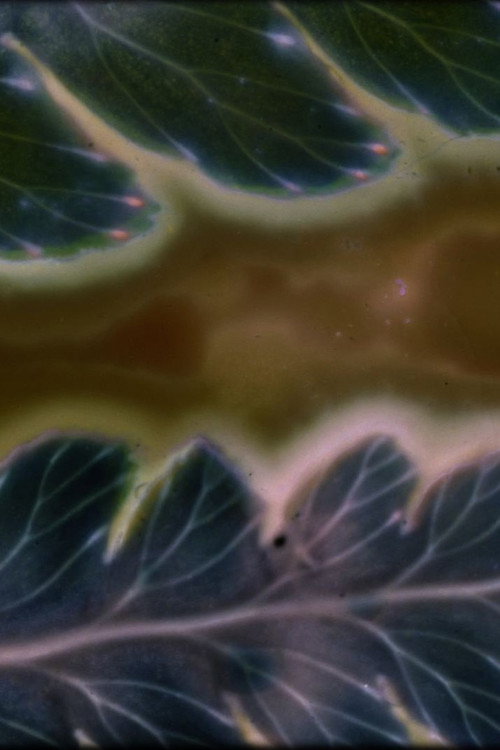
Karel Doing's Phytophonics is a four-minute camera-less film in which plant matter is pressed directly onto 16mm photochemical emulsion, producing botanical textures that the optical sound system then converts into noise.
Consciousness Markers
The official synopsis declares the film to be 'eco-punk against the abyss created by late-capitalism.' This is not a subtle subtext. It is the stated purpose of the work, printed plainly on the tin.
The film's entire conceptual premise centers plant life and non-human agency as a corrective to anthropocentric modernity. The eco-punk framing is explicit in the work's promotional materials and academic context.
The film itself cannot lecture, being abstract and without dialogue. The framing text, however, adopts a declarative ideological posture that earns a token score.
There is no cast. The film contains no human beings of any demographic. Scoring this marker is a philosophical exercise with a predetermined outcome.
No characters, no narrative, no LGBTQ+ content of any kind. The plants have not disclosed their orientations.
No human subjects are present. No feminist themes, framing, or content can be identified in a film consisting entirely of botanical photograms.
No human representation exists in any form. Racial consciousness requires, at minimum, humans.
No bodies are present. The film is camera-less abstract animation. There is nothing to be positive or negative about, physically speaking.
No characters, no narrative, no neurodivergence themes. Not applicable in any meaningful sense.
The film has no historical content or narrative whatsoever. It is botanical noise on celluloid.
Why it received this score
Karel Doing's Phytophonics is a four-minute camera-less film in which plant matter is pressed directly onto 16mm photochemical emulsion, producing botanical textures that the optical sound system then converts into noise. There are no actors. There are no characters. There is no dialogue. There is, however, a press release describing the work as "eco-punk against the abyss created by late-capitalism," which is doing a great deal of ideological heavy lifting on behalf of some ferns.
The film's ecological positioning is sincere and, within its own narrow context, coherent. By centering plant agency over human subjectivity, Doing aligns with posthumanist and new materialist currents in contemporary art theory, communities that have found in non-human life a useful rebuke to anthropocentric modernity. The anti-capitalist framing is explicit in the promotional text, if not audible in the crackling hiss of the film itself. We are invited to understand botanical chemistry as a form of resistance. The moss is not neutral. It has a position.
The scoring of a film with no cast, no narrative, and no human beings presents its own methodological challenges, which this critic accepts with the quiet dignity of a person who has agreed to rate a four-minute film of plant impressions on a scale of progressive social consciousness. Most markers register zero, not from any conservative sympathy, but because there is simply nothing there to score. The film is, in the most literal sense, about plants. It is the anti-capitalist framing alone that elevates it above a perfect null result, and even that framing lives in the curator's notes rather than the celluloid itself.
Analysis generated by our Consciousness Algorithm
Synopsis
Plant matter is used to create finely detailed indexical traces on photochemical film. The traces are not only visible but also audible. Eco-punk against the abyss created by late-capitalism.