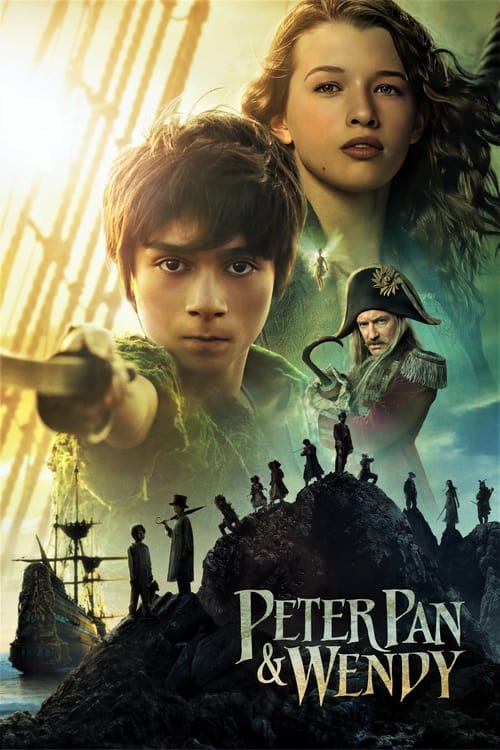
Peter Pan & Wendy (2023)
Directed by David Lowery
Partly — Peter Pan & Wendy is somewhat woke, scoring 47 out of 100 on our wokeness meter.
The modern reimagining of Peter Pan arrives bearing a noticeable weight of cultural intent.
Consciousness Markers
Yara Shahidi, a Black actress, was cast as the traditionally white Tinker Bell, and Alyssa Wapanatâhk, a First Nations performer, plays Tiger Lily; the Lost Children were rebalanced to four boys and four girls, all deliberate race- and gender-conscious casting choices.
Director David Lowery explicitly stated the adaptation had to change elements to avoid the racial stereotypes of the 1953 original, and the film foregrounds a Black Tinker Bell and an Indigenous Tiger Lily as corrective casting.
Wendy is repositioned as the emotional and moral center, scolding Peter for recklessness, choosing to grow up on her own terms, and leading the rescue of her brothers alongside a warrior Tiger Lily and a gender-balanced band of Lost Children.
The film carries a gentle moralizing streak about friendship, growing up, and Peter's failings, with Wendy delivering corrective speeches, but it stays largely within the bounds of family-adventure sentiment rather than overt preaching.
The film substantially rewrites its source mythology, recasting Hook as the original Lost Boy and Peter's former best friend and reframing Peter as a flawed, neglectful friend, though this is revision of a fairy tale rather than of real history.
No LGBTQ+ characters, relationships, or subtext appear anywhere in the film.
No environmental or climate themes are present in the story.
No economic critique or anti-wealth messaging appears; the pirates are simply antagonists, not class allegory.
No body-image or body-acceptance themes are present.
No neurodivergent characters or themes are depicted or referenced.
Why it received this score
The modern reimagining of Peter Pan arrives bearing a noticeable weight of cultural intent. Director David Lowery and his team appear concerned with correcting the inherent visual prejudices of the source material. The deliberate rebalancing of the Lost Children and the casting choices, which place Indigenous and Black performers in key roles, function as a clear statement of contemporary social consciousness. This focus on representation casting is framed not as mere window dressing, but as a structural necessity for the narrative to remain relevant to the current moment. Wendy Darling assumes a position of moral authority within this revised mythology, choosing to grow up on her own terms and actively guiding the plot through her emotional maturity. She is positioned as the film's moral compass, scolding Peter for his perpetual recklessness.
However, the film avoids the heavier end of the progressive spectrum. It is a family adventure, not a manifesto. The progressive sensibilities are contained within the framework of a standard fantasy narrative, making its social critique gentle rather than aggressive. While the screenplay engages in a moderate revision of established folklore, reframing the antagonists and the protagonists' flaws, it maintains a clear dedication to the genre's foundational elements. There is little room for the more extreme thematic explorations of climate anxiety or economic critique. The film settles into a comfortable territory of moralizing sentiment, where the instruction is delivered with a firm but benevolent hand.
Ultimately, Peter Pan & Wendy succeeds as a culturally aware piece of escapism. It is a story that takes the familiar trappings of a childhood myth and polishes them with deliberate, progressive sheen. We are left with a highly conscious retelling that prioritizes a specific, modern set of values without attempting to dismantle the traditional structures of the fairy tale. It is an exercise in balance: enough cultural awareness to justify its existence, but not enough to stray into genuine political discourse.
Analysis generated by our Consciousness Algorithm
Part of

Synopsis
Wendy Darling, a young girl afraid to leave her childhood home behind, meets Peter Pan, a boy who refuses to grow up. Alongside her brothers and a tiny fairy, Tinker Bell, she travels with Peter to the magical world of Neverland. There, she encounters an evil pirate captain, Captain Hook, and embarks on a thrilling adventure that will change her life forever.
Questions about Peter Pan & Wendy
Is Peter Pan & Wendy woke?
Partly — Peter Pan & Wendy is somewhat woke, scoring 47 out of 100 on our wokeness meter. That earns it a verdict of Woke-Adjacent.
What makes Peter Pan & Wendy woke?
4 of the 10 markers register at 30 or above, led by Representation Casting (72), Racial Consciousness (60) and Feminist Agenda (50). On Representation Casting: Yara Shahidi, a Black actress, was cast as the traditionally white Tinker Bell, and Alyssa Wapanatâhk, a First Nations performer, plays Tiger Lily; the Lost Children were rebalanced to four boys and four girls, all deliberate race- and gender-conscious casting choices.
How does Peter Pan & Wendy compare to other 2023 movies?
It ranks #34 of the 200 films from 2023 we've scored; their average is 24. The wokest is Origin (84).
How is the Woke Score calculated?
An AI-assisted process researches the film and its reception, scores it 0–100 on ten markers, then combines those into one 0–100 Woke Score. It measures a specific set of 2020s cultural themes, not film quality.