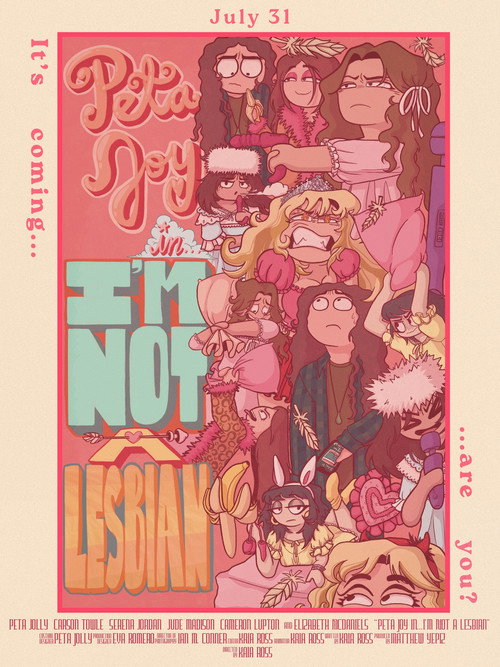
Peta Joy In... I'm Not A Lesbian (2026)
Directed by Kaia Ross
There is a certain efficiency to titling your film Peta Joy In... I'm Not A Lesbian and then spending the runtime depicting a woman in homoerotic female friendships while fleeing a dissatisfying boyfriend known as a "DL Trade."
Consciousness Markers
LGBTQ+ identity is not a theme in this film, it is the entire film. Lesbian identity denial, homoerotic female friendships, and queer self-discovery are the complete narrative substance from title card to credits.
The cast is built around a Black female protagonist and her queer female friend group, with the 'DL Trade' boyfriend drawn from specifically Black queer cultural vocabulary. Representation is organic to the premise rather than decorative, but it is present throughout.
The use of 'DL Trade' as character nomenclature is drawn directly from Black queer vernacular, signaling a culturally specific racial and sexual context. The film does not editorialize on this, it simply exists inside it.
The protagonist's journey toward self-determination over her own sexuality carries an implicit feminist valence, but the film does not frame it as such. There is no feminist agenda visible, only a woman slowly recognizing her own desires.
The film's comedic and self-aware tone actively resists sermonizing. It observes its protagonist's denial with dry patience rather than correcting her aloud. The score is above zero only because the premise itself carries an implicit 'be yourself' message.
No climate themes, environmental messaging, or ecological allegory of any kind are present or documented in this film.
No anti-capitalist themes or critique of economic structures are present. The protagonist's dissatisfaction is romantic and sexual, not economic.
No body positivity messaging or commentary on physical appearance norms is present or documented.
No neurodivergent characters, themes, or representation are present or documented in this film.
This is an original contemporary story with no historical setting, no historical figures, and no engagement with the historical record.
Why it received this score
There is a certain efficiency to titling your film Peta Joy In... I'm Not A Lesbian and then spending the runtime depicting a woman in homoerotic female friendships while fleeing a dissatisfying boyfriend known as a "DL Trade." The thesis is in the title. The evidence is in every scene. The protagonist's self-deception is, in the parlance of cultural taxonomy, doing a lot of heavy lifting.
Director Kaia Ross works in the tradition of queer animated comedy where the joke and the sincerity occupy the same frame without apologizing to each other. The film does not lecture its protagonist into self-acceptance. It simply observes her, with the patience of someone who has heard this particular denial before and is prepared to wait. The horror genre tag is, on reflection, the most honest credit in the package. The scariest thing in the film is Peta Joy's own interior life.
What the film conspicuously lacks is any broader social apparatus. There is no climate allegory lurking in the background, no anti-capitalist treatise smuggled into the third act, no body positivity sidebar, no neurodivergence subplot. It is a tightly focused portrait of one woman's extremely specific problem, animated with independent-short-film economics and released to YouTube with the quiet confidence of someone who knows exactly what they made. The "DL Trade" vocabulary alone signals fluency in a very particular cultural register, one rooted in Black queer vernacular, and the film wears that fluency without commentary or explanation, which is, frankly, the correct choice.
Analysis generated by our Consciousness Algorithm
Synopsis
Growing tired of her mediocre DL Trade, Peta Joy retreats into homoerotic female friendships while refusing to admit she's a lesbian.