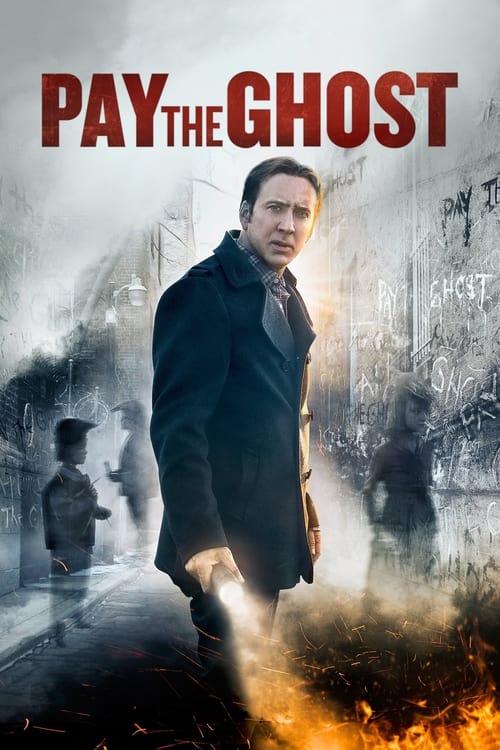
Pay the Ghost (2015)
Directed by Uli Edel
No — Pay the Ghost is not woke, scoring 6 out of 100 on our wokeness meter.
Pay the Ghost arrives from 2015 with the quiet confidence of a film that knows exactly what it is and has no intention of being anything else.
Consciousness Markers
The cast includes a few non-white and international performers (Lyriq Bent, Veronica Ferres) and the abducted children carry names like Mia Wen and Pablo, but these are incidental and never commented upon.
The antagonist is a wronged widow burned as a witch, and the wife and a female psychic drive parts of the plot, but the film makes no feminist argument or commentary.
No LGBTQ+ characters, relationships, or themes appear anywhere in the film.
The film engages no racial themes or commentary whatsoever; the 1679 witch-hunt backstory is not framed through a racial lens.
No environmental or climate themes are present.
No critique of capitalism, wealth, or class appears in the story.
No body-positive themes or messaging are present.
No neurodivergent characters or themes are depicted.
The 1679 witch-burning backstory is a fictional supernatural device, not a revisionist reframing of real history through a modern ideological lens.
The film is a straightforward supernatural horror thriller and never pauses to deliver a social or moral lecture to the audience.
Why it received this score
Pay the Ghost arrives from 2015 with the quiet confidence of a film that knows exactly what it is and has no intention of being anything else. Nicolas Cage plays a professor whose son vanishes at a Halloween carnival, and the ensuing year of grief, spectral phone calls, and burned children leads him into a 1679 witch-burning legend and a basement full of trapped souls. Uli Edel directs with the flat competence of a man fulfilling a contract. Critics were unkind. The Rotten Tomatoes consensus suggested that only the audience would pay, and the Metacritic score of 23 confirms the joke landed.
What interests us here is the film's relationship to contemporary social consciousness, which is to say its near total indifference to it. The cast includes a handful of non-white and international performers, and two of the abducted children carry the names Mia Wen and Pablo, but the film never pauses to acknowledge them as anything other than children in a basement. The antagonist is a widow burned alive by a mob, which offers a faint historical grievance, yet the screenplay treats her as a monster to be defeated, not a symbol to be examined. There is no racial framing of the 1679 backstory, no environmental anxiety, no critique of wealth, no meditation on the body, no neurodivergent character, and no moment where the narrative stops to instruct us on how to live.
This is a supernatural thriller built from vultures, Celtic symbols, and a psychic who gets strangled by an invisible force. It wants only to frighten and occasionally to bore. The result is a film of almost pure generic function, untouched by the cultural currents of its own decade. We classify it accordingly, with the solemn respect owed to any artifact that resists the gravitational pull of its era.
Analysis generated by our Consciousness Algorithm


Synopsis
One year after his young son disappeared during a Halloween carnival, Mike Cole is haunted by eerie images and terrifying messages he can’t explain. Together with his estranged wife, he will stop at nothing to unravel the mystery and find their son—and, in doing so, he unearths a legend that refuses to remain buried in the past.
Questions about Pay the Ghost
Is Pay the Ghost woke?
No — Pay the Ghost is not woke, scoring 6 out of 100 on our wokeness meter. That earns it a verdict of Ultra Based.
Does Pay the Ghost have any woke elements?
Very few. None of the 10 markers reaches 30, the level where a marker counts as present; the highest is Representation Casting at 15.
How does Pay the Ghost compare to other 2015 movies?
It ranks #200 of the 289 films from 2015 we've scored; their average is 15. The wokest is Chi-Raq (78).
How is the Woke Score calculated?
An AI-assisted process researches the film and its reception, scores it 0–100 on ten markers, then combines those into one 0–100 Woke Score. It measures a specific set of 2020s cultural themes, not film quality.