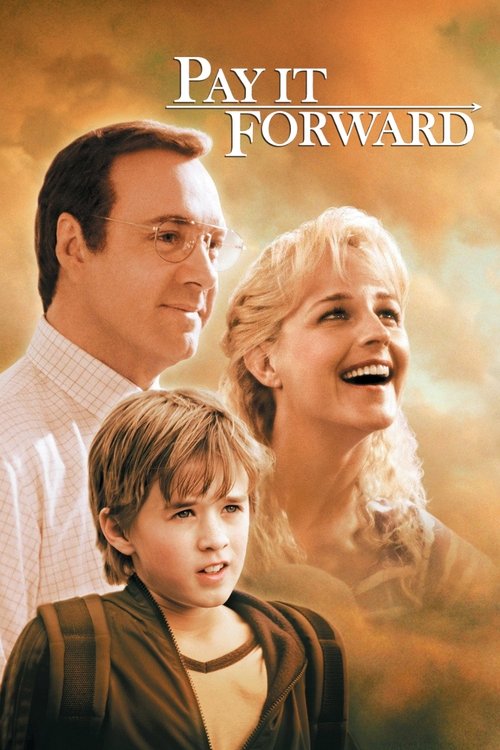
Pay It Forward (2000)
Directed by Mimi Leder
No — Pay It Forward is not woke, scoring 16 out of 100 on our wokeness meter.
Pay It Forward arrives in 2000 convinced that kindness can circulate like currency, and it spends two hours insisting on that proposition.
Consciousness Markers
The film is earnestly didactic about its 'pay it forward' movement, with a social-studies assignment to 'change the world' and a climactic candlelight vigil, though its sermonizing is sentimental humanism rather than modern social-justice messaging.
Directed by Mimi Leder and centered on Helen Hunt's Arlene, a two-job single mother and recovering alcoholic who learns to reject her abusive ex-husband and forgive her negligent mother, giving it a modest female-agency arc without an explicit feminist thesis.
Kevin Spacey's Eugene carries burn scars from childhood abuse and begins as a self-conscious recluse who gradually accepts his disfigured body and enters a relationship, a mild body-acceptance thread.
The supporting cast includes David Ramsey and Gary Werntz, but the film's most notable casting fact is a whitewashing: the novel's African-American lead (Reuben St. Clair, offered to Denzel Washington) was rewritten as the white Eugene Simonet for Kevin Spacey.
The film's racial footprint is largely a subtraction — the source novel's Black protagonist was recast as white — with only incidental minority supporting players and a gang-member subplot offering any diversity.
No LGBTQ+ characters, themes, or subtext appear anywhere in the film.
No environmental or climate themes are present; the film's 'change the world' project is about interpersonal kindness, not ecology.
The film's goodwill movement is framed as personal charity rather than a critique of wealth, capitalism, or economic structures.
No neurodivergent characters or themes are depicted.
The film is a contemporary fictional drama with no historical revisionism.
Why it received this score
Pay It Forward arrives in 2000 convinced that kindness can circulate like currency, and it spends two hours insisting on that proposition. A twelve-year-old named Trevor McKinney receives a social studies assignment to change the world, and he invents a pyramid of good deeds in which each recipient owes three favors to strangers. The narrative then cascades into human decency: a homeless man given a garage, a journalist tracing the chain, a candlelight vigil, and a fatal stabbing that the film treats as the cost of doing business in the goodwill industry.
The cultural footprint here is largely a subtraction. The source novel gave us Reuben St. Clair, an African-American teacher scarred in Vietnam. The film gives us Kevin Spacey as Eugene Simonet, white and burned by his father. Denzel Washington was offered the part and declined, which says something about the casting arithmetic of the era. Helen Hunt's Arlene, a two-job single mother who learns to refuse her abusive ex-husband, supplies a modest thread of female agency, and Eugene's slow acceptance of his scarred body offers a mild note of self-acceptance. Beyond that, the ledger is thin. No queer characters. No ecological conscience. No reckoning with capital. No neurodivergent perspective. No historical revision.
The film's real currency is sincerity, deployed at volume. The assignment, the sermonizing about changing the world, the candles at the end: all of it preaches a sentimental humanism that predates the current vocabulary of social justice by two decades. The movie wants us to feel good, then feel terrible, and it is not subtle about either. A well-acted and emotionally manipulative artifact of its moment, its cultural awareness sits in the shallow end. The performances earn more credit than the screenplay deserves, which is itself a kind of moral.
Analysis generated by our Consciousness Algorithm
Part of


Synopsis
Like some other kids, 12-year-old Trevor McKinney believed in the goodness of human nature. Like many other kids, he was determined to change the world for the better. Unlike most other kids, he succeeded.
Questions about Pay It Forward
Is Pay It Forward woke?
No — Pay It Forward is not woke, scoring 16 out of 100 on our wokeness meter. That earns it a verdict of Ultra Based.
Does Pay It Forward have any woke elements?
1 of the 10 markers register at 30 or above, led by Lecture Energy (30). On Lecture Energy: The film is earnestly didactic about its 'pay it forward' movement, with a social-studies assignment to 'change the world' and a climactic candlelight vigil, though its sermonizing is sentimental humanism rather than modern social-justice messaging.
How does Pay It Forward compare to other 2000 movies?
It ranks #33 of the 125 films from 2000 we've scored; their average is 13. The wokest is But I'm a Cheerleader (72).
How is the Woke Score calculated?
An AI-assisted process researches the film and its reception, scores it 0–100 on ten markers, then combines those into one 0–100 Woke Score. It measures a specific set of 2020s cultural themes, not film quality.