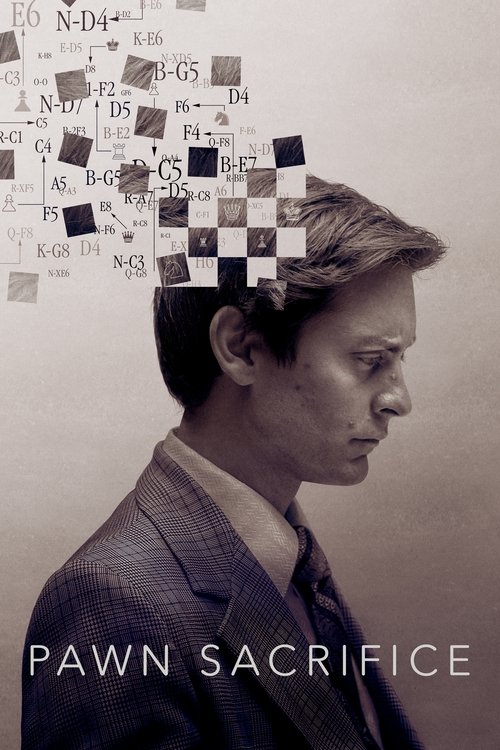
Pawn Sacrifice (2015)
Directed by Edward Zwick
No — Pawn Sacrifice is not woke, scoring 10 out of 100 on our wokeness meter.
Edward Zwick's Pawn Sacrifice arrives as a study in Cold War paranoia, and it conducts itself with the tidy restraint of a film that has no interest in being recruited for anyone's cause.
Consciousness Markers
Fischer's obsessive focus, tantrums, and acute sensory sensitivity to audience noise and the sound of the chessboard are depicted, though the film frames these as paranoia and psychosis rather than an affirming neurodivergence narrative.
The cast is overwhelmingly white, which is historically accurate for a Cold War chess drama about Bobby Fischer and his Soviet rivals; there is no deliberate diverse or color-conscious casting.
Fischer's mother is depicted as a Marxist sympathizer under FBI surveillance, and the film critiques Cold War propaganda systems, but these are historical character details rather than an anti-capitalist message.
Joan Fischer and Regina Fischer are present as sister and mother, but the film is squarely a male-driven psychological portrait and offers no feminist critique or agenda.
The film is a character-driven psychological drama that shows rather than preaches, with no overt moralizing or message-delivery.
The film's central conflict is Cold War ideology and Fischer's antisemitic paranoia, not race; there is no racial consciousness theme.
The film is a dramatized biopic of real events and takes liberties for drama, but it does not reinterpret history through a modern social-justice lens.
There are no LGBTQ+ characters, themes, or subtext anywhere in the film.
Climate and environmental themes are entirely absent.
There is no body positivity theme or content.
Why it received this score
Edward Zwick's Pawn Sacrifice arrives as a study in Cold War paranoia, and it conducts itself with the tidy restraint of a film that has no interest in being recruited for anyone's cause. The cast is white, as the historical record demands, and no effort is made to color the board for contemporary comfort. Bobby Fischer's sister and mother drift through the margins, offering worry and the occasional plea for psychiatric intervention, but the camera belongs to the men and their clocks. There is no romantic subplot to speak of and no queer subtext to excavate, which leaves the film free to spend its runtime on the far more interesting business of a genius coming apart in a Reykjavík hotel room.
Fischer's obsession is rendered as illness. He flinches at the sound of the chessboard, rages at audience noise, and accuses the Soviets of conspiring with International Jewry to destroy him. The film treats this as psychosis, not as an identity to be affirmed, and that distinction matters. His mother's Marxist sympathies and the FBI agents loitering outside give the story a faint political texture, though the target is propaganda itself, the way two superpowers used a board game as a proxy for their own virtue. Nobody eats any rich people here.
What remains is a character study that shows instead of lecturing. Zwick has no sermon to deliver about the climate, the body, or the republic, and the result is a film that feels almost antique in its refusal to instruct. Spassky called it weak. Karpov called the chess positions idiotic. Both men have a point, and neither complaint has anything to do with ideology, which is its own kind of compliment.
Analysis generated by our Consciousness Algorithm


Synopsis
During the height of the Cold War, American chess prodigy Bobby Fischer finds himself caught between two superpowers when he challenges the Soviet Empire.
Questions about Pawn Sacrifice
Is Pawn Sacrifice woke?
No — Pawn Sacrifice is not woke, scoring 10 out of 100 on our wokeness meter. That earns it a verdict of Ultra Based.
Does Pawn Sacrifice have any woke elements?
Very few. None of the 10 markers reaches 30, the level where a marker counts as present; the highest is Neurodivergence at 20.
How does Pawn Sacrifice compare to other 2015 movies?
It ranks #141 of the 289 films from 2015 we've scored; their average is 15. The wokest is Chi-Raq (78).
How is the Woke Score calculated?
An AI-assisted process researches the film and its reception, scores it 0–100 on ten markers, then combines those into one 0–100 Woke Score. It measures a specific set of 2020s cultural themes, not film quality.