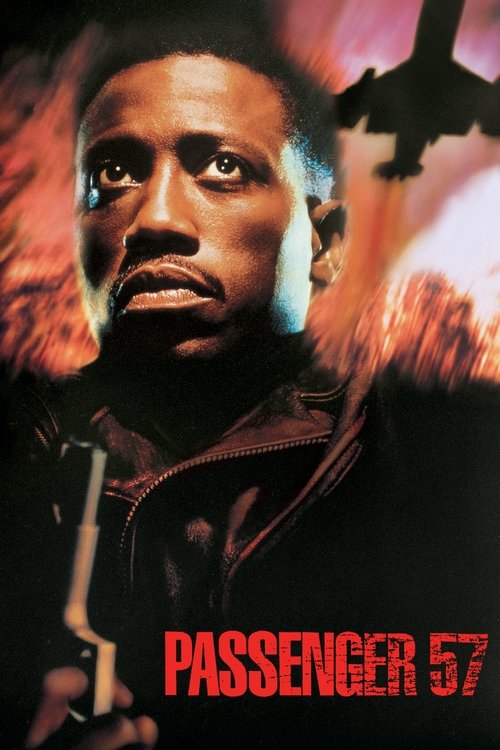
Passenger 57 (1992)
Directed by Kevin Hooks
No — Passenger 57 is not woke, scoring 11 out of 100 on our wokeness meter.
Passenger 57 arrives from 1992 with no agenda beyond getting a man off a hijacked Lockheed TriStar.
Consciousness Markers
Wesley Snipes headlines as a Black action lead, a notable casting choice for a 1992 studio thriller, though the film treats his race as unremarkable rather than a statement.
Flight attendant Marti Slayton is a trained self-defense student who assists Cutter, but she remains a conventional sidekick in a male-driven action vehicle.
The film features a Black protagonist but engages with no racial themes, commentary, or consciousness; the famous 'always bet on black' line is a quip, not a thesis.
No LGBTQ+ characters, themes, or subtext appear anywhere in the film.
No environmental or climate themes are present in this airborne hijacking thriller.
The antagonist is a terrorist kingpin, not a capitalist villain, and the film offers no economic critique whatsoever.
No body-positive themes or messaging appear in the film.
No neurodivergent characters or themes are depicted.
The film is a straightforward fictional action thriller with no historical revisionism.
A pure genre exercise in action and suspense, the film never pauses to deliver social or political sermons.
Why it received this score
Passenger 57 arrives from 1992 with no agenda beyond getting a man off a hijacked Lockheed TriStar. Kevin Hooks directs with efficiency; Wesley Snipes plays John Cutter, a widowed security consultant who happens to be the 57th passenger aboard. The film's most historically interesting decision is placing a Black actor at the center of a studio action vehicle and then refusing to say a single word about it. Cutter's race is a fact of the casting, not a subject. That restraint reads today as either confidence or indifference, and the film offers no guidance either way.
The screenplay makes two small concessions to the era's evolving social awareness. Marti Slayton, a flight attendant and Cutter's former student, has trained in self-defense and holds her own in the cargo hold before being recaptured. She is competent, then she is baggage. Elsewhere, the famous line about betting on black lands as a punchline, which is what it is. No thesis follows it. The villain, Charles Rane, is a terrorist and narcotics kingpin with a taste for casual sadism, not a corporate raider, so the film mounts no argument about money or power.
What remains is machinery. No LGBTQ presence, no climate anxiety, no body-positive messaging, no neurodivergent characters, no revisionist history, no sermon. The movie wants to move and it moves. Bruce Payne's blond menace gives the proceedings a jolt of genuine unease, and the whole thing opened at number one, which tells us something about 1992 appetites. As a document of social consciousness, it is nearly a blank page. As a thriller, it does the job. The sommelier notes a clean, uncomplicated vintage with almost no finish.
Analysis generated by our Consciousness Algorithm
Part of


Synopsis
Airline security specialist John Cutter, finally returning to the job after his wife's death, finds himself stuck on a flight being hijacked by notorious terrorist Charles Rane. Unfortunately for the terrorists, they're also stuck with him.
Questions about Passenger 57
Is Passenger 57 woke?
No — Passenger 57 is not woke, scoring 11 out of 100 on our wokeness meter. That earns it a verdict of Ultra Based.
Does Passenger 57 have any woke elements?
1 of the 10 markers register at 30 or above, led by Representation Casting (45). On Representation Casting: Wesley Snipes headlines as a Black action lead, a notable casting choice for a 1992 studio thriller, though the film treats his race as unremarkable rather than a statement.
How does Passenger 57 compare to other 1992 movies?
It ranks #28 of the 74 films from 1992 we've scored; their average is 12. The wokest is The Crying Game (62).
How is the Woke Score calculated?
An AI-assisted process researches the film and its reception, scores it 0–100 on ten markers, then combines those into one 0–100 Woke Score. It measures a specific set of 2020s cultural themes, not film quality.