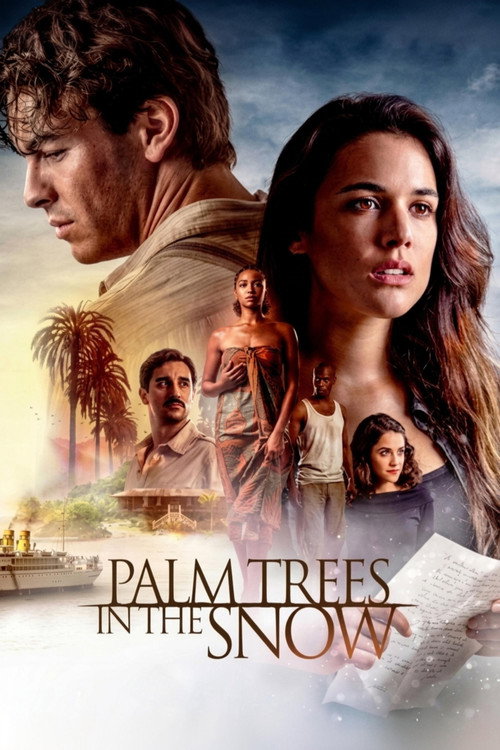
Palm Trees in the Snow (2015)
Directed by Fernando González Molina
Partly — Palm Trees in the Snow is somewhat woke, scoring 45 out of 100 on our wokeness meter.
Palm Trees in the Snow arrives with the full apparatus of a prestige Spanish melodrama: two timelines, a cocoa plantation, a forbidden love, and a running time that respects no bladder.
Consciousness Markers
The film depicts Spanish colonial rule in Equatorial Guinea, including the rape of Bisila by white colonists, the exploitation of Bubi laborers, and the barring of Guineans from leaving the country. Critics nonetheless faulted it for not confronting colonialism more directly.
A Spanish production with a substantial Black African and mixed-race cast in major roles, including Berta Vázquez as the central love interest Bisila and several Bubi characters. However, these roles arise naturally from the colonial setting rather than from deliberate diverse-casting intent.
The cocoa plantation economy and its abusive overseers (notably Gregorio) gesture at colonial labor exploitation, but the film treats this as backdrop to romance rather than as a systemic critique of capital.
The film revisits Spain's largely unexamined colonial history in Equatorial Guinea, a subject rarely depicted in Spanish cinema, though it frames this through a nostalgic romance rather than a corrective historical revision.
Clarence and Julia are active female characters who drive the investigation and rescue subplots, but the film is fundamentally a heterosexual romance without an explicit feminist thesis.
The film is a sweeping romantic drama that prioritizes melodrama and cinematography over didactic messaging; reviewers specifically noted its reluctance to lecture on colonialism.
No LGBTQ+ characters, relationships, or themes appear anywhere in the narrative.
No environmental or climate themes are present in the film.
No body-positivity themes or messaging appear in the film.
Older Kilian suffers from dementia, but this is portrayed as a tragic plot device rather than as neurodivergent representation or advocacy.
Why it received this score
Palm Trees in the Snow arrives with the full apparatus of a prestige Spanish melodrama: two timelines, a cocoa plantation, a forbidden love, and a running time that respects no bladder. Fernando González Molina directs with the patience of someone adapting a beloved novel, which he is, and the film moves between 1950s Fernando Pó and a 2003 investigation with the unhurried confidence of a story that knows it will be forgiven its length.
The film's most substantial engagement with social consciousness lies in its depiction of Spanish colonial rule in Equatorial Guinea. The cast is heavily Black African and mixed-race, with Berta Vázquez carrying the emotional weight of the central romance. The abuse is present: the rape of Bisila, the overseer Gregorio, the barring of Guineans from leaving their own country. Yet critics were right to note that the film treats this material as backdrop for a love story. The plantation economy gestures toward exploitation without ever naming capital as the culprit. The history here is revisited, not corrected.
Elsewhere the ledger runs empty. There is no LGBTQ content, no environmental concern, no interest in body politics, and the dementia that afflicts the older Kilian functions as a narrative device for a hat-based reunion. The women, Clarence and Julia, do drive the investigation and the smuggling subplot, which counts for something, though the film's heart remains a heterosexual romance. What the film does not do is lecture. It wants to be swept up in, not schooled by, its own history, and on that modest ambition it succeeds with genuine craft.
Analysis generated by our Consciousness Algorithm


Synopsis
Spain, 2003. An accidental discovery leads Clarence to travel from the snowy mountains of Huesca to Equatorial Guinea, to visit the land where her father Jacobo and her uncle Kilian spent most of their youth, the island of Fernando Poo.
Questions about Palm Trees in the Snow
Is Palm Trees in the Snow woke?
Partly — Palm Trees in the Snow is somewhat woke, scoring 45 out of 100 on our wokeness meter. That earns it a verdict of Woke-Adjacent.
What makes Palm Trees in the Snow woke?
4 of the 10 markers register at 30 or above, led by Racial Consciousness (55), Representation Casting (45) and Eat the Rich (30). On Racial Consciousness: The film depicts Spanish colonial rule in Equatorial Guinea, including the rape of Bisila by white colonists, the exploitation of Bubi laborers, and the barring of Guineans from leaving the country.
How does Palm Trees in the Snow compare to other 2015 movies?
It ranks #19 of the 289 films from 2015 we've scored; their average is 15. The wokest is Chi-Raq (78).
How is the Woke Score calculated?
An AI-assisted process researches the film and its reception, scores it 0–100 on ten markers, then combines those into one 0–100 Woke Score. It measures a specific set of 2020s cultural themes, not film quality.