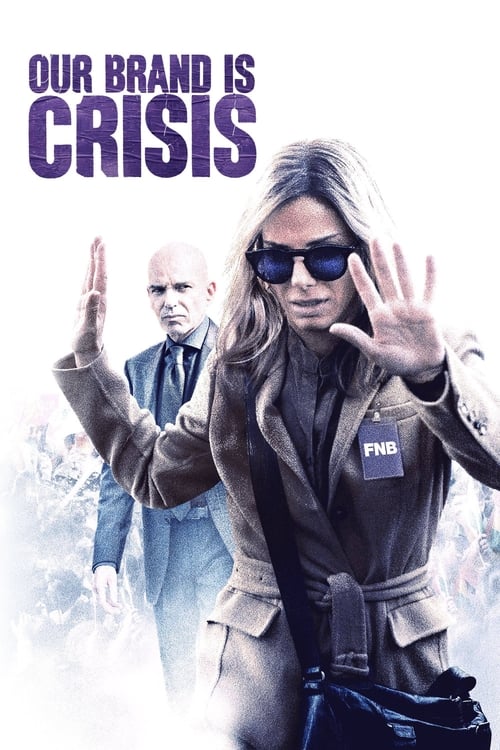
Our Brand Is Crisis (2015)
Directed by David Gordon Green
Partly — Our Brand Is Crisis is somewhat woke, scoring 45 out of 100 on our wokeness meter.
A burned-out American political consultant named "Calamity" Jane Bodine is summoned to Bolivia to drag a fading presidential candidate across the finish line, and the film watches her do it with the grim efficiency of a mechanic servicing a car she no longer likes.
Consciousness Markers
Sandra Bullock headlines as a female political consultant, with Anthony Mackie and a largely Latino supporting cast playing Bolivian characters. The diversity is partly organic to the Bolivian setting rather than a deliberate representational statement.
The plot foregrounds indigenous Bolivians who are a majority yet lack political power, and critiques American consultants ignorant of local language and culture. The consciousness is more anti-imperialist than US racial discourse.
The film critiques the cynical American political-consulting industry, smear campaigning, and the IMF's imposition on Bolivia, with protesters rallying against foreign economic interests.
The film carries a moral about the corruption of political consulting and ends with Bodine abandoning her trade to join protesters, though critics noted it 'lacks enough of a bite' to fully preach.
Bullock's 'Calamity' Jane Bodine is a woman thriving in the male-dominated world of political consulting, and critics called it one of the best female roles in years, but the film makes no explicit feminist argument.
No LGBTQ+ characters or themes appear anywhere in the film.
No environmental or climate themes are present.
No body-positivity themes or messaging.
Bodine is described as burned-out and neurotic, but this is character color rather than any neurodivergence advocacy or representation.
The film is a fictionalized dramatization of the 2002 Bolivian election and the real GCS consulting firm, but it presents itself as dramatized history rather than a revisionist reframing of the record.
Why it received this score
A burned-out American political consultant named "Calamity" Jane Bodine is summoned to Bolivia to drag a fading presidential candidate across the finish line, and the film watches her do it with the grim efficiency of a mechanic servicing a car she no longer likes. Sandra Bullock carries the picture on her back, all twitch and exhaustion, a woman operating inside a boys' club and beating the men at their own ugly game. The movie notices this without ever staging a seminar about it. Her competence is simply the premise, so the feminist content registers at a moderate hum instead of a shout.
The Bolivian setting supplies the rest of the social texture. Indigenous protesters fill the streets, a majority without power, and the visiting consultants cannot be bothered to learn the language or the names. There is real anger here at the machinery of American image-making and at the International Monetary Fund's quiet arrival on the last page of a broken promise. It plays more as anti-imperialist grumbling than as domestic racial discourse, which keeps the temperature low. The consultants are Latino and Bolivian where the story requires it, and the cameras move on.
Where the film finally shows its hand is the ending, when Bodine stops the car to the airport and walks into the crowd of demonstrators. That is a moral, delivered plainly, though the surrounding satire is toothless enough that the sermon never quite lands. No same-sex threads, no climate concern, no body-image commentary, no neurodivergent framing, nothing that reorders the historical record. A movie about selling lies that is itself a little too polite to sell one.
Analysis generated by our Consciousness Algorithm


Synopsis
Based on the documentary "Our Brand Is Crisis", this feature focuses on the use of American political campaign strategies in South America.
Questions about Our Brand Is Crisis
Is Our Brand Is Crisis woke?
Partly — Our Brand Is Crisis is somewhat woke, scoring 45 out of 100 on our wokeness meter. That earns it a verdict of Woke-Adjacent.
What makes Our Brand Is Crisis woke?
5 of the 10 markers register at 30 or above, led by Eat the Rich (45), Racial Consciousness (45) and Representation Casting (45). On Eat the Rich: The film critiques the cynical American political-consulting industry, smear campaigning, and the IMF's imposition on Bolivia, with protesters rallying against foreign economic interests.
How does Our Brand Is Crisis compare to other 2015 movies?
It ranks #19 of the 289 films from 2015 we've scored; their average is 15. The wokest is Chi-Raq (78).
How is the Woke Score calculated?
An AI-assisted process researches the film and its reception, scores it 0–100 on ten markers, then combines those into one 0–100 Woke Score. It measures a specific set of 2020s cultural themes, not film quality.