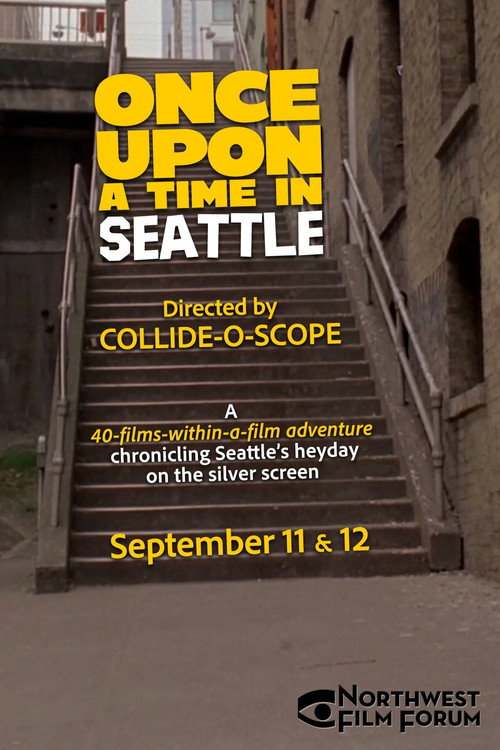
Once Upon a Time in Seattle (2026)
Directed by Shane Wahlund
Once Upon a Time in Seattle is a found-footage compilation assembled from over 40 films shot in or around the city across several decades, directed by the Collide-O-Scope duo of Shane Wahlund and Michael Anderson.
Consciousness Markers
The film's central preoccupation with gentrification and the erasure of Seattle's landscape carries a faint anti-capitalist undertone, in the sense that rapid development is framed as loss. It is ambient rather than argued.
The film's premise carries a mild air of civic scolding about Seattle's amnesia toward its own past, but it delivers this through imagery rather than argument. It is more elegy than sermon.
The film has no original casting whatsoever. Its 'cast' is a roster of ghosts borrowed from decades of Hollywood productions, assembled without any apparent agenda beyond geographic coincidence.
No LGBTQ+ themes are present in the film's own construction, though the directors' background includes video art for Seattle drag performers. That context does not transfer to the film's content.
No feminist framing, narrative, or commentary is present. The film does not speak at all, in any direction, about gender.
There is no racial commentary, no discourse on race, and no evidence that the selection of clips was guided by racial consciousness. The city of Seattle's demographics are not addressed.
No climate messaging is present. The film mourns the loss of old Seattle streetscapes to development, but this is aesthetic nostalgia, not environmental activism.
No body positivity themes are present or implied. The film has no characters with agency of any kind.
No neurodivergence themes are present. None are possible in a work with no original dialogue or narrative.
The film is archival and celebratory of cinematic history rather than revisionist. It preserves the record rather than reframing it.
Why it received this score
Once Upon a Time in Seattle is a found-footage compilation assembled from over 40 films shot in or around the city across several decades, directed by the Collide-O-Scope duo of Shane Wahlund and Michael Anderson. Its cast, which includes Elvis Presley and Harrison Ford, did not attend the premiere, having contributed their performances to other films years or decades prior. This is the kind of movie where the credit roll functions primarily as a history lesson.
The film makes no original arguments, delivers no original dialogue, and takes no discernible position on the great social debates of our moment. It is, by the standards of this analysis, almost aggressively inert. The closest it comes to a progressive sensibility is a pervasive melancholy about urban gentrification, the sense that Seattle has been eating its own past to feed its future. This is a real concern, and a locally resonant one, but it arrives as atmosphere rather than thesis. No one is lectured. No one is even spoken to.
Scoring a work like this feels like using a spectrometer to analyze fog. The fog is real. The spectrometer is accurate. The reading comes back as nearly nothing, and that is the correct reading. As an artifact of civic cinephilia produced for local film festivals and Seattle cultural podcasts, Once Upon a Time in Seattle exists in a register entirely outside the culture-war taxonomy this instrument was built to measure. We note this not as a failing of the film, but as a data point of some interest.
Analysis generated by our Consciousness Algorithm
Synopsis
Comprised of moments from over 40 films shot in Seattle, and a few irresistible facsimiles, Once Upon a Time in Seattle is part love letter, part loony action adventure, and part free-associative meditation on the transience of landscape in a city that has always had a complicated relationship with honoring its past while moving swiftly into the future.