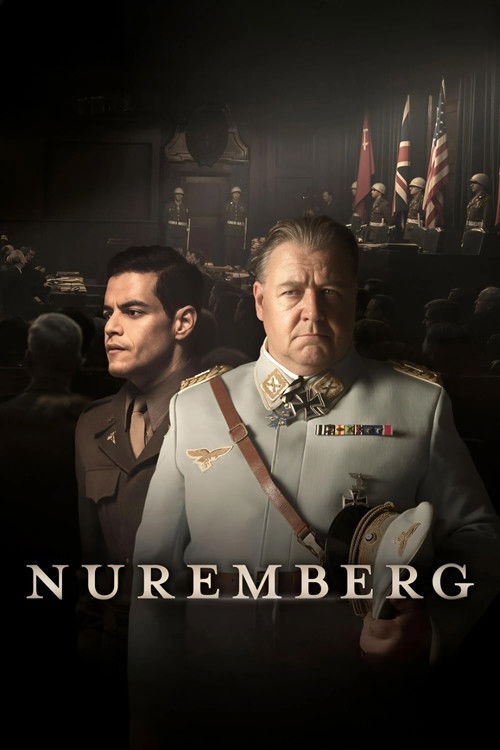
Nuremberg (2025)
Directed by James Vanderbilt
No — Nuremberg is not woke, scoring 11 out of 100 on our wokeness meter.
Nuremberg arrives as a handsomely mounted historical drama of a type the studios once produced with regularity: the autumn prestige picture, calibrated for adult audiences and awards-season consideration.
Consciousness Markers
The film is earnest and moralistic about accountability and evil, but its lessons are humanist rather than modern social-justice preaching.
The film depicts Nazi racial persecution and includes a Jewish interpreter's testimony, but it frames this as historical atrocity rather than contemporary racial consciousness.
The cast is overwhelmingly white and male, consistent with the historical subject; no deliberate modern diversity casting is evident.
No LGBTQ+ characters, themes, or subtext appear in the film.
Female characters are peripheral and the narrative does not advance a feminist agenda.
No environmental or climate themes are present.
The story does not critique capitalism or wealth; Kelley's profit motive is personal, not systemic.
No body positivity themes or diverse body representation are present.
Mental health evaluations of Nazis are historical and forensic, not a modern neurodivergence narrative.
The film follows a documented historical account rather than revising history for ideological purposes.
Why it received this score
Nuremberg arrives as a handsomely mounted historical drama of a type the studios once produced with regularity: the autumn prestige picture, calibrated for adult audiences and awards-season consideration. James Vanderbilt directs with a straight back, following psychiatrist Douglas Kelley as he evaluates Hermann Göring and the other prisoners ahead of the tribunal. Russell Crowe chews the scenery with imperial calm. Rami Malek plays Kelley as a man slowly realizing he has brought a notebook to a moral abyss. The film wants to educate and to move. It manages the first and mostly the second.
The cultural weather inside the film is temperate. The cast is white and male because the historical record is white and male; no modern hand has rearranged the guest list. Female characters drift at the edges of the frame. There is no romance between women, no ecological sermon, no indictment of markets. Kelley's scheme to publish a tell-all is treated as private vanity, not as evidence of a broken economic order. Bodies remain bodies, and the psychiatric examinations are forensic instruments instead of invitations to celebrate neural variety. The moment that lands hardest, the interpreter Howard Triest revealing that his parents were murdered in 1942, functions as testimony about atrocity. That is a different thing from a lesson about the present.
Where the film leans forward, it leans toward an older sermon: accountability, complicity, the smallness of a man who insists he never knew. This is earnest, occasionally heavy-handed instruction, the sort that predates the current vocabulary and never reaches for it. We are told that evil must be answered. We are not told which living institutions deserve the blame, and the film seems content to let the audience draw its own conclusions about the century that followed. A well-tailored garment from an earlier season, still wearable, still flattering to the wearer. The temperature, by current standards, is cool.
Analysis generated by our Consciousness Algorithm


Synopsis
In postwar Germany, an American psychiatrist must determine whether Nazi prisoners are fit to go on trial for war crimes, and finds himself in a complex battle of intellect and ethics with Hermann Göring, Hitler's right-hand man.
Questions about Nuremberg
Is Nuremberg woke?
No — Nuremberg is not woke, scoring 11 out of 100 on our wokeness meter. That earns it a verdict of Ultra Based.
Does Nuremberg have any woke elements?
Very few. None of the 10 markers reaches 30, the level where a marker counts as present; the highest is Lecture Energy at 20.
How does Nuremberg compare to other 2025 movies?
It ranks #157 of the 217 films from 2025 we've scored; their average is 26. The wokest is STRAW (92).
How is the Woke Score calculated?
An AI-assisted process researches the film and its reception, scores it 0–100 on ten markers, then combines those into one 0–100 Woke Score. It measures a specific set of 2020s cultural themes, not film quality.