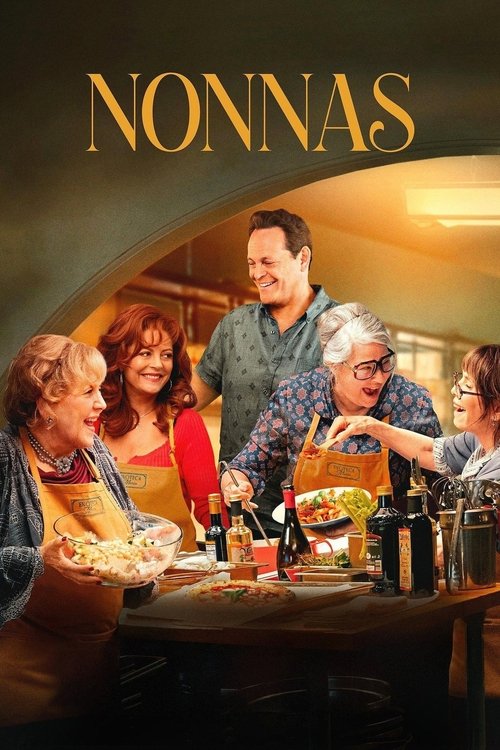
Nonnas (2025)
Directed by Stephen Chbosky
No — Nonnas is not woke, scoring 11 out of 100 on our wokeness meter.
Nonnas arrives from Netflix with the soft landing of a Sunday gravy, a Vince Vaughn vehicle in which a grieving MTA mechanic spends his mother's life insurance on a Staten Island restaurant staffed entirely by grandmothers.
Consciousness Markers
The film features a diverse cast of nonnas from various Italian regions, offering a mild form of cultural representation, though it is not a modern progressive statement.
The plot involves a small business struggling against market forces and local resistance, which is a mild anti-establishment theme.
The nonnas are powerful figures in the kitchen, but their roles are framed within a traditional, domestic setting rather than a modern feminist agenda.
There is no discernible presence of LGBTQ+ themes or characters in the provided synopsis.
The film focuses on Italian heritage and community, not on contemporary racial justice or systemic racial issues.
There is no mention of environmental concerns or a 'Climate Crusade' within the narrative.
The film does not engage with modern discussions of body positivity or diverse body types as a thematic element.
There is no evidence of characters or plot points addressing neurodivergence.
The film is a contemporary biographical comedy and does not challenge established historical narratives.
The film is sentimental and character-driven, lacking any didactic or overtly progressive social commentary.
Why it received this score
Nonnas arrives from Netflix with the soft landing of a Sunday gravy, a Vince Vaughn vehicle in which a grieving MTA mechanic spends his mother's life insurance on a Staten Island restaurant staffed entirely by grandmothers. Stephen Chbosky directs with the gentle hand of a man who knows precisely which heartstrings to pluck and plucks them in order. The result is warm, edible, and almost aggressively inoffensive, which for the purposes of this classification makes it a curiously barren specimen.
The picture's cultural furniture is Italian-American and regional. A Sicilian and a Bolognese bicker over methods before bonding at a salon, and the kitchen becomes a small congress of grandmothers from different provinces. That is representation of a sort, though it is heritage rather than a contemporary statement, and the film treats these women as custodians of memory instead of agents of any modern program. Their authority is genuine and entirely domestic, which is why the feminist reading stalls at the doorway. The plot does gesture at a small business squeezed by local vendors and market forces, a mild anti-establishment murmur that never hardens into an argument. Nobody lectures. Nobody preaches. The film wants only to feed you.
What remains is a sincere, well-reviewed comfort object that hit number one on Netflix over Mother's Day weekend, a scheduling decision so on-the-nose it deserves its own trophy. The closing credits show the real Enoteca Maria, open fifteen years, staffed by grandmothers from everywhere. It is a lovely coda. It is also the entire thesis, delivered without a single raised voice. We score it accordingly, and we go make dinner.
Analysis generated by our Consciousness Algorithm


Synopsis
After losing his beloved mother, a man risks everything to honor her by opening an Italian restaurant with actual nonnas — grandmothers — as the chefs.
Questions about Nonnas
Is Nonnas woke?
No — Nonnas is not woke, scoring 11 out of 100 on our wokeness meter. That earns it a verdict of Ultra Based.
Does Nonnas have any woke elements?
1 of the 10 markers register at 30 or above, led by Representation Casting (30). On Representation Casting: The film features a diverse cast of nonnas from various Italian regions, offering a mild form of cultural representation, though it is not a modern progressive statement.
How does Nonnas compare to other 2025 movies?
It ranks #157 of the 217 films from 2025 we've scored; their average is 26. The wokest is STRAW (92).
How is the Woke Score calculated?
An AI-assisted process researches the film and its reception, scores it 0–100 on ten markers, then combines those into one 0–100 Woke Score. It measures a specific set of 2020s cultural themes, not film quality.