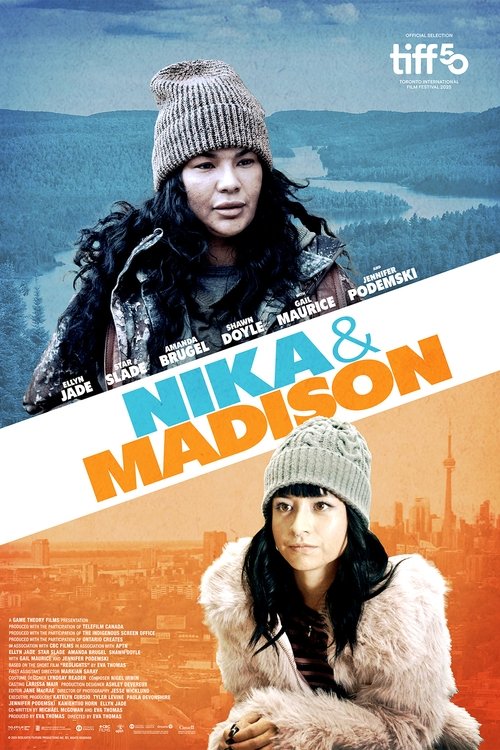
Nika & Madison (2026)
Directed by Eva Thomas
Nika & Madison arrives bearing the full weight of its intentions, which are many and not lightly carried.
Consciousness Markers
The production was built from the ground up with an Ojibwe director, Ojibwe leads, and a majority-Indigenous cast and crew as an explicit creative and political priority. The detective pairing of a Black female officer against a white male cop is a textbook application of intersectional casting logic.
MMIWG, the documented Starlight Tours practice, systemic police racism, and Indigenous cultural displacement are not subtext but the load-bearing walls of the narrative. The film was expanded from a short film literally inspired by this specific history of racialized police violence.
The entire engine of the plot is a woman defending another woman from sexual assault by a male authority figure, and the director has explicitly framed the central bond as an act of resistance. Female solidarity is not a backdrop here; it is the thesis.
The detective pairing, in which a Black female officer is positioned against a white male colleague who reflexively defends a suspect officer, is constructed to be instructive about institutional bias. Critics noted its authenticity, which keeps it from full sermon territory, but the architecture of the subplot is clearly designed to make a point.
The film inverts the standard procedural grammar so that law enforcement functions as the institutional threat rather than the heroic corrective, and it grounds this inversion in the documented reality of Starlight Tours. This is counter-narrative work, though it is built on historical record rather than pure revisionism.
The contrast between reservation life and urban university attendance gestures at economic marginalization along racial lines, but the film does not mount a coherent anti-capitalist argument and the class dynamic is incidental to the central chase narrative.
No LGBTQ+ characters, themes, or content appear in any available material about the film.
No climate or environmental themes are present in the film's narrative or promotional materials.
No body positivity themes or content appear in any available material about the film.
No neurodivergence themes or content appear in any available material about the film.
Why it received this score
Nika & Madison arrives bearing the full weight of its intentions, which are many and not lightly carried. Director Eva Thomas, herself Ojibwe, has expanded her 2023 short Redlights into a feature-length fugitive drama grounded in the documented practice of Starlight Tours, a subject that requires no embellishment and receives none. The film's central premise, two Indigenous women fleeing after Nika injures a police officer who attempts to sexually assault Madison, is both a thriller mechanism and a thesis statement delivered at the same time. Thomas has said she wanted to move away from depicting Indigenous women as victims, and to her credit the film largely delivers on this. The leads survive through trust, not rescue.
The supporting architecture is where the film's instructional ambitions become more visible. The detective pairing of a Black female officer and a white male colleague who reflexively shields a suspect cop is a structural diagram of institutional racism as much as it is a plot device. It is, as one critic noted, offensive in its authenticity, which is precisely the kind of compliment that tells you everything about how the film has been designed. The cultural contrast between Nika's reservation life and Madison's University of Toronto enrollment adds a layer of internal community complexity that keeps the film from collapsing into simple allegory, and this is its most interesting quality.
As an artifact of its moment, Nika & Madison scores with unusual consistency across the markers that define contemporary Canadian progressive filmmaking. The racial consciousness is total, the feminist architecture is structural, and the representation casting is deliberate at every level of production. The climate marker remains untouched, and the anti-capitalist reading requires more interpretive generosity than the film itself invites. It is, in the taxonomy of these things, a very serious entry. We file it accordingly.
Analysis generated by our Consciousness Algorithm
Synopsis
Fearing they won't be believed, two young Indigenous women go on the run after one's defense of the other results in a violent attack against a police officer.