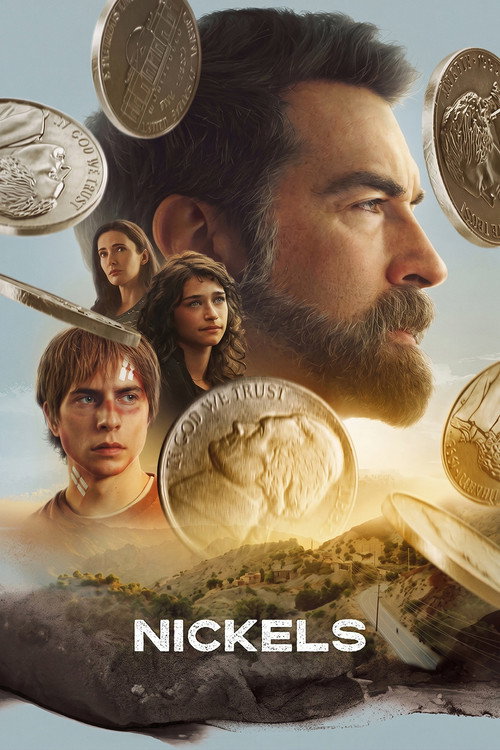
Nickels (2026)
Directed by Spencer King
Nickels arrives as a grief drama built around a premise that critic Mark Dujsik accurately described as "inherently absurd," which the film wears as a badge of sober intention.
Consciousness Markers
The cast is modestly diverse without any apparent agenda in its assembly. Aaron Holliday and Odessa A'zion represent minority presences in the ensemble, but the film's discourse contains no indication that casting choices were made as a statement.
The film's deliberate ambiguity around faith and spirituality carries a faint undercurrent of therapeutic messaging about grief processing. It is restrained enough that critics praised its lack of melodrama, but the premise nudges gently toward the instructional.
No LGBTQ+ themes, characters, or subtext are present or reported anywhere in the film's narrative or promotional materials.
The film centers on male grief and fraternal loss. Female characters exist in supporting domestic roles, and no feminist framing or commentary is evident.
Race is not a subject, subtext, or structural concern of the film. No evidence of racial consciousness as a thematic element has been identified.
Climate, environmentalism, and ecological themes are entirely absent from this intimate grief drama.
The protagonist is described as a successful entrepreneur, a status the film appears to treat as unremarkable rather than as a moral indictment.
No body positivity discourse, fat acceptance themes, or commentary on physical appearance exists in the film or its surrounding cultural conversation.
No neurodivergent characters or themes are present. The protagonist's grief-induced psychological state is treated as ordinary human suffering, not a neurodivergence framework.
The film is a contemporary personal drama with no historical setting, revisionist perspective, or engagement with collective historical narrative.
Why it received this score
Nickels arrives as a grief drama built around a premise that critic Mark Dujsik accurately described as "inherently absurd," which the film wears as a badge of sober intention. A successful family man becomes convinced that his neighbor's injured son is, in some fashion, a vessel for his dead brother's spirit. Director Spencer King has reportedly stated that he wanted audiences to bring their own ideas about faith and coincidence to the material. This is the cinematic equivalent of a restaurant menu that declines to list prices and asks you to pay whatever feels right.
The film's social consciousness quotient is, by the standards of contemporary drama, approximately zero. There is no racial reckoning, no gender manifesto, no character who delivers a quietly devastating speech about systemic anything. The cast is modestly diverse in the way that a mid-budget drama assembled from working actors in 2026 simply is, without apparent calculation. Rob Riggle, known for being loudly funny, is here asked to be quietly sad, and the surrounding cultural conversation has focused almost entirely on this novelty. The progressive content analysis desk finds little to process and files a thin report.
What Nickels offers instead is a film about male grief, fraternal loss, and the psychological machinery of wanting signs from the dead. These are old, human concerns, untouched by the currents of the current moment. In a media landscape where scoring a drama's ideological coordinates is usually a brisk exercise, Nickels presents the unusual challenge of a film that is simply about what it says it is about. We note this without praise or complaint. The instrument reads nearly flat, and we record the reading.
Analysis generated by our Consciousness Algorithm


Synopsis
A successful entrepreneur and family man is involved in a bike accident involving his neighbor's son, triggering memories of his older brother's tragic death 30 years earlier.