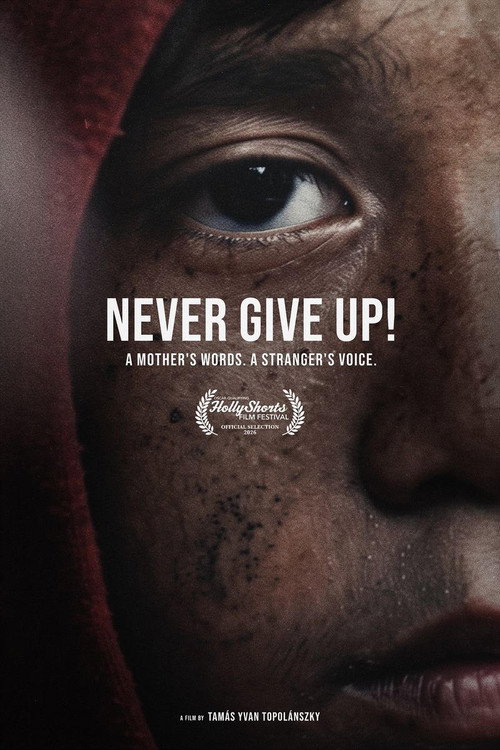
Never Give Up! (2026)
Directed by Tamás Yvan Topolánszky
A nine-year-old boy walks alone through a desert with a broken phone.
Consciousness Markers
The film centers on a young Latino boy with Spanish-language dialogue and a story explicitly rooted in the U.S.-Mexico border immigrant experience. The casting and narrative are built around Latino identity as the primary lens.
The border crossing setting and Latino identity are central to the narrative, and the film is indexed on diversity-focused platforms for its representation of marginalized groups. However, the director frames the project as conceptual and humanistic, and there is no explicit racial consciousness rhetoric in the available material.
The U.S.-Mexico border crossing subject carries inherent political charge in the current climate, and festival programmers grouped it among politically conscious work. The director's stated conceptual framing and a twist ending that reportedly subverts border-narrative tropes keep the sermonizing impulse in check.
A mother's guiding wisdom is the emotional engine of the story, but this reads as a universal maternal archetype rather than a consciously feminist framing.
No LGBTQ+ themes, characters, or subtext are present in the film.
No climate themes are present. The desert setting is a survival backdrop, not an environmental statement.
No anti-capitalist themes or critique of economic systems are present.
No body positivity themes are present.
No neurodivergence themes are present.
No revisionist history elements are present. The film is a fictional contemporary narrative.
Why it received this score
A nine-year-old boy walks alone through a desert with a broken phone. This is the entirety of the setup, and in twenty minutes, director Tamás Yvan Topolánszky asks us to consider what a message means when the person who sent it may no longer be there to confirm its intent. The U.S.-Mexico border crossing is the film's geography, and the immigrant experience is its vocabulary. Neither of these choices is accidental. The film spent seven years in development, which is a long time to think about a concept, and the thinking shows.
The border narrative is, at this point, a genre unto itself, carrying with it a full wardrobe of expected postures and predetermined emotional destinations. Never Give Up! earns modest credit for apparently declining to wear all of them. Festival audiences have noted a twist that recontextualizes the survival story, which suggests the film is at least nominally interested in complicating its own premise. The director's stated question, about who owns a message, is a more interesting question than most films in this territory bother to ask. It is also the kind of question that can be asked without providing an answer, which this short film, running to twenty minutes, wisely declines to fully answer.
The representation markers are present and legible: a Latino lead, Spanish dialogue, a story about the most politically loaded stretch of geography in the contemporary American imagination. The film is listed on diversity-focused platforms accordingly. None of this is cynical, and none of it rises to the level of a lecture. The social consciousness here is embedded in the subject matter itself, not applied on top of it like a coat of paint. This is the distinction that separates a film about something from a film determined to make sure you know it is about something. Never Give Up! appears to belong to the former category. We note this with something approaching relief.
Analysis generated by our Consciousness Algorithm
Synopsis
After a deadly border crossing separates him from his mother, a young boy is left alone in the desert. He clings to a damaged phone and carries with him the words she taught him to live by: never give up.