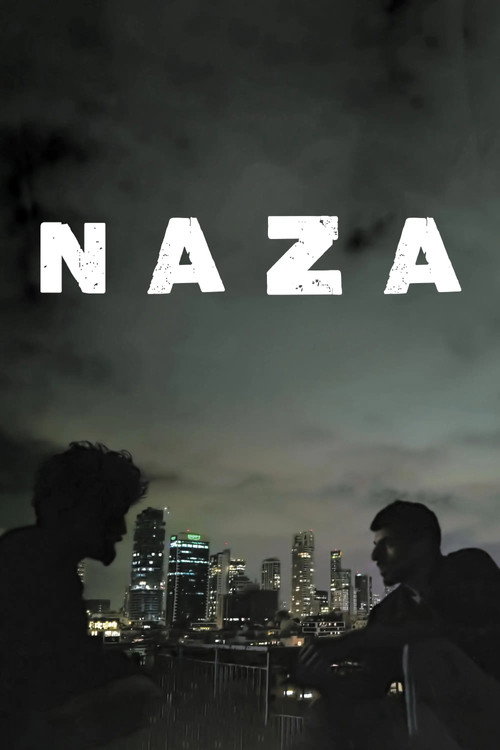
NAZA (2026)
Directed by Yuval Abraham
NAZA is a documentary that arrives with a Venice Special Jury Prize, a standing ovation, and a credible threat from the Israeli Prime Minister to revoke its directors' citizenship.
Consciousness Markers
Director Yuval Abraham publicly stated his goal as sparking debate about the normalization of a war of annihilation, and the film's rooftop-confession structure is designed to indict a system. The moral architecture is deliberate and pointed, though it earns more of its gravity than it simply asserts.
The film foregrounds Palestinian civilian death in a way that carries implicit racial and ethnic consciousness, though the framing is more geopolitical and institutional than explicitly racially coded in the 2020s activist sense.
There is a faint anti-militarist-industrial undercurrent in the critique of AI targeting systems as bureaucratic, automated machinery of death, but the film does not frame this as a critique of capitalism per se.
The documentary challenges official Israeli military narratives about targeting protocols, which carries a modest revisionist charge, though it is more investigative journalism than historical revisionism.
The film features anonymized Israeli military whistleblowers. Representation in the casting sense is not a concern or a framework the documentary operates within.
There are no LGBTQ+ themes, characters, or framing present. The film has no interest in this territory.
The documentary does not engage with feminist frameworks or gender analysis. Co-director Rachel Szor's presence behind the camera does not constitute feminist agenda.
Climate themes are entirely absent. The film is occupied with entirely different kinds of destruction.
Body positivity is not a concern anywhere in the film's runtime or framing.
No neurodivergence themes are present. The film does not engage with this category.
Why it received this score
NAZA is a documentary that arrives with a Venice Special Jury Prize, a standing ovation, and a credible threat from the Israeli Prime Minister to revoke its directors' citizenship. On the woke-o-meter, this is something of a calibration problem. The film is serious, morally grave, and politically incendiary, but it achieves this through the old-fashioned mechanisms of journalism: anonymous sources, night-sky cinematography, and the quiet horror of bureaucratic testimony. It is not, in the 2020s cultural sense, a vehicle for progressive social identity politics. It is something older and, depending on your disposition, more or less alarming.
The film's primary instrument is lecture energy, though the word "lecture" feels slightly unkind given the material. Director Yuval Abraham has stated plainly that he wants to spark public debate about the normalization of civilian death as a military variable, and the film's structure, 24 anonymized voices describing an AI system called Lavender as if narrating a spreadsheet, is designed to make the audience feel the weight of that normalization. There is a faint anti-militarist-industrial undercurrent in the critique of automated targeting as a cost-benefit algorithm, and the focus on Palestinian civilian casualties carries implicit racial and ethnic consciousness. But the film does not reach for the vocabulary of intersectionality or systemic racism in the 2020s activist register. It reaches, instead, for the vocabulary of war crimes.
What keeps NAZA from scoring heavily on our scale is precisely what makes it a more substantial object than most films that do. It is not interested in your feelings about identity. It is interested in whether a machine can be morally responsible for a death, and whether the human who configured the machine can sleep at night. The answer to the second question, based on the testimony presented here, appears to be: sometimes, uneasily, on a rooftop in Tel Aviv. The film is, by the metrics we apply here, relatively restrained in its progressive-cultural signaling. By most other metrics, it is not restrained at all.
Analysis generated by our Consciousness Algorithm
Synopsis
In secret conversations on the rooftops of Tel Aviv at night, the systems behind Israel's calculated mass killing of Palestinian civilians in Gaza are revealed by the people who designed and operated them.