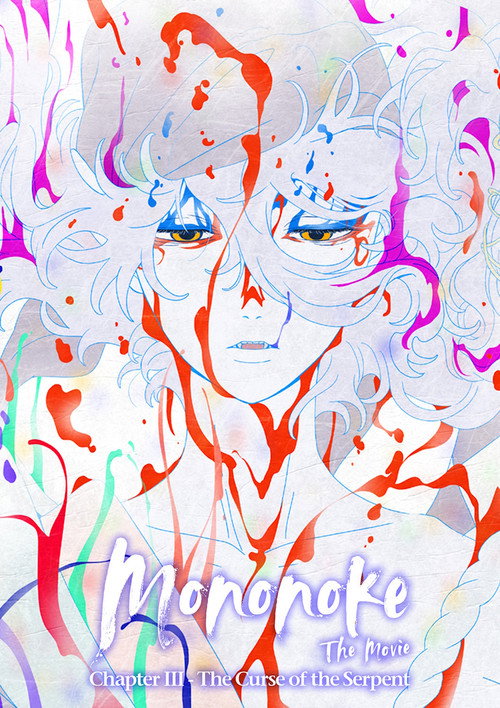
Mononoke the Movie: Chapter III - The Curse of the Serpent (2026)
Directed by Kenji Nakamura
Mononoke the Movie: Chapter III – The Curse of the Serpent arrives as the concluding chapter of a trilogy that has, with admirable consistency, ensured we understand that the Ōoku was bad for women.
Consciousness Markers
The film's feminist credentials are unusually well-documented, including a producer statement explicitly citing the depiction of female suffering as grounds for recasting the lead actor. Critics described the trilogy as a sustained examination of institutional misogyny, forced confinement, and reproductive coercion under feudal patriarchy, with the supernatural monsters themselves being born from that oppression.
The production committee's own public statements confirm that the film is meant to 'depict the suffering and remedy of women' as an explicit thematic mission. Critics noted the trilogy's sustained emphasis on the plight of women in feudal society, suggesting the films wear their moral agenda with some visibility, though the supernatural horror framing softens the sermonizing.
The trilogy uses the historical Ōoku as a lens to foreground female suffering and systemic oppression, framing the historical record through a modern feminist consciousness. This is a soft revisionism: not rewriting events, but insisting the audience read them through a contemporary moral framework.
The cast is entirely Japanese voice actors performing a story set in feudal Japan, which is simply appropriate. The production's documented decision to recast the lead specifically on grounds of thematic alignment with the film's feminist subject matter is, however, a genuinely novel form of representation-conscious casting policy.
The film's critique of rigid social hierarchy and the Ōoku's institutional power structures carries a faint anti-establishment undercurrent, though this reads as feudal-historical critique rather than modern anti-capitalist messaging.
The Ōoku setting carries historical associations with complex gender and sexuality dynamics, but the film does not appear to foreground LGBTQ+ themes in any explicit, modern-coded way. Score reflects the ambient historical context rather than any concrete narrative element.
No evidence of racial consciousness themes in the modern progressive sense. The film is a Japanese production set in historical Japan, and race does not function as a thematic concern.
No climate or environmental themes are present or suggested in the research or metadata.
No evidence of body positivity themes in the film's content or critical reception.
No neurodivergence themes are present or suggested anywhere in the available research.
Why it received this score
Mononoke the Movie: Chapter III – The Curse of the Serpent arrives as the concluding chapter of a trilogy that has, with admirable consistency, ensured we understand that the Ōoku was bad for women. The Medicine Seller once again descends into a world of repressed trauma and supernatural manifestation, where the monsters are born from institutional misogyny and the cure requires confronting what the patriarchy hath wrought. Director Kenji Nakamura renders all of this in the franchise's distinctive woodblock-fever-dream aesthetic, which is genuinely beautiful, and which the film uses to explore the suffering of Lady Yukiko and the Midaidokoro with the visual intensity of someone who has thought very hard about how to make feudal oppression look like a gallery installation.
The film's most instructive quality may be paratextual. When the production committee publicly stated in 2023 that a voice actor was removed because the film's social themes demanded it, they performed a rare act: they filed the thematic paperwork in advance. This is lecture energy made administrative. The supernatural horror, in which grudges and grief literally coalesce into demons, is a structurally elegant metaphor for generational trauma, and it works. It also means the film cannot introduce a grieving, confined woman without the audience understanding that her suffering is systemic. The monsters are the patriarchy. The patriarchy is the monsters. We have all agreed to be here.
The subsequent controversy, in which the quietly reinstated original voice actor was discovered at the climax and the lead producer resigned in apology, is perhaps the most purely concentrated cultural artifact the franchise could have produced. A film about the importance of institutional accountability generated a small institutional accountability crisis. The producer cited the breach of fan trust and departed. Somewhere, a mononoke was born from the irony, and it is probably gorgeous.
Analysis generated by our Consciousness Algorithm


Synopsis
When tragedy strikes within the walls of the Ōoku, twisted human passions and festering grudges spawn the Medicine Seller's most fearsome opponent yet.
Critic Reviews
“Look past the fast pacing and intense action to see that Mononoke the Movie: Chapter III – The Curse of the Serpent is ultimately a satisfying finale to the Mononoke film trilogy, complete with both style and substance.”
“Mononoke The Movie: Chapter III – The Curse Of The Serpent ends up overplaying its hand. Despite sometimes overreaching, it still delivers an emotional tale that firmly touches the heart.”