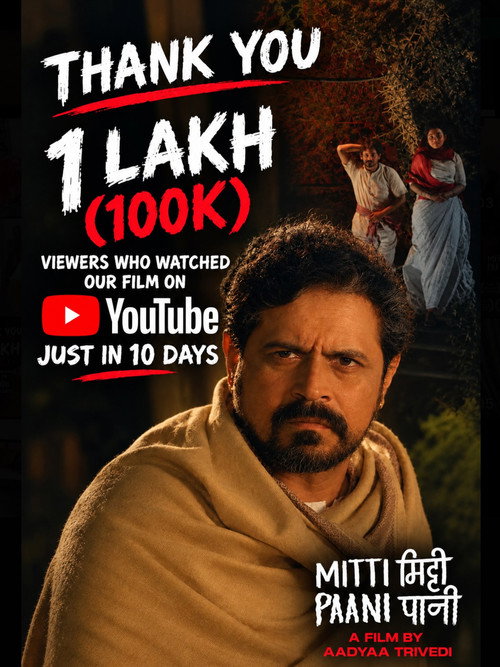
Mitti Paani (2026)
Directed by Aadyaa Trivedi
Mitti Paani, a short film of approximately 29 minutes adapted from Dolat Bhatt's Gujarati short story Chabutaro, arrives with the quiet confidence of a film that has nothing to prove to the broader cultural conversation.
Consciousness Markers
The film is directed by a 20-year-old woman making her debut, and the central emotional axis concerns a daughter's place within her father's world. The promotional framing leans on female authorship, though the narrative itself does not appear to advance an overt feminist argument.
The film draws its cast from regional Gujarati talent, including Kalpana Gagdekar, whose background with Budhan Theatre connects her to advocacy for Denotified and Nomadic Tribes. This is incidental to the film's content rather than a programmatic casting statement.
The promotional tagline gestures toward a pointed emotional thesis about daughters and fathers, but critical discourse suggests the film earns its sentiment through story rather than speechifying. The lecture energy is low.
No LGBTQ+ themes, characters, or subtext are present in the film. The narrative centers on a rural father-daughter relationship with no evidence of such elements.
No racial consciousness framing is present. The film operates within a culturally specific Gujarati context without engaging in the modern discourse of racial identity politics.
There is no evidence of climate or environmental messaging in the film. The rural setting of Banaskantha is backdrop, not sermon.
No anti-capitalist themes are identified. The story concerns family and emotional bonds in a rural setting, with no critique of economic systems.
No body positivity themes are present or implied in any available material about the film.
No neurodivergence themes or characters are identified in any source material.
The film adapts an existing work of Gujarati literature faithfully, with no indication of revisionist historical reframing.
Why it received this score
Mitti Paani, a short film of approximately 29 minutes adapted from Dolat Bhatt's Gujarati short story Chabutaro, arrives with the quiet confidence of a film that has nothing to prove to the broader cultural conversation. Set in rural Banaskantha and centered on the emotional architecture between a father and a daughter, it concerns itself with soil, water, and the weight of familial love. It does not, to its considerable credit, concern itself with much else.
The film was directed by Aadyaa Trivedi at the age of 20, a biographical detail that promotional materials have understandably highlighted, and which the film's win at the Saptarang Film Festival appears to have validated. The presence of Kalpana Gagdekar, an actress whose off-screen work with Budhan Theatre has long engaged with the lives of Denotified and Nomadic Tribes, adds a faint layer of social texture to the casting. This is, however, an artifact of a career brought to bear on a role, not a manifesto smuggled into a family drama. The film's social consciousness, to the extent it exists, is the organic kind: the kind that comes from telling a specific story about specific people in a specific place, which is the oldest and most defensible form.
For a film released in 2026, Mitti Paani is a genuinely unusual object. It is adapted from literature. It is regional. It is short. It is about a father and a daughter. The discourse around it has not once, by any available account, devolved into a debate about representation metrics or ideological alignment. In the current landscape, this qualifies as a minor act of resistance, even if an entirely accidental one.
Analysis generated by our Consciousness Algorithm
Synopsis
a film based on a very popular short story Chabutaro of Gujarati literature by Dolat Bhatt.