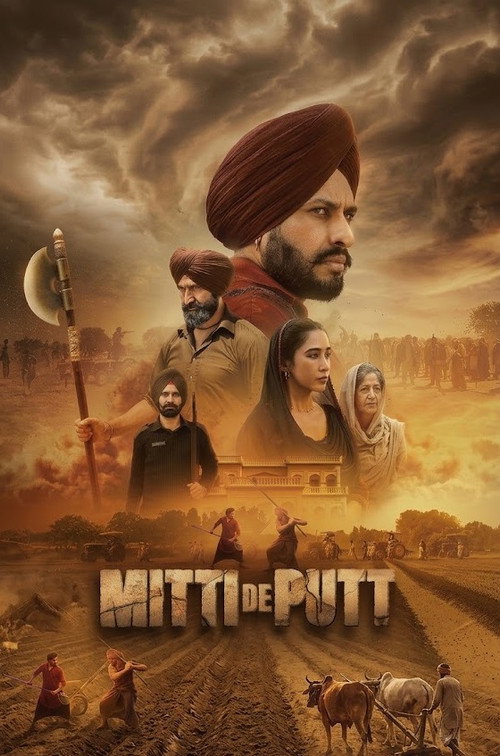
Mitti De Putt (2026)
Directed by R Malkana
Mitti De Putt arrives as a Punjabi action-drama so committed to its own traditional gravity that it seems almost aggressively unaware that a culture war is happening somewhere nearby.
Consciousness Markers
The cast is drawn entirely from the Punjabi regional industry and reflects the culture the film depicts, which is contextually appropriate rather than a progressive casting statement. No detectable effort to diversify beyond the story's natural demographic.
No LGBTQ+ characters, themes, or subtext were identified. The film's emotional architecture is built entirely on heteronormative family bonds and patrilineal honor.
The mother figure is the moral center of the story, but she exists as a passive prize to be rescued rather than an agent of her own liberation. The film does not interrogate this dynamic; it celebrates it.
The film operates entirely within a single cultural community and does not engage with inter-racial dynamics, systemic racism, or any framework of racial awareness as understood in the 2020s sense.
The land is a spiritual and emotional symbol, not an ecological one. No climate anxiety, environmental messaging, or green consciousness was identified at any point.
The conflict is rooted in family honor and blood feuds, not class struggle or wealth inequality. Capitalism is neither the villain nor the subject.
No body positivity discourse, size representation, or commentary on physical appearance norms was identified. The film is entirely unconcerned with such matters.
No neurodivergent characters or related themes were identified. The film's psychological landscape is occupied exclusively by vengeance and grief.
The film draws on traditional Punjabi rural mythology and does not attempt to reframe, reclaim, or complicate any historical narrative from a modern progressive perspective.
The film delivers no sermons. Its moral universe is pre-modern and operates on the logic of blood and soil, which leaves no room for contemporary social instruction.
Why it received this score
Mitti De Putt arrives as a Punjabi action-drama so committed to its own traditional gravity that it seems almost aggressively unaware that a culture war is happening somewhere nearby. Director R. Malkana has constructed a film around land, lineage, and the kind of revenge that skips the therapy appointment entirely. The soil of the title is not a metaphor for ecological grief. It is, refreshingly, just soil. A young man's grandparents are murdered, his mother is taken, and the film does not pause to interrogate the toxic masculinity implicit in his response. It simply watches him ride toward violence with the quiet approval of a village elder who has seen this before and considers it correct.
The emotional architecture here rests on the mother-son bond, which the film treats as the most sacred unit in the universe, above law, above the state, and above any notion of systemic reform. Sharan Kaur's mother figure exists as the moral axis around which all male action orbits, a role the film assigns without apology or self-awareness. Yograj Singh, a man who has spent decades embodying a particular strain of Punjabi patriarchal authority, appears in what amounts to a casting decision that is the opposite of a statement. It is an anti-statement. It is silence, wearing a kurta.
We can confirm, after considerable deliberation, that Mitti De Putt scores in the lowest tier of our index. It is not that the film is unaware of progressive cultural frameworks. It is that the film exists in a register where those frameworks have not yet been invented. The revenge drama is one of cinema's oldest and most durable forms precisely because it predates the discourse. Mitti De Putt offers nothing to alarm the cultural thermometer, and it does so with complete conviction.
Analysis generated by our Consciousness Algorithm

Synopsis
Two villages are bound by a rivalry that has outlived the men who started it. For one young man, the feud stops being history the day his uncle murders his grandparents and carries his mother away. Left with nothing but the land beneath his feet and the promise he makes on it, he sets out to answer blood with blood. To bring his mother home, he must first confront the man who took her, and the price the soil demands is heavier than he knows.