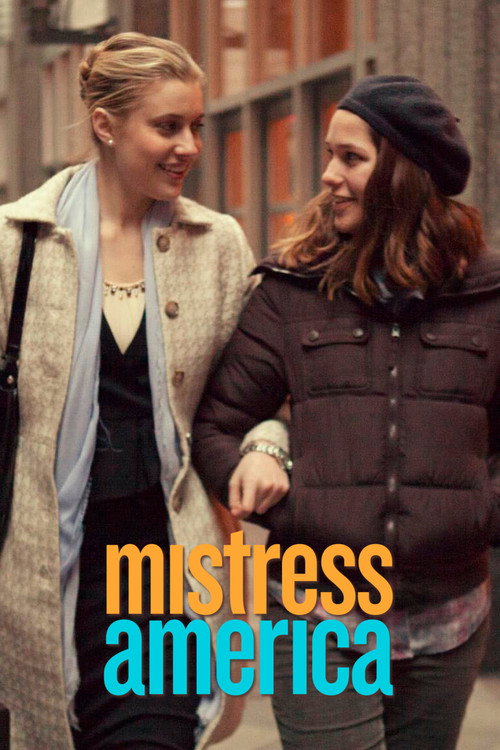
Mistress America (2015)
Directed by Noah Baumbach
No — Mistress America is not woke, scoring 8 out of 100 on our wokeness meter.
The films of Noah Baumbach tend to arrive with a certain downtown literary sheen, and Mistress America is no exception.
Consciousness Markers
The film is built around two women, female friendship, and a young female writer's ambition, but it treats these as comic material rather than advancing any explicit feminist thesis.
The cast includes a Black supporting player (Jasmine Cephas Jones) and an Asian actress (Cindy Cheung), but their presence is incidental to a story centered on white protagonists and carries no representational commentary.
Money, restaurant financing, and a stolen T-shirt business idea drive the plot's betrayals, but the film treats commerce as farce rather than critiquing capitalism.
Baumbach's script is witty and observational but never preachy; it aims to amuse rather than instruct.
No LGBTQ+ characters, themes, or subtext appear anywhere in the film.
Race is never a subject of the film; the story is a white, upper-middle-class New York milieu with no engagement with racial dynamics.
There is no environmental or climate content whatsoever.
No body-image or body-positivity themes are present.
No neurodivergent characters or themes are depicted or discussed.
The film is a contemporary original story with no historical subject matter to revise.
Why it received this score
The films of Noah Baumbach tend to arrive with a certain downtown literary sheen, and Mistress America is no exception. Greta Gerwig co-wrote and stars as Brooke, a thirty-year-old whirlwind of half-finished ventures, while Lola Kirke plays Tracy, the Barnard freshman who mistakes her for a life. The two women dominate every scene. Their friendship, their arguments, and Tracy's hunger to become a writer supply the engine. A viewer scanning for a thesis about women's ambition will find the raw material sitting right there, unprocessed. Baumbach and Gerwig are after laughs, not argument, and the laughs are plentiful.
The supporting cast includes Jasmine Cephas Jones and Cindy Cheung, both of whom do their jobs and settle into the furniture of a story that belongs to white Manhattan. Nobody remarks on this. Nobody remarks on anything of the sort, because the film has no interest in remarking. Race never surfaces as a subject. Neither does sexuality, nor the body, nor the climate, nor the wiring of the mind. What the characters do care about is money: a restaurant called Mom's, a T-shirt business idea lifted by a friend, a check that arrives with strings attached. The screenplay treats all of it as farce. Commerce here is a source of humiliation and comedy, never a system to be indicted.
The extended set piece in a Connecticut mansion, where Brooke crashes a book club to beg for financing, is the closest the film comes to a sermon, and it is a sermon about nothing except the difficulty of being Brooke. The script observes. It needles. It never instructs. That restraint is the whole achievement. On the ledger of contemporary social instruction, the film registers as a faint mark, a comedy that trusts its audience to draw its own conclusions and mostly declines to supply any.
Analysis generated by our Consciousness Algorithm


Synopsis
A college freshman cures her disappointment and loneliness by allowing herself to be pulled into the wacky schemes of her future stepsister.
Questions about Mistress America
Is Mistress America woke?
No — Mistress America is not woke, scoring 8 out of 100 on our wokeness meter. That earns it a verdict of Ultra Based.
Does Mistress America have any woke elements?
Very few. None of the 10 markers reaches 30, the level where a marker counts as present; the highest is Feminist Agenda at 20.
How does Mistress America compare to other 2015 movies?
It ranks #158 of the 289 films from 2015 we've scored; their average is 15. The wokest is Chi-Raq (78).
How is the Woke Score calculated?
An AI-assisted process researches the film and its reception, scores it 0–100 on ten markers, then combines those into one 0–100 Woke Score. It measures a specific set of 2020s cultural themes, not film quality.