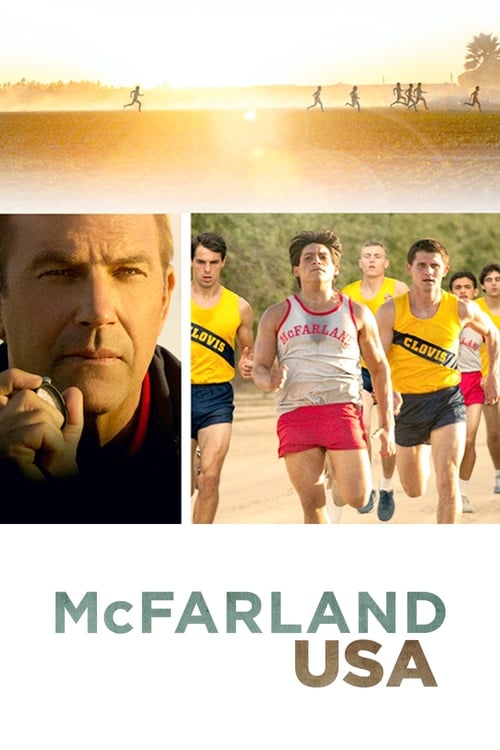
McFarland, USA (2015)
Directed by Niki Caro
No — McFarland, USA is not woke, scoring 17 out of 100 on our wokeness meter.
McFarland, USA is a Disney sports drama from 2015, directed by Niki Caro and built on the true story of a cross-country team in a Latino farming town.
Consciousness Markers
Features a predominantly Latino cast in leading roles, reflecting the true story's demographics, but the narrative centers on a white coach, and the diversity is organic rather than a deliberate woke casting choice.
Depicts a Latino community's economic struggles and cultural traditions, but avoids systemic critique, framing success through individual effort and a white savior.
One character, Danny Diaz, is depicted as overweight yet becomes a contributing runner, but this is a minor subplot without explicit body-positive messaging.
Inspirational and sentimental but not preachy about social issues; the film avoids overt lecturing.
Directed by a woman, but the story focuses on a male coach and a boys' cross-country team; female characters are largely supportive.
No LGBTQ+ characters or themes are present.
No environmental or climate-related themes.
No anti-capitalist or class-warfare messaging; the film celebrates hard work and community support within existing systems.
No neurodivergent characters or themes.
While the film takes significant liberties with the true story (e.g., inventing a rivalry, omitting the girls' team), these changes serve conventional Hollywood dramatization rather than a progressive ideological agenda.
Why it received this score
McFarland, USA is a Disney sports drama from 2015, directed by Niki Caro and built on the true story of a cross-country team in a Latino farming town. It is a competent and likable film, and its cultural thermostat reads modest. The Latino community is cast with faces and textures that feel lived-in, but the camera belongs to Kevin Costner's coach. Representation here is demographic circumstance, not a thesis. The white savior architecture is old-fashioned and entirely unexamined. The film wants us to feel good about individual effort, not to rethink the systems that surround it.
The progressive signals are sparse and mild. There is no LGBTQ thread, no climate sermon, no anti-capitalist anger. The film celebrates field work, family sacrifice, and community fundraisers within the existing order. A minor runner is overweight and becomes a contributing team member, but the film does not construct a body-positive argument around him. Female characters are supportive wife and daughters; a woman directed the picture, yet the text remains male-centered. Racial consciousness appears in tamale sales, quinceañera planning, and economic strain, but the story stops short of systemic critique. Success is grit plus a coach's stopwatch.
The historical liberties are standard Hollywood carpentry, not ideological revision. An invented rivalry, an omitted girls' team, a composite brother: these are screenwriting conveniences. The film's lecture energy is low. It is sentimental, formulaic, and earnestly likable. We are left with a well-intentioned artifact from 2015, a Disney fable about running and community that never threatens its audience. Its social awareness is real but mild, like a warm tortilla: pleasant, filling, and gone quickly.
Analysis generated by our Consciousness Algorithm
Part of


Synopsis
A track coach in a small California town transforms a team of athletes into championship contenders.
Questions about McFarland, USA
Is McFarland, USA woke?
No — McFarland, USA is not woke, scoring 17 out of 100 on our wokeness meter. That earns it a verdict of Ultra Based.
Does McFarland, USA have any woke elements?
2 of the 10 markers register at 30 or above, led by Racial Consciousness (35) and Representation Casting (35). On Racial Consciousness: Depicts a Latino community's economic struggles and cultural traditions, but avoids systemic critique, framing success through individual effort and a white savior.
How does McFarland, USA compare to other 2015 movies?
It ranks #90 of the 289 films from 2015 we've scored; their average is 15. The wokest is Chi-Raq (78).
How is the Woke Score calculated?
An AI-assisted process researches the film and its reception, scores it 0–100 on ten markers, then combines those into one 0–100 Woke Score. It measures a specific set of 2020s cultural themes, not film quality.