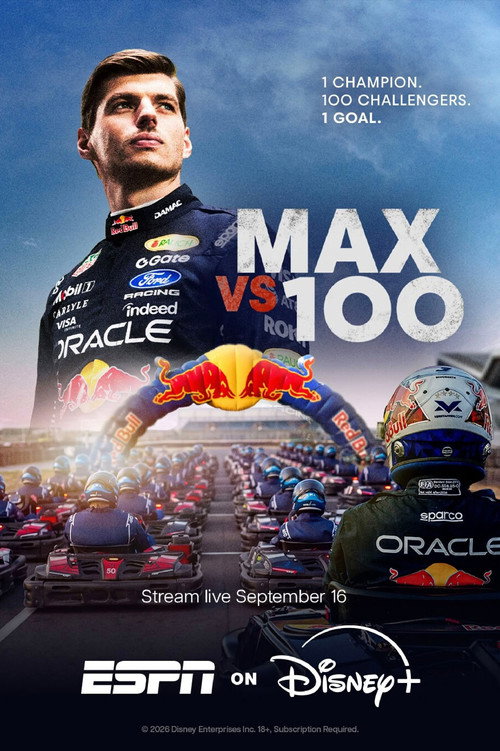
Max vs 100 (2026)
A four-time Formula 1 World Champion is placed at the back of a go-kart grid behind one hundred assorted humans and told to drive forward.
Consciousness Markers
The 100-driver field is eclectic and cross-demographic, but this is framed as entertainment spectacle rather than social statement. No casting choices appear designed to signal progressive values.
No LGBTQ+ themes, characters, or messaging are present anywhere in the production.
Female participants compete alongside male ones without comment or framing as a feminist statement. There is no feminist agenda detectable.
Race and racial identity are entirely absent as topics. The diverse participant pool is never framed through a racial consciousness lens.
No climate themes are present. The irony of a petrol-sport promotional event ignoring its own carbon footprint goes entirely unacknowledged, which is itself a form of innocence.
This is a Red Bull production broadcast on Disney+ and ESPN. Capitalism is not being critiqued here. It is being celebrated at moderate volume.
No body positivity messaging is present. Participants are athletes and competitors, evaluated on go-kart performance rather than body acceptance.
Neurodivergence is not raised, referenced, or implied at any point in the production.
There is no history to revise. The film is a live sporting event set in the present tense.
Nobody lectures anybody about anything. The closest thing to a moral lesson is that starting last is a disadvantage, which has been known since antiquity.
Why it received this score
A four-time Formula 1 World Champion is placed at the back of a go-kart grid behind one hundred assorted humans and told to drive forward. This is the premise. It is also, in its entirety, the ideology. Somewhere in a cultural studies department, a dissertation is not being written about this film, and that silence is the most eloquent thing about it.
The participant roster is diverse in the way that a party invitation list is diverse: you invited people from different places and they showed up. No one pauses to acknowledge this. No one delivers a speech. The host, Mo Gilligan, appears to be having a genuinely good time, which is not a crime but is, in this analytical context, somewhat disorienting. The production, a joint venture between Red Bull and the sports entertainment apparatus, is less interested in dismantling systemic structures than in the question of whether a Dutch racing driver can pass ninety-seven amateur go-kart operators before the chequered flag. It cannot be stressed enough that this is a reasonable thing to be interested in.
Scored against our ten markers of contemporary progressive sensibility, Max vs 100 registers as a flatline. The climate goes unmentioned. Capitalism is not eaten. Bodies are not celebrated for their diversity so much as deployed competitively against one another, which is arguably the opposite impulse. The film exists in a pre-theoretical space, cheerfully unconcerned with the cultural conversations swirling around it, like a go-kart driver who has put on his helmet and can no longer hear anything. There is something almost restful about it.
Analysis generated by our Consciousness Algorithm

Synopsis
Follows Four-time Formula 1 World Champion Max Verstappen who will take on 100 drivers in a unique go-karting event competition.