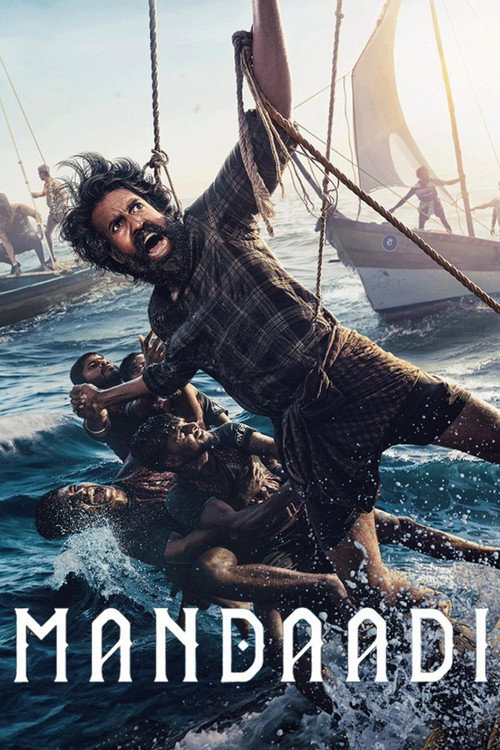
Mandaadi (2026)
Directed by Mathimaran Pugazhendhi
Mandaadi arrives as a document of catamaran racing and coastal community pride, two subjects that Tamil cinema has largely left to the sea.
Consciousness Markers
The film is rooted in authentic regional Tamil coastal identity, and the post-release controversy around the director's defence of Suhas against colorism-based mockery suggests a conscious philosophy around skin tone in casting. This is more cultural authenticity than progressive casting doctrine, but the intent is documented.
The villain's exploitation of the fishing community through non-native labor and commercial control of traditional waters constitutes a discernible anti-exploitation narrative. It reads as community-versus-commerce rather than structured anti-capitalist ideology.
The film's central conflict pits a native coastal community against an outsider using non-native labor to control their waters, carrying an ethnic-autonomy dimension. The colorism controversy emerged from post-release remarks rather than the film's text, limiting the in-film score.
Critics noted the cultural preservation theme is organically embedded in the story rather than imposed upon it. The post-release controversy generated more sermonizing than the film itself appears to contain.
No LGBTQ+ themes, characters, or subtext are present in the film or noted in any available research.
The research explicitly notes that female characters are sidelined by traditional male-ego tropes, and public commentary flagged this as a shortcoming. The film operates squarely within the conventions of mainstream Tamil male-ensemble sports drama.
No climate themes, environmental messaging, or ecological consciousness is present in the film or documented in the research.
No body positivity themes are present. The colorism discourse occurred externally to the film's narrative and does not translate into in-text body positivity messaging.
No neurodivergent characters, themes, or related discourse are present in the film or the available research.
The film is a contemporary sports drama with no historical revisionism. Its engagement with tradition is celebratory and preservationist, not corrective.
Why it received this score
Mandaadi arrives as a document of catamaran racing and coastal community pride, two subjects that Tamil cinema has largely left to the sea. Director Mathimaran Pugazhendhi, working under the creative supervision of Vetrimaaran, plants his flag firmly in the waters off Ramanathapuram and proceeds to tell a story about native fishermen, outsider exploitation, and the ancient dignity of a boat race. The film's social architecture is straightforward: the community has something worth preserving, a villain is trying to commodify it, and Soori's Muthukaali will settle the matter on the water. This is a genre template as old as sport itself, and the film wears it without apology.
The more culturally animated dimension of Mandaadi turned out to exist largely outside the film itself. The post-release success meet produced a minor inter-regional incident when the director publicly defended co-lead Suhas against colorism-based mockery he had received, a statement that was then interpreted as a broadside against the Telugu film industry, then clarified, then argued about on social media for several news cycles. It is a curious situation in which the most pointed social commentary generated by a film occurs at a press event, not on screen. The film's own treatment of race and skin tone is, by all accounts, incidental to a narrative that is far more interested in the mechanics of a six-person racing crew and the male bonds forged within one. Female characters, per the available record, are present in the traditional sense of the word.
As a specimen for this particular taxonomy, Mandaadi presents a mild profile. The anti-exploitation thread running through its plot has ideological potential that the film appears to leave largely untheorized, content to let the race itself serve as verdict. There is no environmental consciousness, no gender reckoning, no identity-political scaffolding imported from another cultural context. The colorism conversation it accidentally sparked is, if anything, evidence that the film's cultural surroundings were more charged than the film chose to be. We score what is on screen. The catamaran wins or loses on its own terms.
Analysis generated by our Consciousness Algorithm
Synopsis
A fishing captain applies his maritime knowledge in a traditional boat race along Tamil Nadu's coast during a festival, leading a six-person team against other crews.