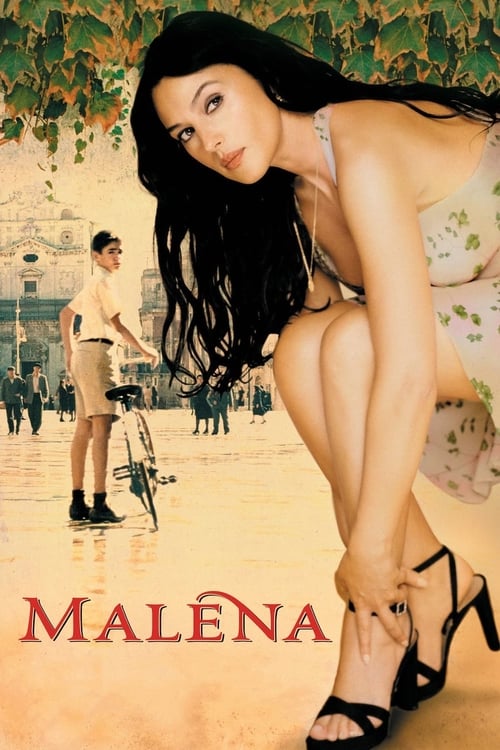
Malena (2000)
Directed by Giuseppe Tornatore
No — Malena is not woke, scoring 0 out of 100 on our wokeness meter.
Giuseppe Tornatore's Malena arrives like a bottle from a cellar nobody has opened since 2000: dust on the shoulder, a promising nose, and a finish that leaves the modern palate slightly confused.
Consciousness Markers
The cast is entirely Italian and white, with no diverse or minority casting choices made for representation purposes.
There are no LGBTQ+ characters or themes anywhere in the film.
The film is told entirely through the adolescent male gaze and was widely criticized for objectifying its title character rather than empowering her; it is the opposite of a feminist agenda.
No racial themes or racial consciousness are present; the story concerns a homogeneous Sicilian town.
There is no environmental or climate-related content in the film.
No economic critique or anti-capitalist messaging is present.
The film centers on conventional beauty and desirability rather than body positivity; no such themes appear.
No neurodivergent characters or themes are depicted.
The film is a straightforward period drama set during WWII with no revisionist historical framing.
The film is a nostalgic, sensual coming-of-age drama that observes rather than preaches; it contains no didactic or lecture-style messaging.
Why it received this score
Giuseppe Tornatore's Malena arrives like a bottle from a cellar nobody has opened since 2000: dust on the shoulder, a promising nose, and a finish that leaves the modern palate slightly confused. The film concerns a Sicilian town at the start of the Second World War, a boy on a bicycle, and Monica Bellucci crossing a piazza while the entire male population rearranges its afternoon. The camera adopts the boy's vantage point with no apology and no framing device to put distance between us and it. We are invited to look, and looking is the whole architecture of the picture.
The film observes. It does not sermonize. Its subject is beauty and the tax levied upon it. Gossip is a local industry here, and the town can agree to destroy a woman and then offer her free fruit once she is safely married and no longer a threat. That is serious material, handled with a certain velvet gloom, but the film never stops to instruct us in how to feel about it. No thesis is pinned to the wall. No character is drafted in to explain the moral. The women who beat Malena are simply shown doing it, and the camera, like the boy, does nothing.
On the matter of contemporary social consciousness, the cellar is bare. The cast is uniformly Italian and uniformly white, by circumstance and by design. There is no economic critique, no environmental concern, no interest in neurodivergence, and the film's attitude toward its title character has been described by better-stocked critics as the precise opposite of empowerment. The Academy nominated it for cinematography and score, which are not categories that reward a lecture. A clean plate, then, and a faintly melancholy one: a well-photographed vintage from a season that has gone badly out of fashion.
Analysis generated by our Consciousness Algorithm


Synopsis
12-year-old Renato experiences three significant events on the same day: the beginning of the Second World War, getting a bike, and witnessing the arrival of the gorgeous Malèna. Through his eyes, we see the curse of beauty and loneliness of Malena, whose husband is presumed dead, and, through his soul, we see his love for her.
Questions about Malena
Is Malena woke?
No — Malena is not woke, scoring 0 out of 100 on our wokeness meter. That earns it a verdict of Ultra Based.
Does Malena have any woke elements?
No. All 10 markers score zero.
How does Malena compare to other 2000 movies?
It ranks #112 of the 125 films from 2000 we've scored; their average is 13. The wokest is But I'm a Cheerleader (72).
How is the Woke Score calculated?
An AI-assisted process researches the film and its reception, scores it 0–100 on ten markers, then combines those into one 0–100 Woke Score. It measures a specific set of 2020s cultural themes, not film quality.