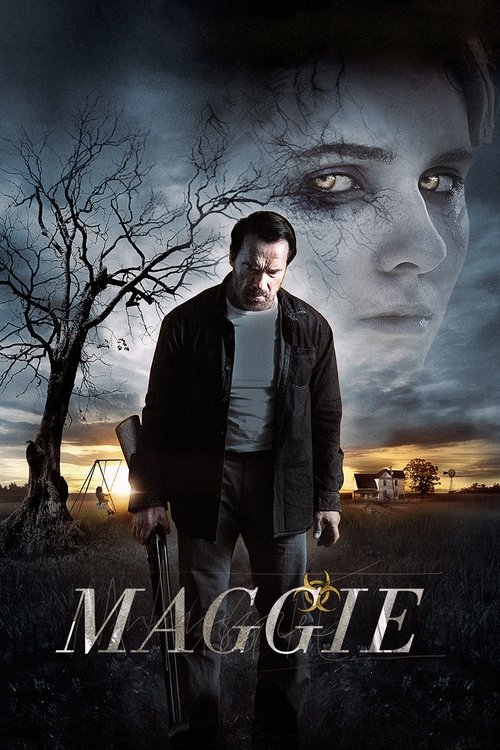
Maggie (2015)
Directed by Henry Hobson
No — Maggie is not woke, scoring 7 out of 100 on our wokeness meter.
Arnold Schwarzenegger spends most of Maggie not punching anything, which for 2015 counted as a formal experiment.
Consciousness Markers
Maggie is a young woman with some agency in her own fate, but the film is a father-daughter tragedy rather than a work advancing a feminist agenda.
A neighbor briefly decries the dehumanizing treatment of the infected, but the film is a restrained family drama rather than a preachy message piece.
The cast is overwhelmingly white, led by Arnold Schwarzenegger, Abigail Breslin, and Joely Richardson, with no meaningful diverse representation or commentary on casting.
There are no LGBTQ+ characters, relationships, or themes anywhere in the film.
The film engages no racial themes or commentary whatsoever; the apocalypse is colorblind in the most literal sense.
No environmental or climate themes are present; the pandemic is viral, not ecological.
There is no economic critique or anti-capitalist messaging in the film.
No body positivity themes; the film's horror derives from bodily decay and transformation.
No neurodivergent characters or themes are present.
The film is a fictional zombie drama with no historical revisionism.
Why it received this score
Arnold Schwarzenegger spends most of Maggie not punching anything, which for 2015 counted as a formal experiment. He plays Wade, a Midwest farmer who retrieves his bitten daughter from a hospital for the infected and brings her home to die slowly in a house full of pale light. The zombie pandemic is present mostly as paperwork and curfew. The film wants to be a grief drama with a virus in the walls, and for long stretches it succeeds, mostly because Breslin plays the title role with a steady, unshowy dread.
The cultural inventory here is close to bare. The cast is white from top to bottom, and nobody in the film seems to have noticed or cared, which is its own kind of statement about who gets to be the default American family in a genre picture. There is no LGBTQ presence, no racial commentary, no ecological framing (the plague is viral, not climatic), no economic critique, no body-positive counterweight. The body, in fact, is the enemy: Maggie's arm oozes, maggots arrive, and the horror is decay, not acceptance. Neurodivergence goes unmentioned. History is untouched, since the whole thing is invented. On the feminist ledger we can grant a modest entry. Maggie chooses her own exit, refuses quarantine, and kisses a boy she knows is doomed. That is agency, but the film belongs to her father's helplessness, and it knows it.
Preachiness arrives exactly once, when a neighbor named Bonnie says the infected are being treated as less than human, and the film declines to build a sermon on top of it. That restraint is the film's best quality and its commercial problem. It is a quiet, gray, well-acted chamber piece that never tells us what to think, which in this genre is nearly radical. We are left with a father, a shotgun, a garden of daisies, and a girl on a roof. Not much to argue about. Not much to cheer for either. It simply sits there, sad and small, and waits for us to leave.
Analysis generated by our Consciousness Algorithm
Part of


Synopsis
There's a deadly zombie epidemic threatening humanity, but Wade, a small-town farmer and family man, refuses to accept defeat even when his daughter Maggie becomes infected. As Maggie's condition worsens and the authorities seek to eradicate those with the virus, Wade is pushed to the limits in an effort to protect her. Joely Richardson co-stars in this post-apocalyptic thriller.
Questions about Maggie
Is Maggie woke?
No — Maggie is not woke, scoring 7 out of 100 on our wokeness meter. That earns it a verdict of Ultra Based.
Does Maggie have any woke elements?
Very few. None of the 10 markers reaches 30, the level where a marker counts as present; the highest is Feminist Agenda at 10.
How does Maggie compare to other 2015 movies?
It ranks #183 of the 289 films from 2015 we've scored; their average is 15. The wokest is Chi-Raq (78).
How is the Woke Score calculated?
An AI-assisted process researches the film and its reception, scores it 0–100 on ten markers, then combines those into one 0–100 Woke Score. It measures a specific set of 2020s cultural themes, not film quality.