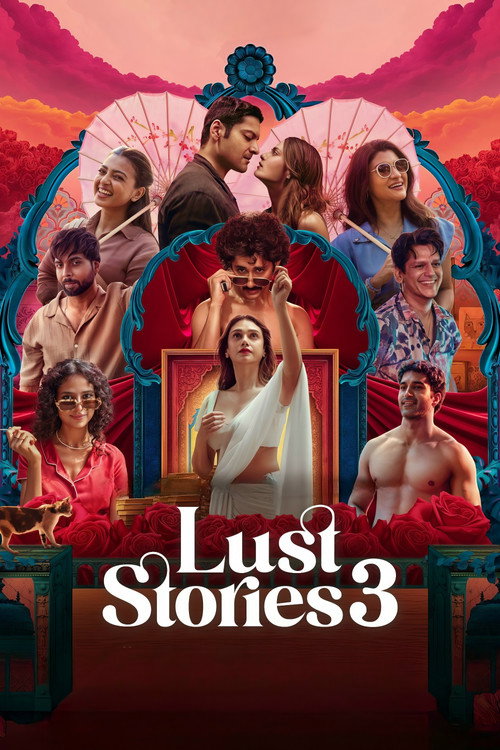
Lust Stories 3 (2026)
Directed by Vikramaditya Motwane
The Lust Stories franchise has now reached its third installment, which in the world of Indian streaming anthologies is roughly equivalent to a restaurant adding a third page to its menu: encouraging, and also a sign that no one is leaving.
Consciousness Markers
Female desire as a legitimate, everyday subject is the organizing thesis of the entire anthology. Bhardwaj's segment specifically frames a woman writing erotica as an act of artistic agency against conservative social constraint, and Radhika Apte's press tour commentary on bodily autonomy and systemic exploitation in the industry extended the film's feminist argument off-screen.
The anthology is overwhelmingly female-led, with women occupying the central dramatic role in at least three of the four segments. This is less a casting policy and more the structural premise of the entire franchise, but the effect is the same.
Motwane's segment features two women in sexless suburban marriages who develop a playful, romantically charged dynamic and contemplate a partner swap. The framing is ambiguous and treated with levity, stopping well short of explicit queer narrative.
Bhardwaj's segment, set in late-1980s Hyderabad, reclaims that historical moment through the lens of a woman's erotic and artistic self-discovery, implicitly rewriting the era's conservative social landscape from a female perspective.
The anthology's stated aim of normalizing female desire implicitly extends to a non-judgmental depiction of female bodies in intimate contexts. This is more a byproduct of the subject matter than a foregrounded campaign.
Critics broadly described the anthology as lighthearted and frivolous, suggesting the filmmakers largely resisted the urge to sermonize. The thematic architecture is pointed, but the execution appears to show rather than tell, most of the time.
The suburban Mumbai setting gestures at middle-class domesticity as a slow suffocation, and the sexless marriages can be read as a critique of bourgeois respectability. This is atmospheric rather than argued.
This is an Indian film made by Indian filmmakers about Indian characters for an Indian audience. There is no racial consciousness framing in the modern woke sense present here.
No climate themes, ecological anxiety, or environmental messaging of any kind appear in the research or the film's content.
No neurodivergence themes, characters, or framing appear anywhere in the available research or metadata.
Why it received this score
The Lust Stories franchise has now reached its third installment, which in the world of Indian streaming anthologies is roughly equivalent to a restaurant adding a third page to its menu: encouraging, and also a sign that no one is leaving. Four directors, four segments, one organizing thesis: that Indian women have inner lives, including inconvenient ones. The discovery, apparently, remains inexhaustible.
Motwane's contribution features two women in Kandivali processing the slow erosion of marital desire through the grammar of Korean dramas, which is a genuinely precise observation about how global media colonizes domestic imagination. Bhardwaj's period segment, set in late-1980s Hyderabad, positions a woman writing erotica as a quietly radical act of self-determination against a conservative social backdrop. Batra's divorcing couple use physical intimacy as a substitute for conversation, which is either a psychological insight or a plot device, depending on how charitable you are feeling. Kiran Rao's segment examines power in modern courtship with the careful attention she brought to Laapataa Ladies, and is reportedly the one critics praised most, which means it is almost certainly the one that will be discussed least. The feminist architecture here is genuine and coherent: female desire as a legitimate subject, not a scandal. What keeps the score from climbing further is the critical consensus that the whole enterprise is, in the end, rather frivolous, which is itself a kind of feminist statement, though probably not an intentional one. A film about women being lighthearted about sex is still, in 2026, a mild provocation. We have catalogued it accordingly.
Analysis generated by our Consciousness Algorithm


Synopsis
Through four bite-sized yet emotionally resonant films, the anthology once again explores lust, love, relationships, and repressed desire, offering fresh perspectives on intimacy, longing, and human connection in all their complexity.
Critic Reviews
“Lust Stories 3 is the most consistent and satisfying anthology yet, with four distinct directorial voices exploring desire, marriage and modern relationships.”
“Lust: The gift that keeps on giving - a thoughtful exploration of desire across four compelling narratives.”
“Lust Stories 3 reclaims the diversity of desire with lust framed as a middle-class construct, a weapon, a medicine, and a language across four distinct directorial visions.”
“The frustratingly derivative nature of Shakun Batra's divorce drama, Kiran Rao's contrived thriller, and Vikramaditya Motwane's confused exploration of partner swapping.”