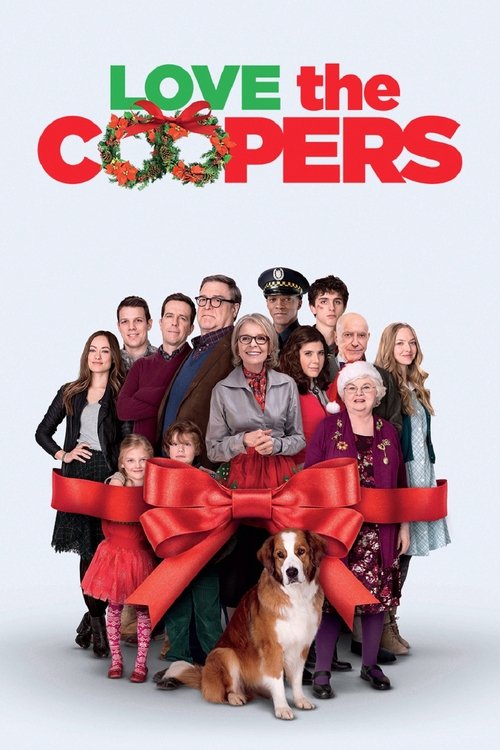
Love the Coopers (2015)
Directed by Jessie Nelson
No — Love the Coopers is not woke, scoring 8 out of 100 on our wokeness meter.
Love the Coopers arrives with four generations, a snowstorm, a Bernese Mountain Dog who turns out to be narrating, and a cast of decorated professionals who have all been in better rooms.
Consciousness Markers
The ensemble is predominantly white, though Anthony Mackie appears in a supporting role as Officer Percy Williams. There is no evident color-conscious or diversity-driven casting agenda.
A woman directed the film and several female characters have relationship-centered arcs, but the story remains traditional in its family and romance conventions. No explicit feminist agenda is advanced.
No LGBTQ+ characters, relationships, or themes are present in the film.
The film does not engage with racial identity, systemic racism, or racial justice themes.
There is no environmental or climate-related messaging in the film.
Hank loses his photography job to automation, but this is not framed as an anti-capitalist or eat-the-rich critique.
The film does not address body image, size acceptance, or related body-positivity themes.
No characters are identified as neurodivergent, and the film does not explore neurodiversity themes.
The film is a contemporary fictional family comedy-drama and does not revise or reinterpret historical events.
The film aims for warm holiday reconciliation rather than delivering progressive social or political lectures.
Why it received this score
Love the Coopers arrives with four generations, a snowstorm, a Bernese Mountain Dog who turns out to be narrating, and a cast of decorated professionals who have all been in better rooms. Jessie Nelson directs, which puts a woman at the helm, and the film dutifully spreads its emotional labor across Charlotte, Eleanor, Emma, and Ruby. The arcs remain courtship arcs. Eleanor needs a man to survive dinner, Emma needs a man's advice to buy a gift, and Charlotte's forty-year marriage resolves into a reconciliation. The arrangement is traditional to its bones, and no thesis about gender or power is advanced, which keeps the relevant marker modest.
Elsewhere the cupboards are bare. Anthony Mackie appears as Officer Percy Williams, a supporting role with no comment attached to it, and the ensemble is otherwise white and unbothered by the fact. There is no LGBTQ+ presence, no engagement with racial identity or systemic injustice, no environmental messaging, no meditation on body image, and no neurodivergent character in sight. Hank loses his photography job to a machine, a detail that would be a gift to a certain kind of screenplay, and the film declines it entirely. History is left alone. Nothing is revised.
The film wants reconciliation, not instruction. Its sins are of craft: the smarm, the tonal lurching, the hospital climax, the dog. Audiences graded it a B minus. Critics were less generous. For a work that assembles this much talent and this much available meaning, the restraint is almost impressive.
Analysis generated by our Consciousness Algorithm


Synopsis
When four generations of the Cooper clan come together for their annual Christmas Eve celebration, a series of unexpected visitors and unlikely events turn the night upside down, leading them all toward a surprising rediscovery of family bonds and the spirit of the holiday.
Questions about Love the Coopers
Is Love the Coopers woke?
No — Love the Coopers is not woke, scoring 8 out of 100 on our wokeness meter. That earns it a verdict of Ultra Based.
Does Love the Coopers have any woke elements?
Very few. None of the 10 markers reaches 30, the level where a marker counts as present; the highest is Representation Casting at 15.
How does Love the Coopers compare to other 2015 movies?
It ranks #158 of the 289 films from 2015 we've scored; their average is 15. The wokest is Chi-Raq (78).
How is the Woke Score calculated?
An AI-assisted process researches the film and its reception, scores it 0–100 on ten markers, then combines those into one 0–100 Woke Score. It measures a specific set of 2020s cultural themes, not film quality.