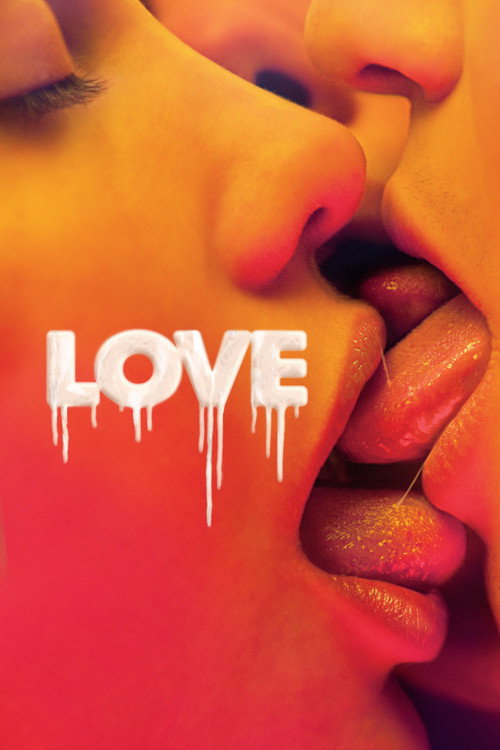
Love (2015)
Directed by Gaspar Noé
No — Love is not woke, scoring 4 out of 100 on our wokeness meter.
Gaspar Noé's Love arrives with the solemnity of a confession and the mechanics of a provocation.
Consciousness Markers
The cast is a natural international mix (American, Danish, French) reflecting the Parisian setting, with no evident agenda of representation casting.
The central threesome is heterosexual (two women, one man) and the film contains no LGBTQ+ themes or characters.
The film is a male-gaze-driven erotic drama centered on a man's memories and desires, with no feminist framework whatsoever.
No engagement with racial themes or consciousness; race is entirely absent as a subject.
No environmental or climate content of any kind.
No economic critique or anti-capitalist themes; the film is preoccupied with sex, drugs, and romantic obsession.
While the film features extensive nudity and unsimulated sex, it does not advance a body-positivity message or celebrate diverse body types as an agenda.
Electra's depression and suicide attempts are depicted as personal tragedy, not framed through a neurodivergence-affirming lens.
No historical revisionism; the film is a contemporary personal drama.
The film is provocatively experiential rather than didactic, offering no moral instruction or social messaging.
Why it received this score
Gaspar Noé's Love arrives with the solemnity of a confession and the mechanics of a provocation. Murphy, an American film student in Paris, spends a rainy January day recalling Electra, the girlfriend who has vanished, and the two years of drugs, rough sex, and tenderness that preceded her disappearance. The film is remembered, when it is remembered at all, for its unsimulated sex scenes, shot in 3D, roughly half its running time, and for Noé's cheerful prediction that it would give men an erection and make women cry. That is the entire thesis. The camera lingers, the bodies entwine, and the plot, such as it is, concerns a broken condom and an unplanned pregnancy.
In the ledger of contemporary social consciousness, the film is a blank page, and it seems proud of it. The cast is a natural international mix, an American, a Dane, a Frenchwoman, assembled because the story is set in Paris, not to make a statement. The central threesome is heterosexual. Race never surfaces as a subject. There is no economic critique, no environmental sermon, no affirmation of body diversity, no framework for reading Electra's depression as anything but private ruin. Noé is interested in obsession, jealousy, and the specific gravity of a memory, and he pursues them with a single-mindedness that borders on the monastic. The film lectures no one, which is perhaps its only restraint.
What remains is a mood piece about desire and its aftermath, executed with technical confidence and almost no interest in meaning beyond the sensory. It is the work of a filmmaker who would rather show than tell, and who has concluded that showing, at sufficient length and in three dimensions, is argument enough. The result is neither instructive nor especially illuminating. It is a long, humid recollection of a relationship that ended badly, and it asks nothing of us except our attention and, ideally, our arousal. The classification of such a film is straightforward. There is very little here to unsettle anyone's politics, and that, for once, appears to be the point.
Analysis generated by our Consciousness Algorithm

Synopsis
Murphy is an American living in Paris who enters a highly sexually and emotionally charged relationship with the unstable Electra. Unaware of the seismic effect it will have on their relationship, they invite their pretty neighbor into their bed.
Questions about Love
Is Love woke?
No — Love is not woke, scoring 4 out of 100 on our wokeness meter. That earns it a verdict of Ultra Based.
Does Love have any woke elements?
Very few. None of the 10 markers reaches 30, the level where a marker counts as present; the highest is Representation Casting at 10.
How does Love compare to other 2015 movies?
It ranks #226 of the 289 films from 2015 we've scored; their average is 15. The wokest is Chi-Raq (78).
How is the Woke Score calculated?
An AI-assisted process researches the film and its reception, scores it 0–100 on ten markers, then combines those into one 0–100 Woke Score. It measures a specific set of 2020s cultural themes, not film quality.