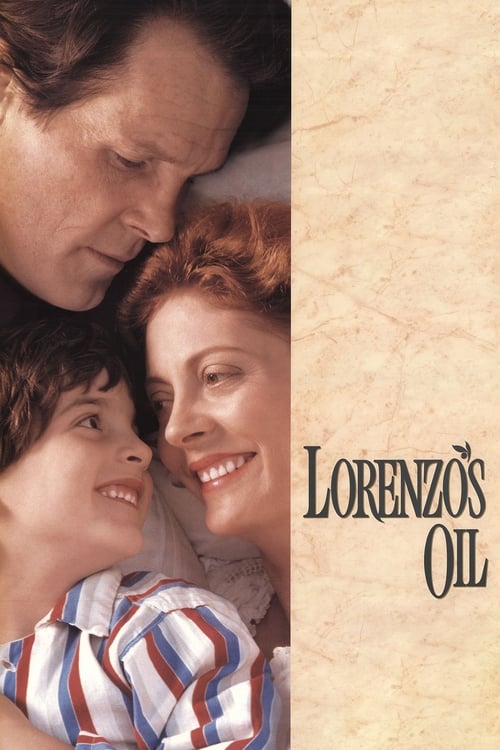
Lorenzo's Oil (1992)
Directed by George Miller
No — Lorenzo's Oil is not woke, scoring 7 out of 100 on our wokeness meter.
George Miller's Lorenzo's Oil arrives from 1992, a year when a film could still concern two parents and a dying child without anyone reaching for a spreadsheet of identity categories.
Consciousness Markers
The medical symposium scenes and the parents' research montages deliver substantial didactic exposition about ALD and fatty-acid biochemistry, giving the film a moderate instructional tone.
Susan Sarandon's Michaela Odone is a fierce, determined maternal advocate, but the film frames her as a devoted parent rather than advancing any explicit feminist thesis.
The cast is overwhelmingly white, with a handful of Black actors appearing naturally in the Comoros-set opening and minor roles; there is no deliberate diversity-driven casting agenda.
The narrative touches on the medical establishment's and industry's reluctance to pursue an unprofitable rare-disease cure, but this is incidental to the parents' personal quest rather than a systemic critique of capitalism.
The brief Comoros setting and incidental Black supporting cast provide texture but the film engages no racial themes or commentary.
No LGBTQ+ characters, themes, or subtext appear anywhere in the film.
There is no environmental or climate-related content in the film.
No body-positivity themes are present; the film deals with a degenerative illness, not body-image or self-acceptance messaging.
The film concerns a fatal neurological disease (ALD), not neurodivergence as identity or the neurodiversity movement.
The film dramatizes a true story faithfully rather than reinterpreting or revising historical events for ideological purposes.
Why it received this score
George Miller's Lorenzo's Oil arrives from 1992, a year when a film could still concern two parents and a dying child without anyone reaching for a spreadsheet of identity categories. Nick Nolte and Susan Sarandon play Augusto and Michaela Odone, whose son develops adrenoleukodystrophy, a disease so rare that no pharmaceutical concern has bothered to chase a cure. The parents camp in medical libraries, badger researchers, and convene an international symposium. It is a story of perseverance, and the film tells it with the grim patience of a case study.
Susan Sarandon's Michaela is a formidable presence, all clenched jaw and maternal fury, though the screenplay treats her as a devoted mother, not as a vehicle for any thesis about women in science or medicine. The film's only systemic gesture concerns the medical industry's indifference to an unprofitable orphan disease, a complaint it raises and then drops in favor of the family's private quest. The symposium scenes and research montages carry a heavy instructional load, walking us through fatty-acid biochemistry with the air of a well-meaning lecturer who has lost track of the hour.
The Comoro Islands opening provides a brief, sunlit texture of Black supporting players who exist naturally in the story and are asked to do nothing more. There is no LGBTQ content, no climate anxiety, no body-acceptance messaging, and no engagement with neurodiversity as identity; ALD is a degenerative illness, not a community. What remains is an earnest, well-acted humanist drama, the sort that collects nominations and loses money, and that treats its audience as adults. A modest artifact from a less self-conscious era.
Analysis generated by our Consciousness Algorithm


Synopsis
Lorenzo Odone, a Virginia 5-year-old, develops a degenerative nerve disease so rare that nobody is working on a cure, so his parents decide to immerse themselves in research and tackle the problem themselves.
Questions about Lorenzo's Oil
Is Lorenzo's Oil woke?
No — Lorenzo's Oil is not woke, scoring 7 out of 100 on our wokeness meter. That earns it a verdict of Ultra Based.
Does Lorenzo's Oil have any woke elements?
Very few. None of the 10 markers reaches 30, the level where a marker counts as present; the highest is Lecture Energy at 20.
How does Lorenzo's Oil compare to other 1992 movies?
It ranks #41 of the 74 films from 1992 we've scored; their average is 12. The wokest is The Crying Game (62).
How is the Woke Score calculated?
An AI-assisted process researches the film and its reception, scores it 0–100 on ten markers, then combines those into one 0–100 Woke Score. It measures a specific set of 2020s cultural themes, not film quality.