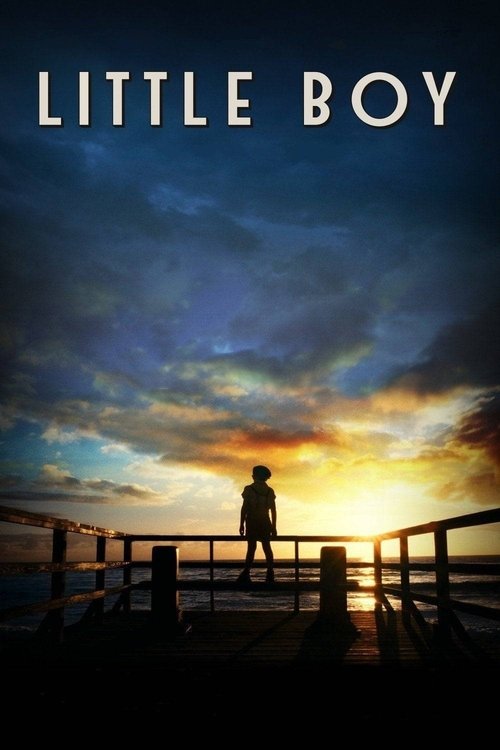
Little Boy (2015)
Directed by Alejandro Monteverde
No — Little Boy is not especially woke, scoring 21 out of 100 on our wokeness meter.
Little Boy arrives with its heart in the correct anatomical position and its brain somewhere in the collection plate.
Consciousness Markers
The film explicitly engages anti-Japanese sentiment on the home front and centers a redemptive friendship between Pepper and Hashimoto, with the boy overcoming internalized prejudice. The framing is Christian moralism rather than modern racial-justice discourse, but the content is concrete.
The cast features Cary-Hiroyuki Tagawa as Hashimoto, a Japanese-American man given a substantial and sympathetic role, alongside a generally mixed ensemble. However, this is organic to the WWII-era story rather than a self-conscious diversity statement.
Pepper's small stature and the bullying he endures are a recurring thread, and he learns to stand up for himself. It is a mild self-acceptance arc rather than a body-positivity movement statement.
The film is heavily didactic about faith, forgiveness, and loving one's enemies, with Father Oliver's task list functioning as explicit moral instruction. The preachiness is religious rather than progressive, but the lecture energy is real.
Emily Watson's mother is a resilient figure holding the family together, but the film offers no feminist critique or gendered power analysis; her role is traditional and maternal.
Critics objected to the film's use of the Hiroshima bombing as a heartwarming narrative device, which flirts with historical trivialization, but it is not an ideological rewriting of history.
No LGBTQ+ characters, themes, or subtext appear anywhere in the film.
No environmental or climate themes are present.
No economic critique or anti-capitalist messaging appears in the film.
No neurodivergent characters or themes are depicted.
Why it received this score
Little Boy arrives with its heart in the correct anatomical position and its brain somewhere in the collection plate. Alejandro Monteverde's wartime parable follows Pepper, an eight-year-old of diminished stature in a California coastal town, who decides that mustard-seed faith can end the Second World War and bring his father home from the Pacific. The theology is administered in generous doses. Father Oliver hands the boy a checklist of good deeds, which serves as both plot device and Sunday school worksheet, and the film never passes up a chance to explain its own moral. That instruction is religious in flavor, not political, but the lecturing is relentless all the same. The film has no interest in the economy, the climate, or the inner lives of anyone outside its prayer circle.
Where the picture shows unexpected grace is in Hashimoto, the Japanese-American neighbor Pepper is ordered to befriend. Cary-Hiroyuki Tagawa gives the role a wounded dignity, and the screenplay engages home-front prejudice against Japanese Americans with more honesty than this genre usually permits. It is moral instruction of an older, Christian variety, the love-thy-enemy sort, and it lands. The boy's struggle with his height, and the bullying that accompanies it, receives a modest arc of self-acceptance, resolved less by consciousness-raising than by a friend teaching him to stand his ground.
The trouble arrives with Hiroshima. The film reaches for the bombing as a device meant to warm the audience, and the effect is closer to nausea than uplift. That is not an ideological rewriting of the past so much as a tonal miscalculation of staggering confidence. Elsewhere the picture is content to be a sincere, old-fashioned weepie about fathers and sons, faith and forgiveness, and it earns a few of its tears honestly. It also earns its drubbing. A film can be well-meaning and still leave the viewer checking the exits.
Analysis generated by our Consciousness Algorithm


Synopsis
An eight-year-old boy is willing to do whatever it takes to end World War II so he can bring his father home. The story reveals the indescribable love a father has for his little boy and the love a son has for his father.
Questions about Little Boy
Is Little Boy woke?
No — Little Boy is not especially woke, scoring 21 out of 100 on our wokeness meter. That earns it a verdict of Based.
Does Little Boy have any woke elements?
2 of the 10 markers register at 30 or above, led by Racial Consciousness (45) and Representation Casting (35). On Racial Consciousness: The film explicitly engages anti-Japanese sentiment on the home front and centers a redemptive friendship between Pepper and Hashimoto, with the boy overcoming internalized prejudice.
How does Little Boy compare to other 2015 movies?
It ranks #68 of the 289 films from 2015 we've scored; their average is 15. The wokest is Chi-Raq (78).
How is the Woke Score calculated?
An AI-assisted process researches the film and its reception, scores it 0–100 on ten markers, then combines those into one 0–100 Woke Score. It measures a specific set of 2020s cultural themes, not film quality.