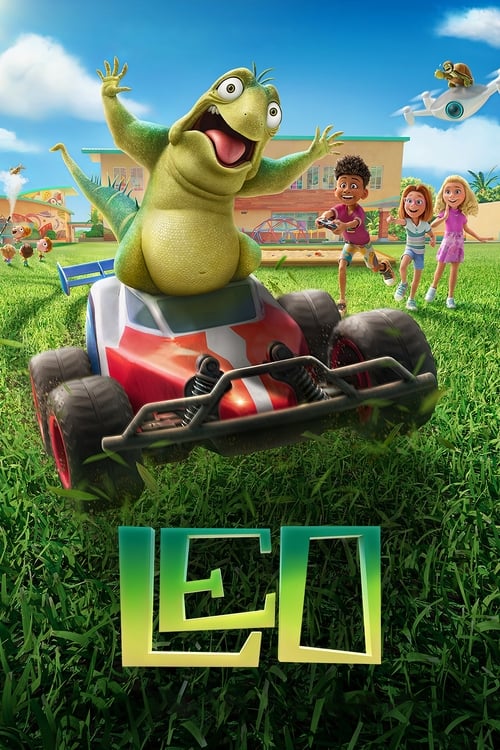
Leo (2023)
Directed by Robert Smigel
No — Leo is not woke, scoring 15 out of 100 on our wokeness meter.
Leo arrives as a Netflix animated musical about a 74-year-old tuatara confronting his mortality in a Fort Myers fifth-grade classroom, and it conducts itself with the mild manners of a substitute teacher who has read the room and decided not to raise his voice.
Consciousness Markers
The fifth-grade classroom is populated with a naturally diverse roster of students (Jayda, Kabir, Mia, etc.) and a Filipino-American voice lead in Jo Koy, though the diversity is incidental to a Fort Myers school setting rather than a stated casting agenda.
Leo dispenses life advice to each student and closes with a 'look out for one another' moral, giving the film a steady, if gentle, didactic throughline.
Summer's arc (a talkative girl learning to channel her voice into popularity) and Ms. Malkin's unfulfilled teaching dream offer mild female-centric beats, but there is no structural feminist argument.
The students' anxieties and social struggles (Eli's nervousness, Summer's over-talking) are treated with gentle emotional support, gesturing at mental-health sensitivity without explicit neurodivergence framing.
A multiethnic class exists on screen without commentary; race is never a subject the film engages or interrogates.
Leo's longing for the Everglades is a personal bucket-list yearning for wild nature, not an environmentalist message about climate or conservation.
No LGBTQ+ characters, relationships, or themes appear anywhere in the film.
No critique of wealth, capitalism, or class structures is present; the antagonist is simply a grumpy substitute teacher.
No body-image, size-acceptance, or self-love-about-appearance themes are present.
The history-fair reenactments are played for comedy and carry no revisionist reinterpretation of historical events.
Why it received this score
Leo arrives as a Netflix animated musical about a 74-year-old tuatara confronting his mortality in a Fort Myers fifth-grade classroom, and it conducts itself with the mild manners of a substitute teacher who has read the room and decided not to raise his voice. Adam Sandler voices the reptile. Bill Burr and Cecily Strong fill in around him. The songs are catchy, the animation is slick, and the whole enterprise radiates the soft glow of a Happy Madison production that has finally decided to be nice.
The classroom is stocked with a naturally multiethnic roster of children, and Jo Koy lends a Filipino-American voice to one of them, but the film never comments on any of it. The kids are simply kids. Race sits in the background like a spare chair. There is no LGBTQ presence, no critique of wealth or class, no interest in body image, and the Everglades that Leo dreams of reaching function as a personal bucket list item, not a conservation sermon. The closest the film comes to a social argument is its handling of anxious children: Eli's nerves and Summer's compulsive talking are met with patience and quiet advice, which gestures toward emotional literacy without ever naming it.
Where the film does lean forward is in its advice-giving. Leo dispenses wisdom to each student in turn, and the closing instruction to look out for one another lands the moral with the firmness of a note sent home to parents. It is gentle, it is well-meaning, and it is entirely uninterested in the cultural battles of its moment. A film about a lizard who wants to see the swamp before he dies should perhaps aim higher than a group hug, but there is something almost admirable in its refusal to pick a fight. The result is a warm, harmless hour and a half, culturally room-temperature, and content to stay there.
Analysis generated by our Consciousness Algorithm


Synopsis
Jaded 74-year-old reptile Leo has been stuck in the same Florida classroom for decades with his terrarium-mate turtle. When he learns he only has one year left to live, he plans to escape to experience life on the outside but instead gets caught up in the problems of his anxious students — including an impossibly mean substitute teacher.
Questions about Leo
Is Leo woke?
No — Leo is not woke, scoring 15 out of 100 on our wokeness meter. That earns it a verdict of Ultra Based.
Does Leo have any woke elements?
2 of the 10 markers register at 30 or above, led by Representation Casting (35) and Lecture Energy (30). On Representation Casting: The fifth-grade classroom is populated with a naturally diverse roster of students (Jayda, Kabir, Mia, etc.) and a Filipino-American voice lead in Jo Koy, though the diversity is incidental to a Fort Myers school setting rather than a stated casting agenda.
How does Leo compare to other 2023 movies?
It ranks #105 of the 200 films from 2023 we've scored; their average is 24. The wokest is Origin (84).
How is the Woke Score calculated?
An AI-assisted process researches the film and its reception, scores it 0–100 on ten markers, then combines those into one 0–100 Woke Score. It measures a specific set of 2020s cultural themes, not film quality.