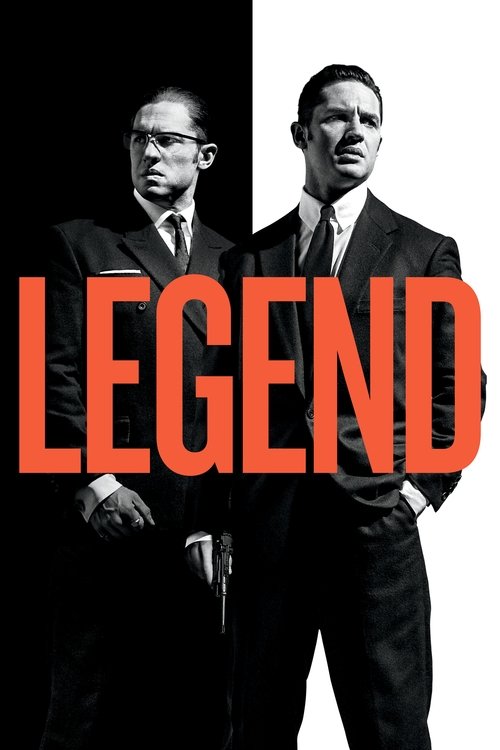
Legend (2015)
Directed by Brian Helgeland
No — Legend is not woke, scoring 11 out of 100 on our wokeness meter.
Legend arrives in 2015 as a study in twin pathology, with Tom Hardy playing both Reggie and Ronnie Kray under Brian Helgeland's direction.
Consciousness Markers
Ronnie Kray's homosexuality is depicted as part of his historical character, including a male companion, but it is framed as one more facet of his volatility rather than as a progressive statement.
Frances (Emily Browning) gets narration and a tragic arc of abuse and suicide, giving her some interiority, but the film is squarely a study of male gangster pathology rather than a feminist text.
Ronnie's paranoid schizophrenia is portrayed as a source of violence and menace, which is the opposite of a neurodivergence-affirming framing.
A period gangster biopic set in 1960s London with an almost entirely white British cast; Tom Hardy's dual role is a performance stunt, not a diversity statement. No meaningful representation casting.
A pulpy, stylish gangster picture that revels in violence and Hardy's showmanship; it has no interest in instructing the audience.
The film concerns white East End gangsters and the American Mafia; race is simply not a subject of the narrative.
No environmental themes whatsoever.
The film is about the pursuit of criminal wealth and power, with no critique of capitalism as a system; the Krays' rackets are simply the backdrop.
No body-positivity content of any kind.
A straightforward adaptation of John Pearson's account of the Kray twins; it dramatizes the record rather than revising it for ideological ends.
Why it received this score
Legend arrives in 2015 as a study in twin pathology, with Tom Hardy playing both Reggie and Ronnie Kray under Brian Helgeland's direction. The film tracks the brothers from psychiatric wards to nightclub floors to life sentences, adapting John Pearson's 1972 book along the way. It is a period piece built on menace and sudden violence, and it makes no effort to examine its own era through a contemporary lens. The East End is white. The gangsters are white. The American mafia contacts are white. The film has not noticed, and it has no reason to notice. Race is simply not a subject here, and neither is the environment, nor the moral standing of the free market. The Krays pursue money and territory because that is the business they are in.
The most socially legible element is Ronnie's homosexuality, which the film treats as a matter of historical record and personal volatility. His male companions appear and recede, and the film frames his sexuality as one more component of his instability. It does not celebrate anything or advocate for anything. Frances, played by Emily Browning, receives narration and a harrowing arc of abuse and suicide, which grants her a measure of interiority. Yet the camera belongs to the brothers. This is a study of male criminal appetite, and the women exist to be damaged by it.
The treatment of Ronnie's paranoid schizophrenia is equally unreconstructed. His condition is rendered as a source of dread and bloodshed, not as something deserving of understanding. There is no body-positive text, no revisionist rewriting of the historical record, no sermonizing of any kind. Legend has no interest in instructing its audience. It wants to entertain with showmanship and violence, and it succeeds at that narrow task. As a document of progressive sensibility, the film is close to a blank page, and it seems content to remain one.
Analysis generated by our Consciousness Algorithm


Synopsis
Suave, charming and volatile, Reggie Kray and his unstable twin brother Ronnie start to leave their mark on the London underworld in the 1960s. Using violence to get what they want, the siblings orchestrate robberies and murders while running nightclubs and protection rackets. With police Detective Leonard "Nipper" Read hot on their heels, the brothers continue their rapid rise to power and achieve tabloid notoriety.
Questions about Legend
Is Legend woke?
No — Legend is not woke, scoring 11 out of 100 on our wokeness meter. That earns it a verdict of Ultra Based.
Does Legend have any woke elements?
1 of the 10 markers register at 30 or above, led by LGBTQ+ Themes (30). On LGBTQ+ Themes: Ronnie Kray's homosexuality is depicted as part of his historical character, including a male companion, but it is framed as one more facet of his volatility rather than as a progressive statement.
How does Legend compare to other 2015 movies?
It ranks #136 of the 289 films from 2015 we've scored; their average is 15. The wokest is Chi-Raq (78).
How is the Woke Score calculated?
An AI-assisted process researches the film and its reception, scores it 0–100 on ten markers, then combines those into one 0–100 Woke Score. It measures a specific set of 2020s cultural themes, not film quality.