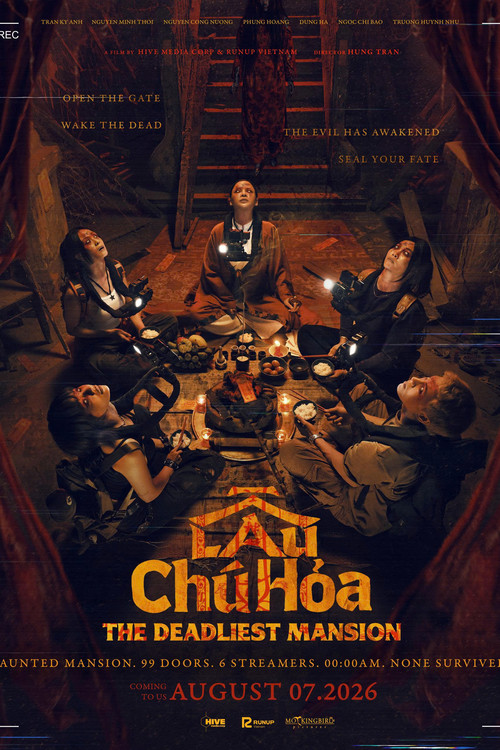
Lau Chu Hoa: The Deadliest Mansion (2026)
Directed by Hùng Trần
Lau Chu Hoa: The Deadliest Mansion arrives as Vietnam's first theatrical found-footage horror release, which is a milestone of the sort that generates press releases and national pride in equal measure.
Consciousness Markers
The film frames its young protagonists as influencers who break into a sacred historical site for streaming revenue and viewer donations. Their greed and disregard for tradition is explicitly the cause of their doom, a critique of clout-chasing economics that carries a mild anti-capitalist charge.
The ghost at the center of the narrative is a woman whose death was ruled an accident despite apparent foul play, a structure that gestures vaguely toward the wronged-woman archetype. The film does not develop this into feminist commentary; it is simply the engine of the haunting.
The social media critique is present and legible, but it functions as plot mechanics rather than sermon. The film does not pause to explain that influencer culture is bad; it simply lets the ghost handle the argument.
The cast is entirely Vietnamese, as one would expect from a Vietnamese production set in Vietnamese history. There is no casting-as-statement here, only casting-as-common-sense.
No LGBTQ+ characters, themes, or subtext have been identified anywhere in the film's content or reception.
No racial consciousness discourse was identified in the film or its reception. The Vietnamese cultural setting is presented as context, not as a platform for racial grievance.
No climate or environmental themes are present.
No body positivity themes or discourse were identified.
No neurodivergence themes or characters were identified.
The film adapts a well-known Saigon urban legend faithfully and does not appear to reframe or interrogate the historical record for ideological purposes.
Why it received this score
Lau Chu Hoa: The Deadliest Mansion arrives as Vietnam's first theatrical found-footage horror release, which is a milestone of the sort that generates press releases and national pride in equal measure. Director Hùng Trần takes the well-documented Hứa family ghost legend of early 20th-century Saigon and runs it through the found-footage format, producing something that critics have noted bears a structural resemblance to the South Korean Gonjiam: Haunted Asylum. This is not an accusation so much as a coordinates system: Vietnam's colonial-era mansion, Korean genre machinery, and a group of young people whose relationship with a camera is, in the end, their undoing.\n\nThe film's one discernible cultural position is its attitude toward content creators. The protagonists are streamers who break into the Hứa estate to monetize their bravery for an online audience, and the film treats this as a form of sacrilege punishable by supernatural violence. This is the mildest possible critique of influencer economics, the kind of observation that could be nodded along to by a Vietnamese grandmother and a Wall Street Journal op-ed writer simultaneously. It is not a manifesto. The ghost is not a metaphor for late capitalism. She is simply very tired of being filmed without consent.\n\nWhat is absent here is, frankly, almost everything on our taxonomy. No identity politics, no lectures, no gestures toward progressive coalition-building. The wronged woman at the center of the haunting is a classic horror figure, not a feminist argument. The Vietnamese cultural setting is presented as atmosphere, not as a grievance. This is a film that wants to frighten you, and its social consciousness extends precisely as far as the observation that perhaps one should not trespass into a haunted mansion for the sake of viewer donations. A modest thesis. The ghost enforces it efficiently.
Analysis generated by our Consciousness Algorithm
Synopsis
In the early 20th century, the daughter of a wealthy family in Saigon met a tragic end in the family's grand estate. Though her death was officially declared as an accident, the rumors of a woman in white, seen weeping by the old window of the mansion late at night, begin to spread.