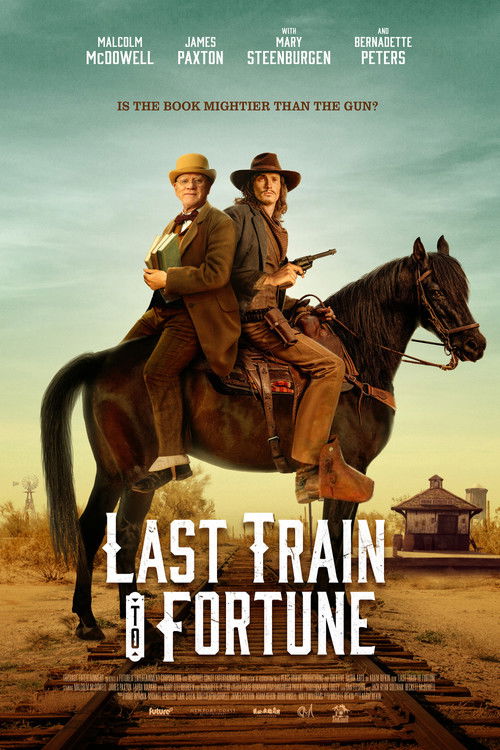
Last Train to Fortune (2026)
Directed by Adam Rifkin
Last Train to Fortune arrives in 2026 carrying the weight of four decades of personal history: a screenplay written by Adam Rifkin's mother in 1985, a lead role originally intended for Bill Paxton, a directorial slot that was meant for Lindsay Anderson before death intervened, and a cultural moment that has, mercifully, passed the film by entirely.
Consciousness Markers
The film's central thesis, anchored by an Epictetus quote about education and freedom, carries a mildly instructive quality. It is earnest rather than hectoring, however, and the 'lesson' is delivered through character rather than speechifying.
The cast is a fairly conventional ensemble for a period Western, with no evidence of deliberate diversity-as-messaging in the casting choices. The modest score reflects the presence of a mixed cast without any apparent advocacy framing around it.
No LGBTQ+ themes, characters, or subtext have been identified in any available material about this film.
The central dynamic is between two men, and no feminist agenda or commentary has been detected in the film's themes, framing, or critical reception.
No racial consciousness themes, systemic racism commentary, or identity-based framing around race has been identified. The film is set in the historical West but does not appear to engage with that setting as a vehicle for modern racial critique.
This is a 19th-century Western. Climate anxiety, as a modern progressive concern, does not appear anywhere in the film's themes or messaging.
No anti-capitalist or wealth-inequality messaging has been identified. The outlaw-and-schoolteacher pairing is framed around knowledge and mutual respect, not class warfare.
No body positivity themes or commentary have been identified in the film.
No neurodivergence representation or related themes have been identified in any available material.
The film does not appear to engage in revisionist history. It uses the Western setting as a backdrop for a character story rather than as an opportunity to deconstruct or reframe the genre's historical mythology.
Why it received this score
Last Train to Fortune arrives in 2026 carrying the weight of four decades of personal history: a screenplay written by Adam Rifkin's mother in 1985, a lead role originally intended for Bill Paxton, a directorial slot that was meant for Lindsay Anderson before death intervened, and a cultural moment that has, mercifully, passed the film by entirely. The result is an old-fashioned Western about a British schoolmaster and a young outlaw learning to tolerate each other across a significant class and temperament gap. Its central philosophical anchor is a quote from Epictetus. Epictetus, who died around 135 AD, would almost certainly be baffled by the current discourse around progressive cinema, and the film shares his apparent indifference to it.
The progressive sensibility index here is, to put it in technical terms, nearly flat. Director Rifkin has framed the film around "the poignancy of the value of enlightenment" and "the importance of learning," which are the kinds of themes that would have seemed earnest and uncomplicated in 1985, because they were, and still do. The odd-couple dynamic between Cecil Peachtree's book knowledge and Dooley's survival instincts is not a Trojan horse for systemic critique. It is simply two men on a train, one of whom knows Latin and the other of whom knows how not to get shot. Critics have described the film as "funny and good-hearted." This is not a phrase that tends to accompany films engineered for cultural combat.
What we have, in the end, is a film that is primarily a tribute: to a mother's screenplay, to a father's legacy, to a directorial friendship that never got to happen. It is, by every available measure, sincere. In the current taxonomy of cinema, sincerity without an agenda is almost its own radical act, though the film itself would be far too polite to frame it that way.
Analysis generated by our Consciousness Algorithm
Synopsis
When schoolteacher Cecil Peachtree misses the last train to Fortune, he strikes a deal with outlaw Dooley to secure safe and timely travel. On the journey, the two develop an odd friendship through the power of knowledge.