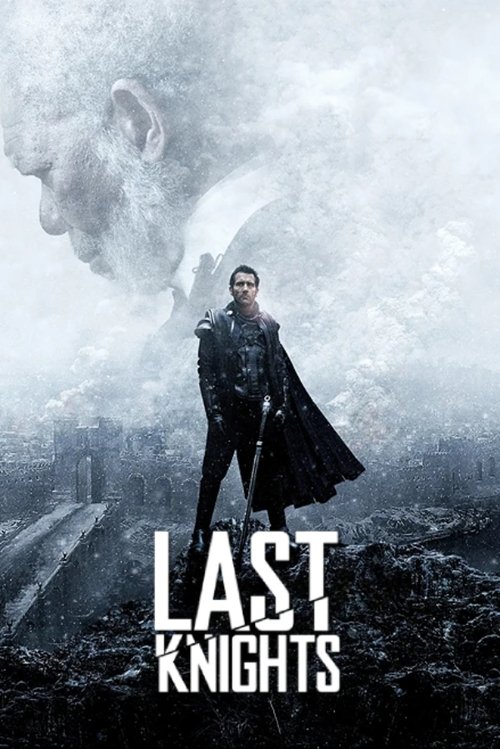
Last Knights (2015)
Directed by Kazuaki Kiriya
No — Last Knights is not woke, scoring 12 out of 100 on our wokeness meter.
Last Knights arrives as a Westernized reading of the forty-seven rōnin legend, relocated to a vaguely medieval Europe and populated by an ensemble that spans several continents.
Consciousness Markers
A notably international ensemble places Morgan Freeman, Cliff Curtis, Shohreh Aghdashloo, Ahn Sung-ki, Tsuyoshi Ihara and Payman Maadi in a medieval European setting, though the casting reads as colorblind co-production pragmatism rather than deliberate representational intent.
Bartok's trial speech denouncing the empire's lost honor provides some speechifying, but the film delivers its themes through conventional genre drama rather than preachy moralizing.
A minor subplot involves freeing Auguste's daughter from an abusive marriage to Geza, and women like Naomi and Maria occupy supporting roles, but the film is overwhelmingly a story of male honor and vengeance.
The villain's corruption and demand for bribes gesture at a critique of a venal ruling class, but the film frames this as a loss of honor rather than a systemic economic indictment.
No LGBTQ+ characters, themes, or subtext of any kind appear in the film.
The diverse cast is deployed without any engagement with race, racism, or racial identity as a theme.
No environmental or climate-related content whatsoever.
No body-positivity themes or messaging present.
No neurodivergent characters or themes are depicted.
The film loosely Westernizes the Japanese forty-seven rōnin legend, but this is genre adaptation rather than a modern revisionist reframing of history.
Why it received this score
Last Knights arrives as a Westernized reading of the forty-seven rōnin legend, relocated to a vaguely medieval Europe and populated by an ensemble that spans several continents. Morgan Freeman, Cliff Curtis, Shohreh Aghdashloo, Ahn Sung-ki, Tsuyoshi Ihara and Payman Maadi share the frame with Clive Owen, and the arrangement is striking in its breadth. The film itself never remarks on any of it. No character raises an eyebrow at the composition of the court, and no theme of identity follows from the casting. The result reads as the practical arithmetic of a British, Czech and South Korean co-production, not a statement of any kind.
The story runs on male honor and its restoration. Bartok is beaten for delivering an inadequate bribe, denounces the empire's decay at his trial, and is then executed by the man who loves him most. That trial speech is the closest the film comes to sermonizing, and it passes quickly. A secondary thread follows Auguste's effort to pull his daughter out of an abusive marriage to the villain, which gives the women in the cast something to do between the sword fights, though the film belongs to the men and their oaths. Geza Mott's appetite for bribes hints at rot among the ruling class, but the movie treats this as a failure of personal honor instead of an argument about power or money.
The rest is simply absent. No romantic or political subtext beyond the conventional, no engagement with race as a lived subject, no environmental concern, no interest in bodies or minds that deviate from the norm. That leaves a somber, well-cast genre exercise that critics greeted with a shrug. The armor is polished. The ideas are not.
Analysis generated by our Consciousness Algorithm
Part of


Synopsis
When an evil emperor executes their leader, his band of knights – bound by duty and honour – embarks on a journey of vengeance that will not come to an end until they've destroyed their mortal foe.
Questions about Last Knights
Is Last Knights woke?
No — Last Knights is not woke, scoring 12 out of 100 on our wokeness meter. That earns it a verdict of Ultra Based.
Does Last Knights have any woke elements?
1 of the 10 markers register at 30 or above, led by Representation Casting (40). On Representation Casting: A notably international ensemble places Morgan Freeman, Cliff Curtis, Shohreh Aghdashloo, Ahn Sung-ki, Tsuyoshi Ihara and Payman Maadi in a medieval European setting, though the casting reads as colorblind co-production pragmatism rather than deliberate representational intent.
How does Last Knights compare to other 2015 movies?
It ranks #125 of the 289 films from 2015 we've scored; their average is 15. The wokest is Chi-Raq (78).
How is the Woke Score calculated?
An AI-assisted process researches the film and its reception, scores it 0–100 on ten markers, then combines those into one 0–100 Woke Score. It measures a specific set of 2020s cultural themes, not film quality.