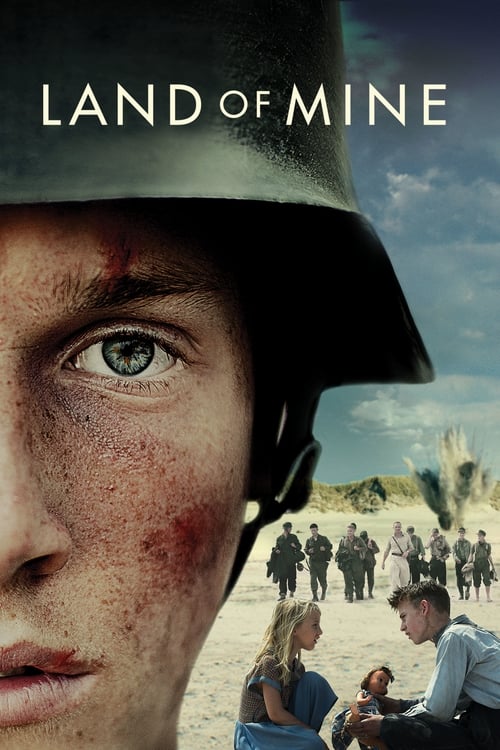
Land of Mine (2015)
Directed by Martin Zandvliet
No — Land of Mine is not woke, scoring 3 out of 100 on our wokeness meter.
Land of Mine arrives from Denmark with a shovel, a beach, and a very old grievance.
Consciousness Markers
The film carries a clear anti-war moral about the mistreatment of POWs, but it is not structured as a modern social-justice lecture.
The cast is historically specific, consisting of Danish and German actors, with no modern inclusive casting agenda.
No LGBTQ+ themes or characters are present.
Women appear only peripherally as local civilians; the film has no feminist critique or agenda.
The conflict is national and military, not racial; no modern racial consciousness is explored.
There is no environmental or climate-related theme.
The film criticizes war and military cruelty, not capitalism or economic inequality.
Malnourished and injured bodies are depicted as suffering, not as a body-positivity statement.
No neurodivergent characters or themes are present.
The film dramatizes documented historical events rather than revising history for modern ideological purposes.
Why it received this score
Land of Mine arrives from Denmark with a shovel, a beach, and a very old grievance. Martin Zandvliet's 2015 drama follows a squad of German prisoners, most of them teenagers, handed to the Danish authorities after the surrender of May 1945 and set to work removing two million landmines from the Jutland sand with their bare hands. The cast is Danish and German and looks it. The boys are gaunt and largely interchangeable, the way actual conscripts are interchangeable. Nobody in the frame exists to satisfy a demographic checklist, which is its own species of period accuracy.
The film's cruelties are physical and immediate. A boy loses his arms. Another is vaporized when one mine sits stacked atop another. Rations are meager, the grain is contaminated, and a sergeant named Rasmussen moves from contempt to something like tenderness and back again. At no point does the picture pause to inform us that war is bad for children, or that starvation is a form of violence, or that the officers who ordered this work violated the Geneva Convention of 1929, though they did. The camera simply watches. Suffering is presented as suffering, not as evidence submitted in a case.
There is a moral here, and the film is not shy about it. The final act insists, with mounting sincerity, that these boys deserved better, and it stages that insistence as drama instead of a closing title card. This is the only real lean toward instruction, and it is a lean toward a lesson most viewers arrived carrying. What remains is a taut, well-built historical picture that trusts its own material. We have seen many films about the second world war. This one is quiet, cold, and effective, and it asks nothing of us but attention.
Analysis generated by our Consciousness Algorithm


Synopsis
In the days following the surrender of Germany in May 1945, a group of young German prisoners of war is handed over to the Danish authorities and subsequently sent to the West Coast, where they are ordered to remove the more than two million mines that the Germans had placed in the sand along the coast. With their bare hands, crawling around in the sand, the boys are forced to perform the dangerous work under the leadership of a Danish sergeant.
Questions about Land of Mine
Is Land of Mine woke?
No — Land of Mine is not woke, scoring 3 out of 100 on our wokeness meter. That earns it a verdict of Ultra Based.
Does Land of Mine have any woke elements?
Very few. None of the 10 markers reaches 30, the level where a marker counts as present; the highest is Lecture Energy at 10.
How does Land of Mine compare to other 2015 movies?
It ranks #249 of the 289 films from 2015 we've scored; their average is 15. The wokest is Chi-Raq (78).
How is the Woke Score calculated?
An AI-assisted process researches the film and its reception, scores it 0–100 on ten markers, then combines those into one 0–100 Woke Score. It measures a specific set of 2020s cultural themes, not film quality.