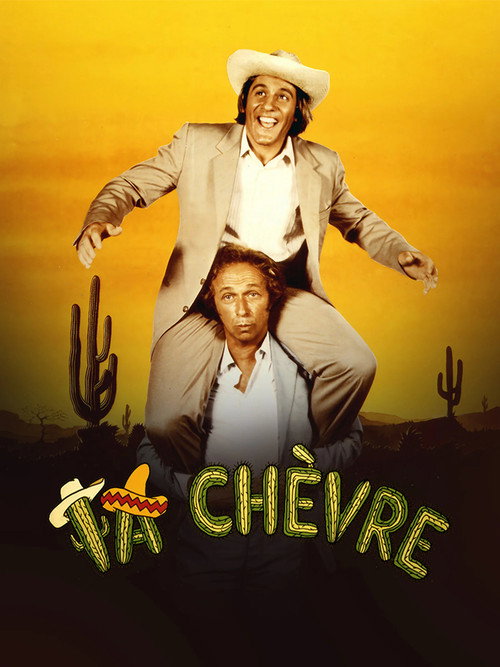
La Chèvre (1981)
Directed by Francis Veber
No — La Chèvre is not woke, scoring 0 out of 100 on our wokeness meter.
La Chèvre arrives from 1981 with the quiet confidence of a film that has no interest in instructing anyone about anything.
Consciousness Markers
The cast includes Mexican actors in Mexican roles, but this is natural, unremarked casting rather than any deliberate representation agenda.
No LGBTQ+ characters, themes, or subtext appear anywhere in this 1981 buddy comedy.
The kidnapped daughter is a pure plot device and the film is a male-driven buddy comedy with no feminist themes.
The France-Mexico setting is treated as exotic backdrop for slapstick; no racial or social commentary is present.
The jungle and rainforest appear only as obstacles for the bumbling protagonists, with no environmental message.
A CEO hires detectives to find his daughter, but the film offers no critique of wealth or capitalism.
No body-positivity themes or messaging of any kind.
Perrin's chronic bad luck is played for comedy, not framed as neurodivergence or any condition.
A fictional contemporary caper with no historical subject matter to revise.
The film is pure farce with no didactic or preachy messaging whatsoever.
Why it received this score
La Chèvre arrives from 1981 with the quiet confidence of a film that has no interest in instructing anyone about anything. Francis Veber's buddy comedy concerns a Parisian accountant named François Perrin, a man whose life is an unbroken chain of small disasters, and the hardened private detective Campana, dispatched to Mexico to find a kidnapped heiress. The psychologist's theory is elegant in its absurdity: send the unluckiest man alive to retrace the missing woman's steps, and misfortune itself will lead the way. What follows is a French-Mexican co-production that treats Puerto Vallarta and the surrounding jungle as a playground for slapstick and nothing more. The local police captain, the prisoner, the bar prostitute, the kidnappers: all of them exist to service the mechanics of the chase. Their presence is unremarked, untheorized, and entirely functional, which is to say the film casts them and moves on.
The kidnapped daughter, Marie Bens, is less a character than a destination. She appears in the final reel, sleepwalking beside Perrin, a plot device with a pulse. The film has no interest in her interior life, no argument to make about women, wealth, or the country it borrows for its third act. Perrin's affliction, meanwhile, is played strictly for laughs. Nobody names it, diagnoses it, or suggests he deserves accommodation. He falls through broken chairs because it is funny, and the film never once suggests otherwise. The rainforest is an obstacle course. The CEO's money is a plot convenience. There is no sermon waiting in the underbrush.
To watch La Chèvre now is to encounter a relic from a less self-conscious era of moviemaking, one in which a man could be pursued across two continents by pure bad luck and nobody felt compelled to extract a lesson from it. It is brisk, well-mannered farce, and it asks nothing of its audience beyond a willingness to laugh at a collapsing dock. The film registers a clean zero on every measure of contemporary social instruction, not through any failure of craft, but through total indifference to the project. It simply wants to be funny. In 1981, that was apparently enough. The American remake, Pure Luck, would arrive a decade later and change nothing of consequence, which is itself a kind of data point worth filing away in the cabinet of harmless entertainments.
It is, in the end, a goat of a movie: stubborn, unburdened, and entirely unaware that it was ever supposed to carry a message. We classify it accordingly, with a clear conscience and a mild sense of relief that not everything from the period demands a lecture in return for its laughs. The Italian exhibition of this film is remembered for a tragedy unrelated to its content, a grim footnote that the movie itself could never have anticipated. The picture on screen remains what it always was, a caper about luck, and nothing else besides.
Analysis generated by our Consciousness Algorithm


Synopsis
When the boss' unlucky daughter is missing in South America, Campana is sent to watch the boss' most unlucky employee who is sent as a private detective in hopes he can duplicate the daughter's mistakes.
Questions about La Chèvre
Is La Chèvre woke?
No — La Chèvre is not woke, scoring 0 out of 100 on our wokeness meter. That earns it a verdict of Ultra Based.
Does La Chèvre have any woke elements?
No. All 10 markers score zero.
How does La Chèvre compare to other 1981 movies?
It ranks #32 of the 43 films from 1981 we've scored; their average is 5. The wokest is The Fox and the Hound (18).
How is the Woke Score calculated?
An AI-assisted process researches the film and its reception, scores it 0–100 on ten markers, then combines those into one 0–100 Woke Score. It measures a specific set of 2020s cultural themes, not film quality.