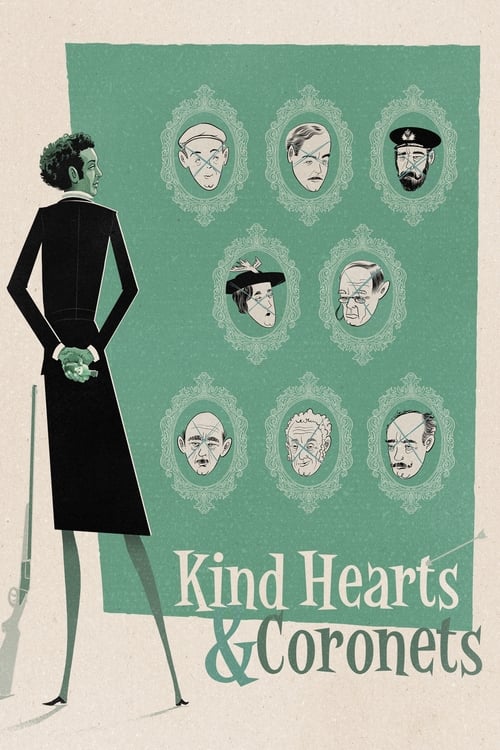
Kind Hearts and Coronets (1949)
Directed by Robert Hamer
No — Kind Hearts and Coronets is not woke, scoring 7 out of 100 on our wokeness meter.
Kind Hearts and Coronets arrives from 1949 with the quiet confidence of a film that knows exactly what it is doing and refuses to explain itself.
Consciousness Markers
The film satirizes aristocratic privilege and class barriers, but its protagonist is an ambitious social climber rather than an anti-capitalist revolutionary.
The film offers subtle satirical commentary on class and morality, but it is not preachy or lecture-driven.
A suffragette character appears as a minor comic murder target, but the film has no sustained feminist agenda or critique of patriarchy.
The cast is entirely white British actors, with no meaningful racial, ethnic, or disability representation.
No LGBTQ+ characters, relationships, or themes appear in the film.
The film contains no exploration of race, racism, or racial identity.
There are no environmental or climate-related themes in the film.
No body positivity themes or diverse body representation are present.
No neurodivergent characters or themes are depicted.
The film is set in Edwardian England but does not revisionist history or challenge historical narratives.
Why it received this score
Kind Hearts and Coronets arrives from 1949 with the quiet confidence of a film that knows exactly what it is doing and refuses to explain itself. Louis Mazzini, denied his mother's aristocratic birthright, resolves to murder the eight relatives standing between him and a dukedom. Alec Guinness plays all eight, a stunt that remains more charming than any modern actor's digital multiplication. The whole affair is dry, cruel, and immaculately composed. It is a comedy about mass murder that never once raises its voice.
The film's social awareness is real but narrow. It sneers at the aristocracy, at inherited privilege, at the cold machinery of class that disowns a woman for marrying an opera singer. Louis is a climber, though, not a reformer. His grievance is personal and his ambition is to join the very class he resents. A suffragette appears among his victims, dropping leaflets from a balloon before he shoots her down, which is either a grim joke about the era or a passing nod to the cause, depending on how charitable the viewer feels. There is no sustained critique of patriarchy here, and no interest in race, sexuality, environment, or the body. The cast is uniformly white, the themes uniformly Edwardian.
What lingers is the tone. Hamer directs with a cold elegance, and the screenplay treats morality as a punchline. The film has no sermon to deliver and no lesson to press upon a captive audience. Its satire is aimed at manners, not at institutions, and it trusts the viewer to draw conclusions without assistance. For a modern audience trained to expect instruction with its entertainment, this restraint may read as evasion. It is, more accurately, a reminder that a film can be vicious, intelligent, and entirely free of agenda. A rare vintage, and one that has not spoiled.
{"thematic_tags": ["book_adaptation"]}
Analysis generated by our Consciousness Algorithm


Synopsis
When his mother eloped with an Italian opera singer, Louis Mazzini was cut off from her aristocratic family. After the family refuses to let her be buried in the family mausoleum, Louis avenges his mother's death by attempting to murder every family member who stands between himself and the family fortune. But when he finds himself torn between his longtime love and the widow of one of his victims, his plans go awry.
Questions about Kind Hearts and Coronets
Is Kind Hearts and Coronets woke?
No — Kind Hearts and Coronets is not woke, scoring 7 out of 100 on our wokeness meter. That earns it a verdict of Ultra Based.
Does Kind Hearts and Coronets have any woke elements?
Very few. None of the 10 markers reaches 30, the level where a marker counts as present; the highest is Eat the Rich at 15.
How does Kind Hearts and Coronets compare to other 1949 movies?
It is the wokest of the 7 films from 1949 we've scored; their average is 3.
How is the Woke Score calculated?
An AI-assisted process researches the film and its reception, scores it 0–100 on ten markers, then combines those into one 0–100 Woke Score. It measures a specific set of 2020s cultural themes, not film quality.